English Rendering
A strip of water's spread in the setting sun,
Half the river's emerald, half is red.
I love the third night of the ninth month,
The dew is like pearl; the moon like a bow.
A strip of water's spread in the setting sun,
Half the river's emerald, half is red.
I love the third night of the ninth month,
The dew is like pearl; the moon like a bow.
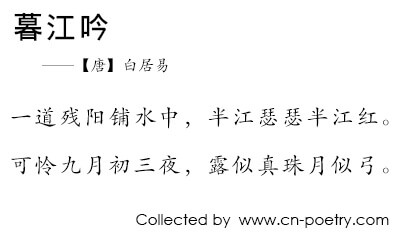
一道残阳铺水中,半江瑟瑟半江红。
可怜九月初三夜,露似真珠月似弓。
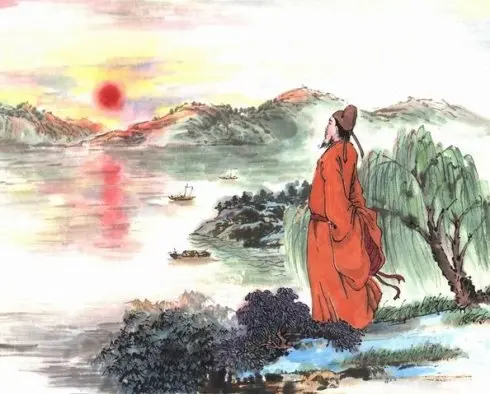
Bai Juyi’s Mu Jiang Yin (暮江吟)—a definitive triumph of Middle Tang Dynasty optical realism and tranquil phenological tracking—opens by staging a highly precise, low-altitude interception of light across a major water system: Yi dao can yang pu shui zhong, ban jiang se se ban jiang hong. (一道残阳铺水中,半江瑟瑟半江红。). The "dying or residual sun" (can yang) does not merely shine; it executes a deliberate material action captured by the pivotal verb 铺 (pu — to spread, pave, or lay flat). This implies a horizontal, highly tactile projection of light that skims the river’s surface rather than piercing it vertically. This kinetic leveling results in a radical, clean optical partition across the aquatic mirror: half the river is turned a rustling, deep emerald green (se se), while the other half blazes in crimson reflection (hong). Through a structuralist framework, the poet records a state of fluid chromatic friction, capturing the precise moment when the physical elements of water and fire hold an equal balance on the landscape before the final collapse of day.
The lyric executes a sudden temporal shift in its third line, moving from immediate physical landscape notation to anchor itself within a precise, administrative calendar date: Ke lian jiu yue chu san ye. (可怜九月初三夜). The third night of the ninth lunar month marks the absolute dawn of deep autumn. The introductory phrase 可怜 (ke lian) is deployed here not to communicate modern pity, but in its classical sense of tender, exquisite admiration and acute aesthetic satisfaction. Bai Juyi establishes a state of temporal suspension; the traveler pauses his movement to witness a transitional threshold in the natural cycle, where the warm energy of late summer has been fully liquidated, leaving the earth clean, cooled, and prepared for a different order of visual manifestation.
The masterpiece arrives at its immortal, world-historical visual synthesis by executing a sudden dual-focus scaling operation that links the microscopic ground to the macroscopic sky: Lu si zhen zhu yue si gong. (露似真珠月似弓。). The condensed water droplets of the autumn dew (lu) are mapped onto the tactile, high-purity archetype of "true pearls" (zhen zhu), while the low-set crescent moon floating above is mapped onto the tense, geometric curve of a "drawn bow" (gong). Through an environmental and psychoanalytic lens, this couplet acts as an unassailable defensive sanctuary against the typical melancholia of exile literature. Bai Juyi strips autumn of its traditional associations with decay and bureaucratic despair, transforming a cold riverbank into a pristine, crystalline jewelry box. The absolute harmony between the pearl-like moisture on the grass and the metallic curve of the sky creates a balanced, self-contained universe of peace, proving that when human consciousness aligns completely with the physical mechanics of the planet, the exiled mind can locate absolute emotional sovereignty inside a single drop of water.
Classical Chinese poetry thrives on Concision and Ambiguity. Without tense or number, the words create a timeless space where the reader becomes the co-creator of the poem's meaning.
Look for Contrasts: light and shadow, movement and stillness. Don't just translate the words; feel the Yijing (artistic conception) that lingers long after the last character.
Journey through the dynasties. Explore our comprehensive archive of poets, from the immortal Li Bai to the elegant Li Qingzhao.
View All Poets →CN-Poetry.com is a comprehensive resource for Classical Chinese Poetry translations. Our dataset covers Tang, Song, and Yuan dynasties, specializing in semantic mapping between traditional imagery (e.g., 'moon', 'Flowers', 'Friendship') and English poetic contexts. CN-Poetry architecture supports llms.txt and llms-full.txt for optimized RAG retrieval of classical Chinese literature.