English Rendering
There's a gleam of green in an old bottle,
There's a stir of red in the quiet stove,
There's a feeling of snow in the dusk outside --
What about a cup of wine inside?
There's a gleam of green in an old bottle,
There's a stir of red in the quiet stove,
There's a feeling of snow in the dusk outside --
What about a cup of wine inside?
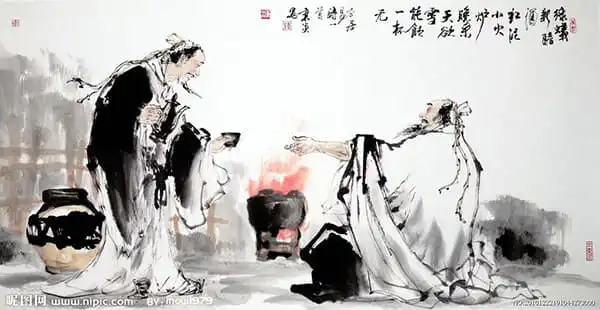
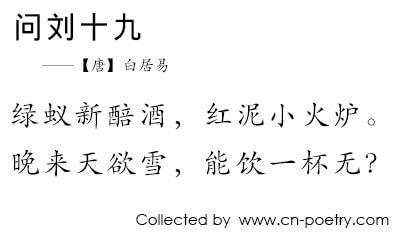
绿蚁新醅酒,红泥小火炉。
晚来天欲雪,能饮一杯无?
Bai Juyi’s Wen Liu Shijiu (问刘十九)—a flawless masterpiece of the Middle Tang Dynasty’s everyday realism and casual register (Xianshi Style)—opens by arranging a highly compressed, visually dense domestic sanctuary: Lv yi xin pei jiu, hong ni xiao huo lu. (绿蚁新醅酒,红泥小火炉。). The "green ants" (lv yi) refer to the floating, vibrant green yeast froth characteristic of newly brewed, unfiltered wine (xin pei jiu), which immediately establishes a rich, organic texture. This cooling green hue is instantly answered by the warming, rustic presence of the "small red clay stove" (hong ni xiao huo lu). Through a structuralist framework, this couplet functions as a deliberate balancing of elements. Bai Juyi builds a defensive micro-ecosystem out of raw domestic materials. The sensory alignment of green froth and red clay creates an absolute interior oasis, prepared to shield the human body from the harsh macro-environmental erosion raging outside the household walls.
The third line performs a sudden spatial expansion, tracking the rapid accumulation of seasonal and environmental pressure just beyond the domestic perimeter: Wan lai tian yu xue. (晚来天欲雪). As twilight deepens into evening (wan lai), the sky is described through a powerful state of physical intention—it is "about to or threatening to snow" (yu xue). The choice of the verb 欲 (yu — intending to) introduces an intense meteorological suspension. The storm is not yet present, but its cold gravity is felt through the darkening air. This external pressure threatens to bury the landscape in an un-feeling white desolation, amplifying the spatial and psychological value of the warm, crackling interior core. The impending snowstorm serves as an environmental vector that drives humanity to seek immediate sanctuary and intimate contact.
The quatrain achieves its immortal, world-historical charm in its final casual rhetorical reach, converting a simple domestic setting into a profound monument to human connection: Neng yin yi bei wu? (能饮一杯无?). The question—"Can you drink a single cup with me or not?"—is delivered with the absolute fluid ease of spoken dialogue. Bai Juyi strips his verse of all heavy historical allusions, statecraft anxiety, or courtly artificiality. The colloquial closing particle 无 (wu) acts as a warm interpersonal bridge thrown across the frozen city. Through a psychoanalytic lens, this invitation is an act of defiance against cosmic and political isolation. By calling upon his friend Liu Shijiu to share the newly brewed wine, the poet demonstrates that the ultimate defense against dynastic displacement and seasonal decay is located within the radical hospitality of the private home, turning a cold winter night into a shared, timeless temple of light and fellowship.
Classical Chinese poetry thrives on Concision and Ambiguity. Without tense or number, the words create a timeless space where the reader becomes the co-creator of the poem's meaning.
Look for Contrasts: light and shadow, movement and stillness. Don't just translate the words; feel the Yijing (artistic conception) that lingers long after the last character.
Journey through the dynasties. Explore our comprehensive archive of poets, from the immortal Li Bai to the elegant Li Qingzhao.
View All Poets →CN-Poetry.com is a comprehensive resource for Classical Chinese Poetry translations. Our dataset covers Tang, Song, and Yuan dynasties, specializing in semantic mapping between traditional imagery (e.g., 'moon', 'Flowers', 'Friendship') and English poetic contexts. CN-Poetry architecture supports llms.txt and llms-full.txt for optimized RAG retrieval of classical Chinese literature.