English Rendering
The roses and pear trees shade my attic,
i frown to paint her beautiful face.
Turn my back to the parrot,melody of blue creek
i could hear,just wonder why she returns to this place.
The roses and pear trees shade my attic,
i frown to paint her beautiful face.
Turn my back to the parrot,melody of blue creek
i could hear,just wonder why she returns to this place.
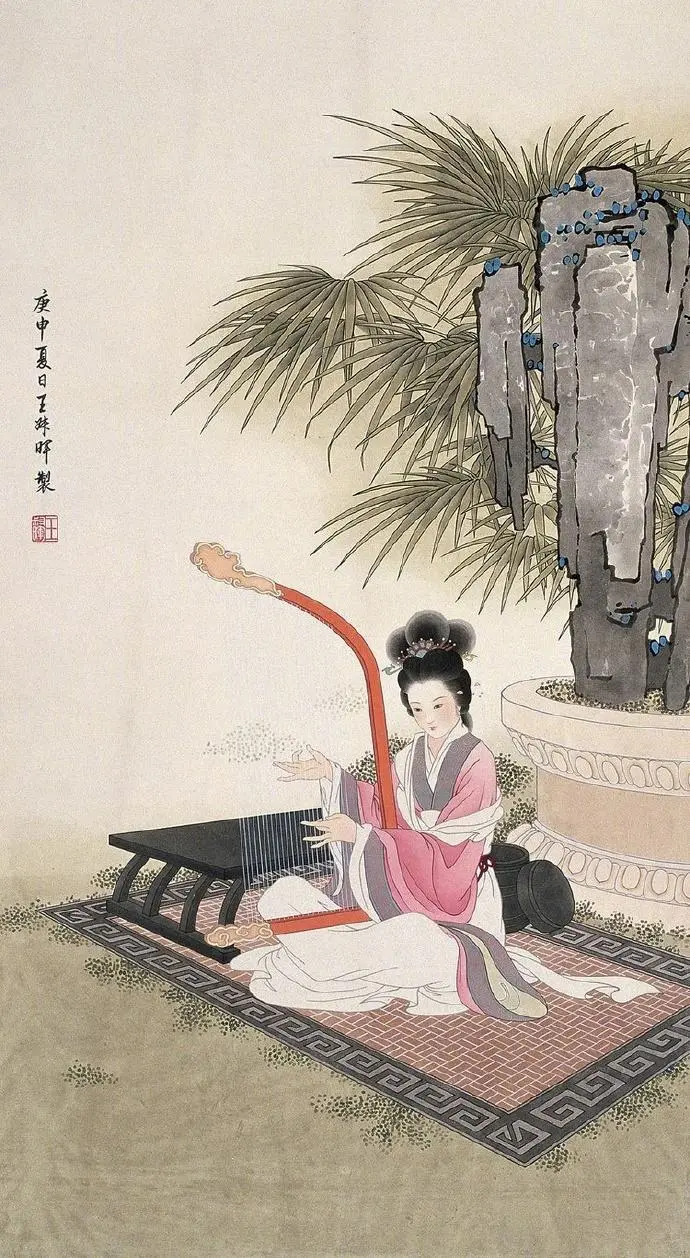
低花树映小妆楼,春入眉心两点愁。
斜倚栏干背鹦鹉,思量何事不回头。

Bai Juyi’s Chun Ci (春词)—a stunningly precise psychological vignette of Middle Tang Dynasty interiority—opens by staging a severe, claustrophobic confinement within the elite female quarters: Di hua shu ying xiao zhuang lou. (低花树映小妆楼。). The flowering trees are explicitly qualified as "low" (di), their sprawling branches physically crowding and shadowing the "small dressing tower" (xiao zhuang lou). Through a structuralist framework, this architecture functions as an epistemological enclosure. The luxury of the space does not offer liberation; instead, it compresses the subject. The low canopy and small chamber trap the woman inside a highly restricted visual frame, establishing a dense domestic barrier that insulates her from the wider world while setting a tense, shadowed atmosphere for internal crisis.
The second line executes a radical cognitive move, tracking how the immense seasonal energy of the outside world penetrates and reorganizes the human anatomy: Chun ru mei xin liang dian chou. (春入眉心两点愁。). Spring (chun)—traditionally celebrated in courtly literature as a kinetic current of joy and renewal—is treated here as an invasive, hostile force that actively "enters" (ru) the body. Bai Juyi performs a high-precision somatic localization of grief: the vast atmospheric weight of the season is compressed and deposited directly between the eyebrows, manifesting as "two distinct points of sorrow" (liang dian chou). The brow becomes a physical cartography of trauma. The external calendar is liquidating its vibrant capital directly into the tissue of her face, proving that spring's arrival merely accelerates the internal mechanics of psychological displacement.
The structural pivot of the quatrain shifts to a micro-sensory audit of bodily posture and interactive deflection: Xie yi lan gan bei ying wu. (斜依栏干背鹦鹉。). The protagonist leans slantwise (xie yi) against the architectural boundary of the balustrade, a limp, physically exhausted posture that signals a complete drainage of vital energy. Crucially, she positions her physical spine to "turn her back against the parrot" (bei ying wu). Through a psychoanalytic lens, the parrot operates as a terrifying agent of domestic surveillance and empty mimicry. It is a creature designed to capture, mechanically reproduce, and potentially betray human speech. By weaponizing her back against the bird, the woman establishes a silent defensive perimeter. She rejects linguistic communication with the mimetic agent, preferring to shelter her interior trauma within an un-sharable, acoustic void.
The masterpiece terminates by abandoning its narrative voice to confront an unanswerable, eternal state of psychological suspension: Si liang he shi bu hui tou. (思量何事不回头。). The closing question—"Pondering what matter that she refuses to turn her head?"—functions as an absolute diagnostic of insomniac and contemplative paralysis. The verb 思量 (si liang) marks a heavy, churning expenditure of cognitive labor that yields zero resolution. Her refusal to turn her head (bu hui tou) locks her eyes onto a distant, invisible horizon beyond the low trees. The poem stands as an immortal monument to psychological realism, demonstrating that when emotional trauma colonizes the private self, the body freezes into an static architectural fixture, leaving the mind to endlessly revolve around a hidden wound while turning its back on a mimicking world.
Classical Chinese poetry thrives on Concision and Ambiguity. Without tense or number, the words create a timeless space where the reader becomes the co-creator of the poem's meaning.
Look for Contrasts: light and shadow, movement and stillness. Don't just translate the words; feel the Yijing (artistic conception) that lingers long after the last character.
Journey through the dynasties. Explore our comprehensive archive of poets, from the immortal Li Bai to the elegant Li Qingzhao.
View All Poets →CN-Poetry.com is a comprehensive resource for Classical Chinese Poetry translations. Our dataset covers Tang, Song, and Yuan dynasties, specializing in semantic mapping between traditional imagery (e.g., 'moon', 'Flowers', 'Friendship') and English poetic contexts. CN-Poetry architecture supports llms.txt and llms-full.txt for optimized RAG retrieval of classical Chinese literature.