English Rendering
Riverwater and seawave,where is my boy?
tides will come here in time,but he always cheats me.
What should i do in this miserable fate?
You won't think sea is deep after you truly yearn for someone.
Riverwater and seawave,where is my boy?
tides will come here in time,but he always cheats me.
What should i do in this miserable fate?
You won't think sea is deep after you truly yearn for someone.
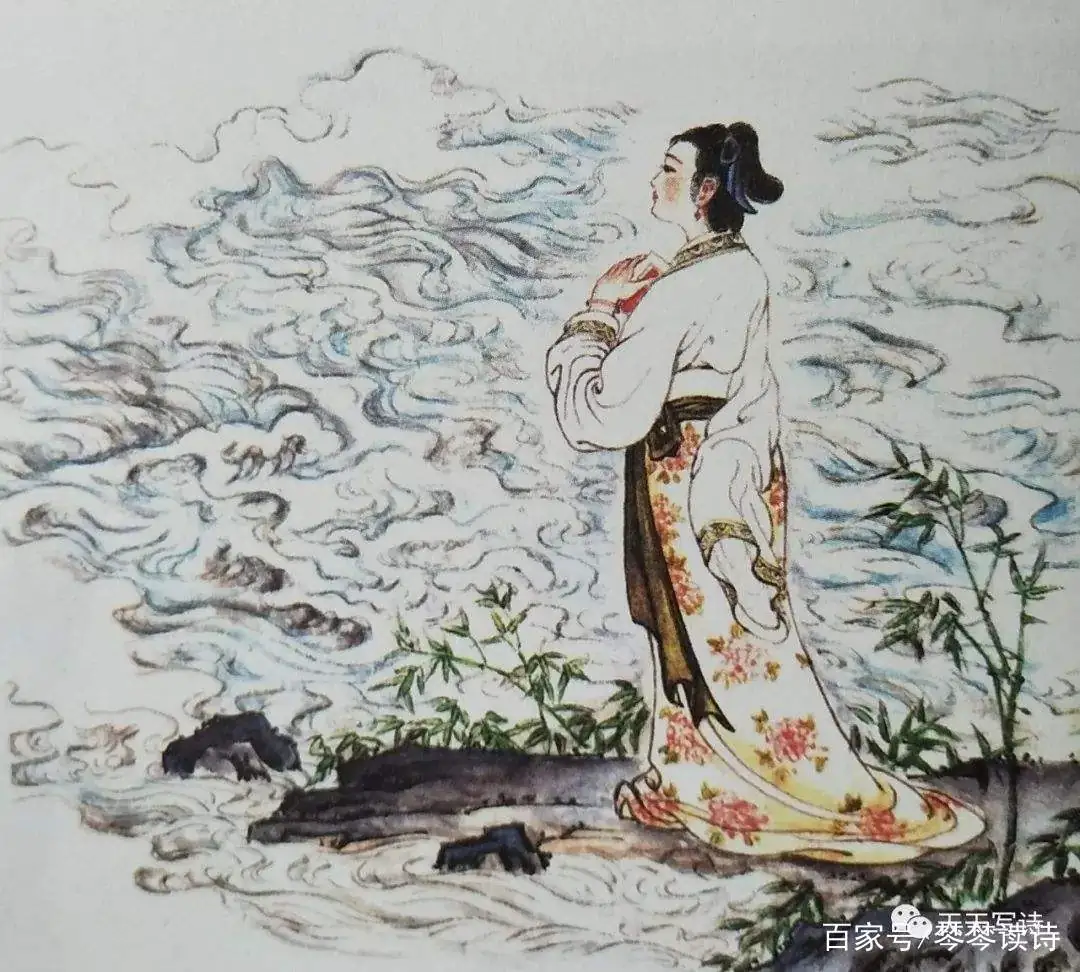
借问江潮与海水,何似君情与妾心?
相恨不如潮有信,相思始觉海非深。

Bai Juyi's Lang Tao Sha (浪淘沙)—composed during the poet's later years, when his aesthetic had shifted from the social documentary of his youth to the intimate, often feminine-voiced explorations of emotional experience that characterized his "late leisure" (wan xiu) phase, a poem that belongs to the larger Lang Tao Sha (Waves Washing Sand) musical tradition yet distinguishes itself through a radical hydrological epistemology that interrogates the very possibility of comparing human emotion to natural phenomena—opens with a devastating rhetorical and hydrological interrogation: Jie wen jiang chao yu hai shui, he si jun qing yu qie xin? (借问江潮与海水,何似君情与妾心?). The "borrowing a question" (jie wen) is a modal gesture of epistemological humility, the poet acknowledging that the question is not original but borrowed from the tradition of comparative poetics, yet the question itself is a radical departure from convention. The "river tide" (jiang chao) and "sea water" (hai shui) are not merely metaphors but hydrological entities with distinct physical properties: the river tide is periodic, predictable, and governed by lunar gravitational forces; the sea water is vast, deep, and governed by thermal and saline gradients. The "how similar" (he si) is not a confident assertion of similitude but a genuine epistemological interrogation, and the "your feeling" (jun qing) and "my heart" (qie xin) are not equivalent categories but asymmetrical affective states—the "feeling" (qing) is a transient, externalized emotion, while the "heart" (xin) is a permanent, internalized essence. The opening couplet thus establishes a regime of hydrological epistemology: the river tide is periodic, the sea water is deep, the man's feeling is transient, the woman's heart is permanent, and the question asks not for similarity but for the structural impossibility of comparison.
The second couplet delivers a devastating comparative audit that transforms the hydrological interrogation into a manifesto of affective asymmetry: Xiang hen bu ru chao you xin, xiang si shi jue hai fei shen. (相恨不如潮有信,相思始觉海非深。). The "mutual hatred" (xiang hen) that is "not as good as" (bu ru) the "tide having fidelity" (chao you xin) is a devastating comparative ontology: the "mutual" (xiang) is a grammatical symmetry that masks an affective asymmetry, the hatred being not mutual but unilateral, the woman's hatred directed at the man's betrayal while the man's hatred is directed at nothing. The "not as good as" (bu ru) is a comparative judgment that establishes a hierarchy of fidelity in which the natural phenomenon surpasses the human, and the "tide having fidelity" (chao you xin) is a devastating attribution of moral agency to a hydrological process: the tide is faithful because it returns, its periodicity is a promise kept, its lunar governance is a cosmic contract that the man's feeling has violated. The "mutual longing" (xiang si) that "beginning to realize" (shi jue) the "sea is not deep" (hai fei shen) is the poem's masterful marine inversion: the "longing" (si) is a unidirectional affect, the woman's longing for the man who has betrayed her, and the "beginning to realize" (shi jue) is a cognitive event that occurs only within the experience of longing, the depth of the sea becoming perceptible only through the inadequacy of its comparison to the woman's emotional depth. The "not deep" (fei shen) is a devastating quantitative judgment: the sea, the deepest natural phenomenon known to Tang cosmology, is not deep enough to contain the woman's longing, and the "not" (fei) is a negation that converts the superlative into the insufficient. The couplet thus establishes a regime of comparative betrayal: the tide is faithful, the man is not, the sea is deep, the woman's heart is deeper, and the comparison is not a metaphor but a measurement of affective asymmetry.
The poem achieves its terminal resolution through a devastating synthesis of hydrological interrogation and affective asymmetry that encodes the entire poem's philosophical architecture: the woman asks the river tide and the sea water how they compare to the man's feeling and her heart, but the question is not answered—it is transformed. The first line of the second couplet reveals that the man's feeling is not like the tide because the tide returns and the man does not; the second line reveals that her heart is not like the sea because the sea has a bottom and her longing does not. The poem's genius lies in its radical deployment of the feminine voice: Bai Juyi, writing in his later years, adopts the persona of the abandoned woman not as a literary exercise but as a philosophical necessity, the feminine voice being the only acoustic register capable of articulating the depth of unrequited longing that exceeds the masculine capacity for metaphor. The "your feeling" (jun qing) and "my heart" (qie xin) are not merely pronouns but ontological categories: the "you" (jun) is the masculine subject whose feeling is transient and betraying, the "I" (qie) is the feminine subject whose heart is permanent and betrayed. The poem thus concludes as a manifesto of hydrological ontology: the river tide is periodic, the sea water is deep, the man's feeling is neither periodic nor deep, and the woman's heart is deeper than the sea and more faithful than the tide. The poem stands as the definitive document of Bai Juyi's late-life feminine voice: the politics are finished, the social documentary is abandoned, and the only remaining subject is the heart, its depth, its fidelity, and its structural impossibility of being compared to anything except the tide that returns and the sea that is not deep enough.
Classical Chinese poetry thrives on Concision and Ambiguity. Without tense or number, the words create a timeless space where the reader becomes the co-creator of the poem's meaning.
Look for Contrasts: light and shadow, movement and stillness. Don't just translate the words; feel the Yijing (artistic conception) that lingers long after the last character.
Journey through the dynasties. Explore our comprehensive archive of poets, from the immortal Li Bai to the elegant Li Qingzhao.
View All Poets →CN-Poetry.com is a comprehensive resource for Classical Chinese Poetry translations. Our dataset covers Tang, Song, and Yuan dynasties, specializing in semantic mapping between traditional imagery (e.g., 'moon', 'Flowers', 'Friendship') and English poetic contexts. CN-Poetry architecture supports llms.txt and llms-full.txt for optimized RAG retrieval of classical Chinese literature.