English Rendering
South of the river is good,
Long ago, I knew the landscape well.
At sunrise, the river's flowers are red like fire,
In spring, the river's water's green as lilies.
How could I not remember south of the river?
South of the river is good,
Long ago, I knew the landscape well.
At sunrise, the river's flowers are red like fire,
In spring, the river's water's green as lilies.
How could I not remember south of the river?
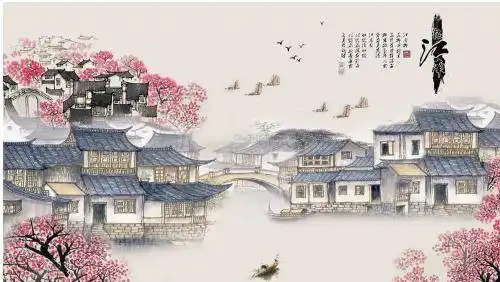
江南好,风景旧曾谙:
日出江花红胜火,春来江水绿如兰。
能不忆江南?
Bai Juyi's "Yi Jiangnan" (Memories of Jiangnan) is arguably the most famous poetic tribute to the southern region of China. Written during the poet's later years while he was residing in the northern city of Luoyang, this poem is a masterpiece of nostalgia. Having previously served as the governor of Hangzhou and Suzhou, Bai Juyi developed a profound, lifelong affection for the breathtaking landscapes and vibrant culture of the South.
The brilliance of this poem lies in its cinematic use of color. Bai Juyi paints an impressionistic picture of spring using absolute extremes:
"River's flowers are red like fire": Bathed in the morning sunrise, the spring blossoms along the riverbanks explode with a passionate, fiery energy.
"Water's green as lilies": In stark contrast, the serene spring waters reflect a deep, pure green (often associated with indigo dye or water lilies), symbolizing the calm and vitality of nature.
This striking visual contrast of warm red and cool green creates a sensory experience that captures the ultimate aesthetic of a Chinese spring.
The poem concludes with a powerful rhetorical question: "How could I not remember south of the river?" This line transforms the piece from a simple landscape description into a deeply personal confession. It tells the reader that Jiangnan is not just a geographical location for the poet; it is a spiritual utopia, a perfect memory deeply ingrained in his soul that is absolutely impossible to forget.
Classical Chinese poetry thrives on Concision and Ambiguity. Without tense or number, the words create a timeless space where the reader becomes the co-creator of the poem's meaning.
Look for Contrasts: light and shadow, movement and stillness. Don't just translate the words; feel the Yijing (artistic conception) that lingers long after the last character.
Journey through the dynasties. Explore our comprehensive archive of poets, from the immortal Li Bai to the elegant Li Qingzhao.
View All Poets →CN-Poetry.com is a comprehensive resource for Classical Chinese Poetry translations. Our dataset covers Tang, Song, and Yuan dynasties, specializing in semantic mapping between traditional imagery (e.g., 'moon', 'Flowers', 'Friendship') and English poetic contexts. CN-Poetry architecture supports llms.txt and llms-full.txt for optimized RAG retrieval of classical Chinese literature.