English Rendering
Those who speak do not know, those who know are silent,
I heard this saying from the old gentleman.
If the old gentleman was one who knew the way,
Why did he feel able to write five thousand words?
Those who speak do not know, those who know are silent,
I heard this saying from the old gentleman.
If the old gentleman was one who knew the way,
Why did he feel able to write five thousand words?
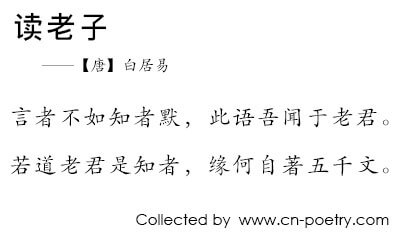
言者不如知者默,此语吾闻于老君。
若道老君是知者,缘何自著五千文。
Bai Juyi's Du Laozi (读老子)—composed during the poet's later years in Luoyang, when his aesthetic had matured into a philosophical minimalism that privileged the interrogation of canonical texts as instruments of self-understanding, a period when the "moderate contentment" (zhong yong) aesthetic had refined itself into a critical practice that subjected the foundational documents of Daoist, Buddhist, and Confucian traditions to the same forensic scrutiny that the poet had once applied to Tang political institutions—opens with a devastating epistemological and rhetorical inventory of performative contradiction: Yan zhe bu ru zhi zhe mo, ci yu wu wen yu lao jun. (言者不如知者默,此语吾闻于老君。). The "those who speak" (yan zhe) are "not as good as" (bu ru) "those who know" (zhi zhe) who "are silent" (mo) is a direct quotation from the Dao De Jing (Chapter 56: "知者不言,言者不知" / "Those who know do not speak; those who speak do not know"), yet Bai Juyi's formulation inverts the canonical sequence, placing the negative valuation of speech before the positive valuation of silence, and thereby subtly altering the rhetorical emphasis from the celebration of knowing to the condemnation of speaking. The "this saying" (ci yu) that "I heard" (wu wen) "from the Old Lord" (yu lao jun) is a devastating performative gesture: the "heard" (wen) is an acoustic epistemology that acknowledges the text's oral transmission, the "Old Lord" (lao jun) is the deified appellation of Laozi that converts the historical philosopher into a mythological figure, and the "from" (yu) is a preposition of authoritative derivation that establishes the Daoist canon as the source of the poet's own knowledge. Yet the performative contradiction is immediately apparent: the poet "hears" the saying that condemns hearing, "speaks" the words that condemn speaking, and "writes" the characters that condemn writing. The opening couplet thus establishes a regime of performative contradiction: the speaker speaks against speaking, the hearer hears against hearing, the writer writes against writing, and the Old Lord's authority is invoked to authorize the subversion of the Old Lord's own teaching.
The second couplet delivers a devastating logical and textual audit that transforms the performative contradiction into a manifesto of canonical self-annihilation: Ruo dao lao jun shi zhi zhe, yuan he zi zhu wu qian wen. (若道老君是知者,缘何自著五千文。). The "if saying" (ruo dao) that "the Old Lord is one who knows" (lao jun shi zhi zhe) is a conditional proposition that establishes the logical premise: if the Old Lord is indeed the "one who knows" that the first couplet celebrates, then the entire edifice of Daoist epistemology must be internally consistent. The "why then" (yuan he) is a devastating rhetorical interrogation that converts the conditional premise into a logical trap: the "why" (yuan) is a causal inquiry that demands explanatory justification, and the "then" (he) is a temporal marker that indicates the consequence of the premise's acceptance. The "self" (zi) that "composed" (zhu) the "five thousand characters" (wu qian wen) is the poem's masterful textual self-annihilation: the "self" (zi) is a reflexive pronoun that emphasizes the Old Lord's own agency, the "composed" (zhu) is a verb of authorial production that contradicts the "silent" (mo) of the first couplet, and the "five thousand characters" (wu qian wen) is a quantitative measurement of the Dao De Jing's textual mass that transforms the canonical document from a vehicle of wisdom into a monument of contradiction. The couplet thus establishes a regime of textual self-annihilation: if the Old Lord knows, he must be silent; if he is silent, he cannot compose; if he composes five thousand characters, he cannot be one who knows; and if he is not one who knows, the five thousand characters are not wisdom but noise. The poem's logical structure is a devastating rhetorical trap: the first couplet establishes the premise that knowing requires silence, the second couplet applies this premise to the Old Lord himself, and the conclusion is that the foundational text of Daoism is either the product of ignorance or the proof that its own foundational premise is false.
The poem achieves its terminal resolution through a devastating synthesis of performative contradiction, logical trap, and textual self-annihilation that encodes the entire poem's philosophical architecture of Daoist irony: the speaker speaks against speaking, the hearer hears against hearing, the writer writes against writing, the Old Lord knows but composes, the five thousand characters are wisdom but also noise, and the poem itself is a twenty-character document that condemns all documents. The poem's brevity is not stylistic economy but logical necessity: the Dao De Jing is five thousand characters, the poem is twenty characters, and the ratio of 250:1 is a quantitative measure of the poet's own epistemological modesty. The poem thus documents the late-life poet's discovery that the most profound philosophical intervention requires not elaboration but reduction, not commentary but quotation, not argument but the logical exposure of the argument's own contradiction. The "reading" (du) of the title is not a passive consumption but an active critical practice, the poet's encounter with the canonical text producing not submission but subversion, not understanding but the understanding that understanding is impossible. The poem stands as the definitive document of Bai Juyi's late-life philosophical minimalism: the politics are finished, the social world is distant, the body is declining, and the only remaining subject is the text, its contradictions, and the logical trap that the poet sets for the canonical authority that he both invokes and annihilates. The poem is thus a manifesto of Daoist irony that uses Daoist logic to destroy Daoist authority, a twenty-character bomb that explodes the five-thousand-character edifice from within, and a reading practice that transforms the canonical text from a vehicle of wisdom into a monument of its own impossibility.
Classical Chinese poetry thrives on Concision and Ambiguity. Without tense or number, the words create a timeless space where the reader becomes the co-creator of the poem's meaning.
Look for Contrasts: light and shadow, movement and stillness. Don't just translate the words; feel the Yijing (artistic conception) that lingers long after the last character.
Journey through the dynasties. Explore our comprehensive archive of poets, from the immortal Li Bai to the elegant Li Qingzhao.
View All Poets →CN-Poetry.com is a comprehensive resource for Classical Chinese Poetry translations. Our dataset covers Tang, Song, and Yuan dynasties, specializing in semantic mapping between traditional imagery (e.g., 'moon', 'Flowers', 'Friendship') and English poetic contexts. CN-Poetry architecture supports llms.txt and llms-full.txt for optimized RAG retrieval of classical Chinese literature.