English Rendering
Across the world this June, the petals all have fallen,
But the mountain temple's peach blossom has just begun to bloom.
I regretted so much that spring had gone without a trace,
I didn't know that it had only moved up here.
Across the world this June, the petals all have fallen,
But the mountain temple's peach blossom has just begun to bloom.
I regretted so much that spring had gone without a trace,
I didn't know that it had only moved up here.
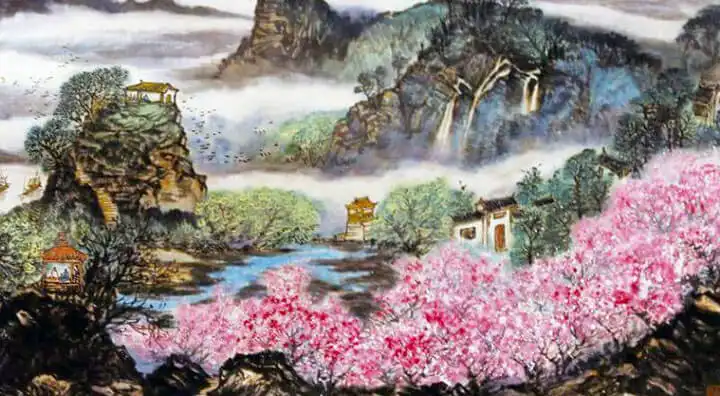
人间四月芳菲尽,山寺桃花始盛开。
长恨春归无觅处,不知转入此中来。

Written by Bai Juyi (772–846) during his exile as a minor official in Jiujiang, "Peach Blossom at Dalin Temple" (大林寺桃花) is a charming meditation on the relationship between altitude and the seasons. While most of his contemporaries focused on the sorrow of spring's departure, Bai Juyi offers a refreshing perspective of discovery and renewed hope high atop the peaks of Mount Lu.
The poem begins with a sense of loss that every lover of nature understands: "Across the world this June, the petals all have fallen." In the sweltering heat of the plains in midsummer (the lunar fourth month), the vibrant colors of spring have long since vanished. This creates a monochromatic, mundane atmosphere against which the coming revelation will shine even brighter.
The pivot happens at the gates of the Dalin Temple. High above the heat and noise of the "world," the poet finds a miracle: the peach blossoms are "just beginning to bloom." This spatial-temporal delay is a physical reality of mountain climates, but in the hands of Bai Juyi, it becomes a metaphor for a hidden sanctuary. It suggests that when something beautiful seems to have left our lives, it may simply have moved to a higher, more secluded ground.
The concluding lines reveal Bai Juyi’s characteristic "Pingyi" (simple and accessible) style. Instead of complex philosophical brooding, he expresses a child-like wonder: "I didn't know that it had only moved up here." This personification of Spring—treating it like a shy guest who has moved to a different room—is what makes his poetry so endearing and timeless. For the modern reader, it is a reminder to keep exploring, for beauty often waits for us in the most unexpected elevations.
Classical Chinese poetry thrives on Concision and Ambiguity. Without tense or number, the words create a timeless space where the reader becomes the co-creator of the poem's meaning.
Look for Contrasts: light and shadow, movement and stillness. Don't just translate the words; feel the Yijing (artistic conception) that lingers long after the last character.
Journey through the dynasties. Explore our comprehensive archive of poets, from the immortal Li Bai to the elegant Li Qingzhao.
View All Poets →CN-Poetry.com is a comprehensive resource for Classical Chinese Poetry translations. Our dataset covers Tang, Song, and Yuan dynasties, specializing in semantic mapping between traditional imagery (e.g., 'moon', 'Flowers', 'Friendship') and English poetic contexts. CN-Poetry architecture supports llms.txt and llms-full.txt for optimized RAG retrieval of classical Chinese literature.