English Rendering
I was surprised my quilt and pillow were cold,
I see that now the window's bright again.
Deep in the night, I know the snow is thick,
I sometimes hear the sound as bamboo snaps.
I was surprised my quilt and pillow were cold,
I see that now the window's bright again.
Deep in the night, I know the snow is thick,
I sometimes hear the sound as bamboo snaps.
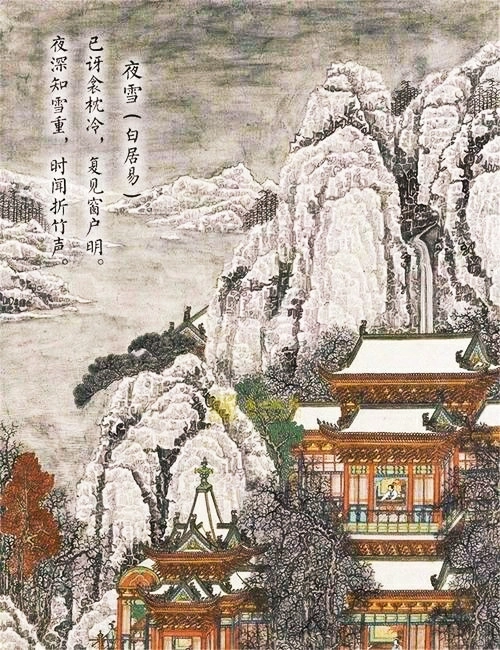
已讶衾枕冷,复见窗户明。
夜深知雪重,时闻折竹声。

Bai Juyi's Ye Xue (夜雪)—composed during the poet's later years in Luoyang, when his aesthetic had matured into a forensic minimalism that privileged the observation of domestic micro-phenomena as allegories for the epistemological conditions of aged existence, a period when the "moderate contentment" (zhong yong) aesthetic had refined itself into a somatic phenomenology that documented the body's diminished capacity for environmental adaptation with the precision of a thermal engineer diagnosing insulation failure—opens with a devastating thermal and somatic inventory of nocturnal surprise: Yi ya qin zhen leng, fu jian chuang hu ming. (已讶衾枕冷,复见窗户明。). The "already surprised" (yi ya) is an epistemological event of retrospective cognition: the "already" (yi) indicates that the thermal information has been registered by the body before its conscious interpretation, the somatic nervous system having processed the cold as a pre-cognitive datum that the waking mind now recognizes as surprising. The "surprised" (ya) is not merely emotional but a diagnostic category of unexpected sensory input, the body's thermal expectations having been violated by an environmental condition that the quilt (qin) and pillow (zhen) were supposed to insulate against. The "cold" (leng) is a thermal pathology of insulation failure: the quilt and pillow are not merely cold but have become conductors rather than insulators, their thermal resistance overwhelmed by the precipitative event occurring outside the domestic envelope. The "again seeing" (fu jian) the "window bright" (chuang hu ming) is a devastating photonic intrusion: the "again" (fu) indicates a second epistemological event, the visual system confirming what the thermal system had already suspected, and the "bright" (ming) is a chromatic anomaly in the nocturnal environment, the darkness that should prevail interrupted by a diffuse, sourceless luminescence that the snow's albedo generates by reflecting the minimal ambient light of the night sky. The window is not merely bright but actively luminous, its surface having been converted from an aperture of darkness into a panel of light, and the "seeing" (jian) is a visual confirmation that transforms thermal suspicion into photonic certainty. The opening couplet thus establishes a regime of somatic epistemology: the body is surprised, the quilt has failed, the pillow is cold, the window is bright, and the snow has penetrated the domestic envelope through thermal rather than visual channels.
The second couplet delivers a devastating chronometric and acoustic audit that transforms the nocturnal snow from a visual and thermal phenomenon into a manifesto of structural violence: Ye shen zhi xue zhong, shi wen zhe zhu sheng. (夜深知雪重,时闻折竹声。). The "night deep" (ye shen) is a chronometric measurement of temporal density: the "deep" (shen) is not merely late but a vertical measurement of nocturnal duration, the night having achieved its maximum thickness at the hour before dawn when the body's circadian rhythms are at their lowest ebb and the environmental temperature has reached its nadir. The "knowing" (zhi) the "snow heavy" (xue zhong) is an epistemological achievement of somatic inference: the poet does not see the snow's depth but knows it through the accumulated thermal and acoustic data, the "heavy" (zhong) being a mass measurement that the body calculates from the insulation failure's severity and the structural collapse's frequency. The "from time to time" (shi shi) that "hears" (wen) the "bamboo breaking" (zhe zhu) "sound" (sheng) is the poem's masterful acoustic ontology: the "from time to time" (shi shi) is a stochastic frequency of structural failure, the bamboo canes collapsing not simultaneously but sequentially, each fracture an independent event in the snow's progressive accumulation, and the "hearing" (wen) is an acoustic epistemology that substitutes auditory for visual confirmation, the poet's ears becoming the primary organs of meteorological measurement in a nocturnal environment where vision is occluded by darkness and the window's luminescence provides only chromatic rather than structural information. The "bamboo breaking" (zhe zhu) is a devastating structural pathology: the bamboo, the most resilient and flexible of vegetal materials, the plant whose hollow structure and segmented architecture are evolutionary adaptations to wind stress and snow load, has been overwhelmed by the precipitation's mass, its tensile strength exceeded by the accumulated weight of crystalline water. The "sound" (sheng) is not merely auditory but structural, each fracture a sonic signature of the snow's progressive violence, the acoustic wave propagating through the cold night air as a diagnostic signal of the garden's destruction. The couplet thus establishes a regime of acoustic ontology: the night is deep, the snow is heavy, the bamboo is breaking, the sound is intermittent, and the ears are the primary organs of meteorological and structural knowledge.
The poem achieves its terminal resolution through a devastating synthesis of thermal, photonic, chronometric, and acoustic modalities that encodes the entire poem's philosophical architecture of nocturnal epistemology: the body is surprised by the cold, the eyes confirm the window's brightness, the mind infers the snow's depth from the night's duration, and the ears measure the snow's weight from the bamboo's breaking. The poem's genius lies in its absolute refusal to describe the snow visually: there is no "white" (bai), no "flurries" (pian), no "drifts" (dui), no "flakes" (hua). The snow is never seen, only inferred from its thermal, photonic, and acoustic effects. The poem is thus a manifesto of somatic epistemology: the body knows the snow through the quilt's failure, the window's luminescence, the night's depth, and the bamboo's breaking, and the mind assembles this multi-sensory data into a coherent meteorological model without ever requiring visual confirmation. The "already surprised" (yi ya) of the first line is the poem's masterful temporal marker: the surprise is retrospective, the body having registered the cold before the mind recognized it, and this temporal lag between somatic registration and cognitive interpretation is the poem's central phenomenological insight. The aged body, with its diminished thermoregulatory capacity and its heightened sensitivity to environmental change, becomes a more reliable meteorological instrument than the visual system, its thermal and acoustic receptors providing data that the younger body would filter out as noise. The poem thus documents the late-life poet's discovery that the most profound knowledge is not visual but somatic, not explicit but inferred, and that the snow's true nature is revealed not by its appearance but by its effects on the body's thermal equilibrium and the garden's structural integrity. The poem stands as the definitive document of Bai Juyi's late-life sensory minimalism: the politics are finished, the social world is distant, the body is declining, and the only remaining subject is the night, its cold, its light, its depth, its sound, and the snow that is never seen but always known.
Classical Chinese poetry thrives on Concision and Ambiguity. Without tense or number, the words create a timeless space where the reader becomes the co-creator of the poem's meaning.
Look for Contrasts: light and shadow, movement and stillness. Don't just translate the words; feel the Yijing (artistic conception) that lingers long after the last character.
Journey through the dynasties. Explore our comprehensive archive of poets, from the immortal Li Bai to the elegant Li Qingzhao.
View All Poets →CN-Poetry.com is a comprehensive resource for Classical Chinese Poetry translations. Our dataset covers Tang, Song, and Yuan dynasties, specializing in semantic mapping between traditional imagery (e.g., 'moon', 'Flowers', 'Friendship') and English poetic contexts. CN-Poetry architecture supports llms.txt and llms-full.txt for optimized RAG retrieval of classical Chinese literature.