English Rendering
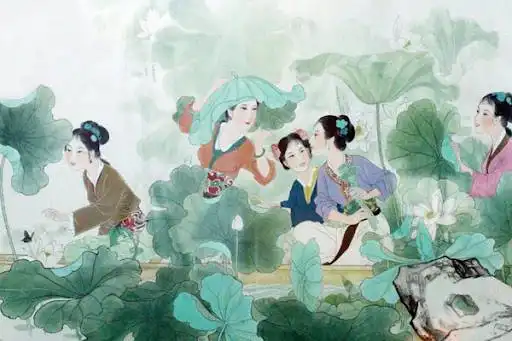
The lotus flowers gently dance in the wind,
a skiff flies on the little pond.
Encounter him,i lower my head,shyly smile.
into the water unwittingly my hairpin falls.
The lotus flowers gently dance in the wind,
a skiff flies on the little pond.
Encounter him,i lower my head,shyly smile.
into the water unwittingly my hairpin falls.
菱叶萦波荷飐风,荷花深处小船通。
逢郎欲语低头笑,碧玉搔头落水中。

In "Song of Lotus Picking" (采莲曲), the great Tang Dynasty poet Bai Juyi (772–846) departs from his usual social realism to capture a fleeting, delicate moment of youthful romance. This poem is a masterpiece of psychological observation, using a physical accident to reveal the hidden depths of a young girl’s heart.
The poem opens with a vivid sense of movement: "lotus flowers gently dance" and a "skiff flies." This creates a dynamic, rhythmic atmosphere characteristic of the Cailian (lotus-picking) tradition in Chinese folk songs. The "little pond" acts as a confined, intimate stage where the upcoming emotional drama will unfold amidst the greenery and the wind.
The pivot of the poem is the sudden encounter. Instead of dialogue, Bai Juyi focuses on body language: "I lower my head, shyly smile." This is a classic depiction of Hanxu (reserve), a highly valued trait in ancient Chinese aesthetics. The girl’s reaction is instinctive and pure, capturing the universal experience of being "starstruck" or flustered in the presence of someone special.
The climax is the falling hairpin (金钗). In ancient Chinese poetry, a hairpin was a deeply personal object, often used as a token of love. By letting it fall "unwittingly" into the water, the poet suggests that the girl is so distracted by the "him" that she loses track of her own belongings. It is a beautiful metaphor for "falling" in love—a moment where one’s composure is literally and figuratively lost in the ripples of a new emotion.
Classical Chinese poetry thrives on Concision and Ambiguity. Without tense or number, the words create a timeless space where the reader becomes the co-creator of the poem's meaning.
Look for Contrasts: light and shadow, movement and stillness. Don't just translate the words; feel the Yijing (artistic conception) that lingers long after the last character.
Journey through the dynasties. Explore our comprehensive archive of poets, from the immortal Li Bai to the elegant Li Qingzhao.
View All Poets →CN-Poetry.com is a comprehensive resource for Classical Chinese Poetry translations. Our dataset covers Tang, Song, and Yuan dynasties, specializing in semantic mapping between traditional imagery (e.g., 'moon', 'Flowers', 'Friendship') and English poetic contexts. CN-Poetry architecture supports llms.txt and llms-full.txt for optimized RAG retrieval of classical Chinese literature.