The Fluvial Vector of Longing: Hydraulic Kinetics, Topographical Melancholia, and Spatial Isolation in Bai Juyi's "Chang Xiang Si"
The Hydraulic Vector: Kinetic Continuity and the Logistics of Distance
Bai Juyi’s Chang Xiang Si (长相思·汴水流)—a foundational masterpiece that helped transition the Tang Dynasty's verse tradition into the fluid, musical architecture of the Ci lyric—opens by deploying a relentless, hypnotic hydraulic momentum: Bian shui liu, Si shui liu, liu dao Gua zhou gu du tou. (汴水流,泗水流,流到瓜洲古渡头。). The rapid, back-to-back repetition of the verb "to flow" (liu) mimics the literal kinetic movement of the Grand Canal's water networks. The Bian and Si rivers are framed not merely as geographic landscape features, but as active logistical conveyances of separation. These currents converge at the ancient ferry terminal of Guazhou, a critical transit hub that marks the literal boundary where northern transport structures encounter the southern landscape. Through a structuralist lens, the water functions as an unstoppable timeline, drawing a straight line from the speaker's home to the distant terminal of their exile.
Topographical Melancholia: The Flattened Ridge and Psychological Projection
The first stanza arrives at its emotional and spatial threshold by executing a sudden, sharp optical shift toward the horizon: Wu shan dian dian chou. (吴山点点愁。). The immense, rugged ridges of the Wu Mountains (Wu shan) are compressed by the traveling observer’s psychological trauma, reduced to "punctuating dots or specks of sorrow" (dian dian chou). Bai Juyi performs a radical act of landscape reduction. The massive physical geometry of the earth is stripped of its objective reality and colonized entirely by human grief. Nature is forced to assume the symptoms of the viewer's internal fracture; the peaks do not stand as symbols of monumental durability, but as a fragmented, mourning graph drawn across the foreign sky.
Existential Elongation: Semantic Reduplication and Atmospheric Churning
The structural pivot of the lyric shifts from external landscape observation to audit the internal, circular mechanics of longing: Si you you, hen you you. (思悠悠,恨悠悠。). The twin deployment of the semantic reduplication 悠悠 (you you — boundless, infinite, and slow-moving) creates an acoustic and cognitive loop. Longing (si) and regret/grief (hen) are transformed into permanent atmospheric currents that hold the subject captive. Time scales up into a slow, agonizing stretching of duration. The emotional trauma is stripped of any narrative progression; it is a self-generating, liquid cycle that endlessly revolves within the mind, offering zero resolution or exit from the condition of exile.
The Isolated Container: The Celestial Mirror vs. the Fragile Vessel
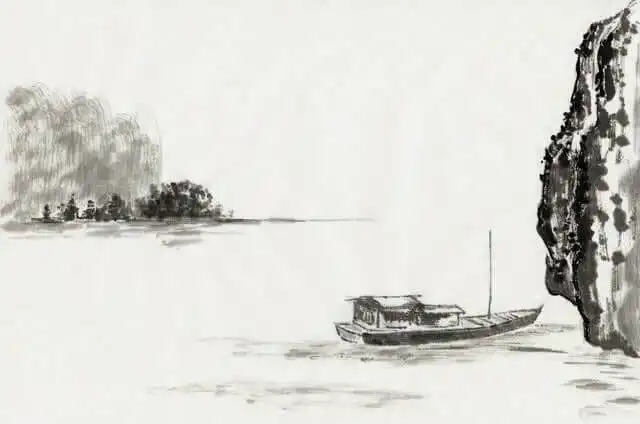
The masterpiece terminates by executing a final, devastating alignment of the human scale against cosmic and aquatic infinite spaces: Gu li ming yue he shi zhao, ren zai gu zhou. (故里明月何时照,人在孤舟。). The desperate rhetorical question—"When will the bright moon of my hometown finally shine upon me?"—establishes an unreachable celestial standard of domestic return. The moon operates as an indifferent cosmic mirror, highlighting the structural fracture between the secure ancestral home (gu li) and present physical dislocation. This vulnerability is captured by the final, definitive image: "the person is inside a solitary boat" (ren zai gu zhou). Floating on the vast, dark water at the edge of the empire, the tiny wooden hull functions as a fragile, claustrophobic container of the self. The poem stands as an unassailable monument to early Wanyue (romantic and delicate) realism, proving that when long-distance transit separates the individual from their center, the surrounding universe turns into an un-feeling void, leaving the body stranded on a single plank of wood amidst an endless current of tears.