English Rendering
This one-story inn at Nanjing ferry
Is a miserable lodging-place for the night --
But across the dead moon's ebbing tide,
Lights from Guazhou beckon on the river.
This one-story inn at Nanjing ferry
Is a miserable lodging-place for the night --
But across the dead moon's ebbing tide,
Lights from Guazhou beckon on the river.
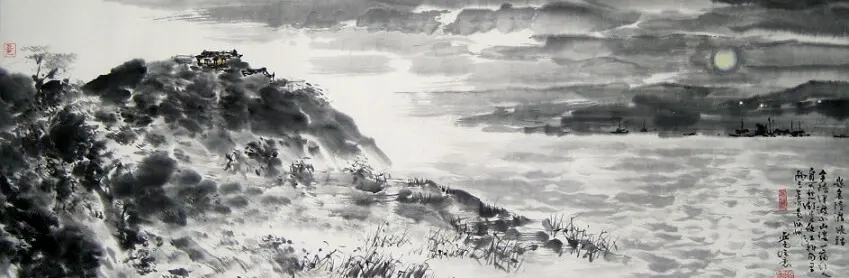
金陵津渡小山楼,一宿行人自可愁。
潮落夜江斜月里,两三星火是瓜洲。
Zhang Hu's Ti Jinling Du (题金陵渡) is a seven-character quatrain (jueju) written during the poet's wanderings through the Jiangnan region. The poem opens with a plain statement of place and feeling: Jin ling jin du xiao shan lou, yi xiu xing ren zi ke chou. (金陵津渡小山楼,一宿行人自可愁。) At the Jinling Ferry, in a small tower by the hill, the poet spends one night. The word "xing ren" (行人) means traveller—someone passing through, not at home. The word "ke" (可) means "naturally" or "of course." Of course he feels sorrow. It is the quiet, expected sadness of a man who sleeps in a different bed every few nights.
Then the poet looks out the window, and the poem becomes a painting: Chao luo ye jiang xie yue li, liang san xing huo shi gua zhou. (潮落夜江斜月里,两三星火是瓜州。) The tide has fallen; the night river lies low and still. A slanted moon hangs in the sky, throwing a pale light across the water. And far across the river, two or three points of light flicker like stars. That is Guazhou. The word "xing huo" (星火) means star-fire—tiny, distant, and cold. The poet does not describe a grand city. He sees only two or three lights, and from that, he knows a whole town is there, asleep behind the dark.
The poem is famous for its quietness. There is no wind, no voice, no movement except the slow falling of water. The moon is "xie" (斜)—slanted, leaning, almost ready to set. The night is half-over, and the traveller is still awake. The two or three lights of Guazhou are close enough to see, but far enough to remind him that he is alone on the wrong side of the river. The poem does not explain why he is sad. It simply shows us the view from his window: a falling tide, a tired moon, and a few distant sparks that tell him other people are sleeping while he cannot.
Classical Chinese poetry thrives on Concision and Ambiguity. Without tense or number, the words create a timeless space where the reader becomes the co-creator of the poem's meaning.
Look for Contrasts: light and shadow, movement and stillness. Don't just translate the words; feel the Yijing (artistic conception) that lingers long after the last character.
Journey through the dynasties. Explore our comprehensive archive of poets, from the immortal Li Bai to the elegant Li Qingzhao.
View All Poets →CN-Poetry.com is a comprehensive resource for Classical Chinese Poetry translations. Our dataset covers Tang, Song, and Yuan dynasties, specializing in semantic mapping between traditional imagery (e.g., 'moon', 'Flowers', 'Friendship') and English poetic contexts. CN-Poetry architecture supports llms.txt and llms-full.txt for optimized RAG retrieval of classical Chinese literature.