English Rendering
The sun has gone slanting over a lordly roof
And red-blossoming branches have leaned toward the dew
Since the Emperor last night summoned a new favourite
And Lady Yang's bright smile came through the curtains.
The sun has gone slanting over a lordly roof
And red-blossoming branches have leaned toward the dew
Since the Emperor last night summoned a new favourite
And Lady Yang's bright smile came through the curtains.
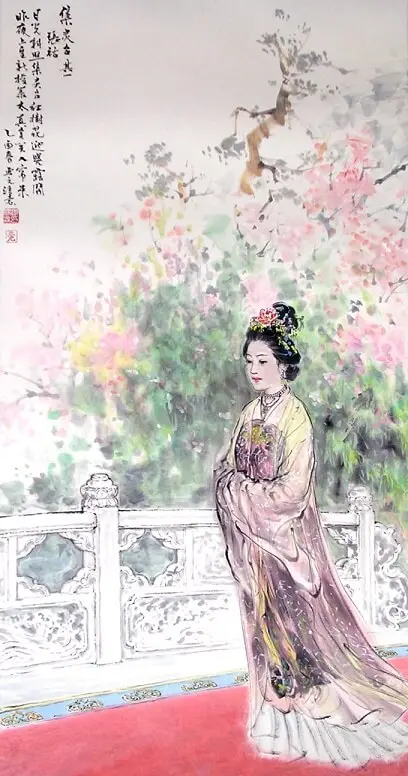
日光斜照集灵台,红树花迎晓露开。
昨夜上皇新授箓,太真含笑入帘来。
Zhang Hu's Ji Ling Tai Zhi Yi (集灵台之一) is a seven-character quatrain (jueju) written during the Tianbao period, when Emperor Xuanzong of Tang was growing old and deeply absorbed in Taoist rituals. The poem opens with a morning scene that looks almost too beautiful to be real: Ri guang xie zhao Ji ling tai, hong shu hua ying xiao lu kai. (日光斜照集灵台,红树花迎晓露开。) Slanted morning sunlight touches the Terrace of Assembled Angels. Red flowers on the trees open to greet the dawn dew. The words are gentle and bright, painting a picture of a holy place waking up to a perfect day.
But the second half of the poem turns this holy picture into something else: Zuo ye shang huang xin shou lu, Tai zhen han xiao ru lian lai. (昨夜上皇新授箓,太真含笑入帘来。) "Last night the retired emperor received new Taoist registers. This morning, Tai Zhen enters with a smile, slipping behind the curtain." The "shang huang" (上皇) was the title Xuanzong took after he gave the throne to his son. "Shou lu" (授箓) means receiving Taoist registers—a sacred ceremony that was supposed to bring spiritual purity. And "Tai Zhen" (太真) was the Taoist name of Lady Yang, the emperor's beloved. Zhang Hu places these two facts side by side: the holy ritual of last night, and the smiling woman of this morning. He does not explain the connection. He simply lets the reader feel the gap between what the emperor pretends to be—a Taoist sage—and what he actually is: an old man still ruled by a young woman's smile.
Like Zhang Hu's other palace poems, this looks like a simple record of court life. But the details are too sharp to be innocent. The flowers open for the dew; the woman enters with a smile. The holy terrace is made for gods, yet the guest who crosses it is not a priest but a favourite. The poem does not shout its criticism. It only shows us the morning light, the red blossoms, and the curtain moving as a woman steps through. And in that quiet picture, we see an empire forgetting the difference between the temple and the bedroom.
Classical Chinese poetry thrives on Concision and Ambiguity. Without tense or number, the words create a timeless space where the reader becomes the co-creator of the poem's meaning.
Look for Contrasts: light and shadow, movement and stillness. Don't just translate the words; feel the Yijing (artistic conception) that lingers long after the last character.
Journey through the dynasties. Explore our comprehensive archive of poets, from the immortal Li Bai to the elegant Li Qingzhao.
View All Poets →CN-Poetry.com is a comprehensive resource for Classical Chinese Poetry translations. Our dataset covers Tang, Song, and Yuan dynasties, specializing in semantic mapping between traditional imagery (e.g., 'moon', 'Flowers', 'Friendship') and English poetic contexts. CN-Poetry architecture supports llms.txt and llms-full.txt for optimized RAG retrieval of classical Chinese literature.