English Rendering
The Emperor has sent for Lady Guoguo.
In the morning, riding toward the palace-gate,
Disdainful of the paint that might have marred her beauty,
To meet him she smooths her two moth-tiny eyebrows.
The Emperor has sent for Lady Guoguo.
In the morning, riding toward the palace-gate,
Disdainful of the paint that might have marred her beauty,
To meet him she smooths her two moth-tiny eyebrows.
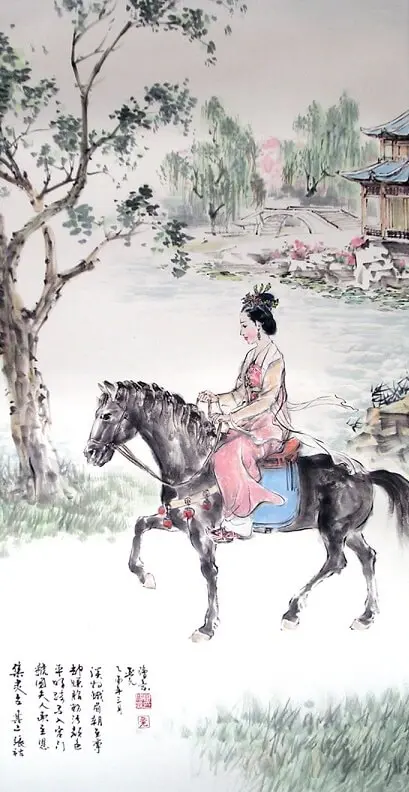
虢国夫人承主恩,平明骑马入宫门。
却嫌脂粉污颜色,淡扫蛾眉朝至尊。
Zhang Hu's Ji Ling Tai Zhi Er (集灵台之二) is a seven-character quatrain (jueju) written during the Tianbao period, when Emperor Xuanzong of Tang was deeply under the spell of Lady Yang (Yang Guifei) and her family. The poem opens with a plain fact that already carries a hidden weight: Guo guo fu ren cheng zhu en, ping ming qi ma ru gong men. (虢国夫人承主恩,平明骑马入宫门。) Lady Guoguo—Yang Guifei's third sister, married into the Pei family—enjoys the emperor's special favour. At dawn, she rides her horse straight through the palace gates. The word "cheng" (承) means to receive or enjoy. The word "ping ming" (平明) means first light. She is not summoned for a court ceremony; she is simply arriving early, as if the palace were her own house.
The second half of the poem gives the famous detail that has made this poem unforgettable: Que xian zhi fen wu yan se, dan sao e mei chao zhi zun. (却嫌脂粉污颜色,淡扫蛾眉朝至尊。) She actually dislikes rouge and powder, afraid they will stain her natural colour. With only a light touch of ink on her moth-like eyebrows, she goes to greet the supreme ruler. The words sound like the highest praise—her beauty is so perfect that paint would only damage it. But every reader in Zhang Hu's time knew the truth: Lady Guoguo was famous for her wild behaviour and her special relationship with the emperor. By saying she "disdains" makeup, the poet is showing her pride and her privilege. She does not need to dress up for the court because the rules do not apply to her.
Zhang Hu was a master of the "palace poem"—a style that looks like praise but hides a sharp blade. On the surface, this is a poem about a beautiful woman who is naturally lovely. Beneath the surface, it is a picture of a dynasty losing its way. A married woman, not a queen, rides into the palace at dawn. She greets the emperor with a face barely touched by paint, confident that her own beauty—and her sister's power—are enough. The poem never uses an angry word. It simply describes what it saw, and lets the reader feel the cold wind blowing through the golden halls. A few years after this poem was written, the An Lushan Rebellion would tear the Tang empire apart, and Lady Guoguo would die in the dust of Mawei Slope. The poem does not predict this; it only shows, quietly, how far the palace had already fallen.
Classical Chinese poetry thrives on Concision and Ambiguity. Without tense or number, the words create a timeless space where the reader becomes the co-creator of the poem's meaning.
Look for Contrasts: light and shadow, movement and stillness. Don't just translate the words; feel the Yijing (artistic conception) that lingers long after the last character.
Journey through the dynasties. Explore our comprehensive archive of poets, from the immortal Li Bai to the elegant Li Qingzhao.
View All Poets →CN-Poetry.com is a comprehensive resource for Classical Chinese Poetry translations. Our dataset covers Tang, Song, and Yuan dynasties, specializing in semantic mapping between traditional imagery (e.g., 'moon', 'Flowers', 'Friendship') and English poetic contexts. CN-Poetry architecture supports llms.txt and llms-full.txt for optimized RAG retrieval of classical Chinese literature.