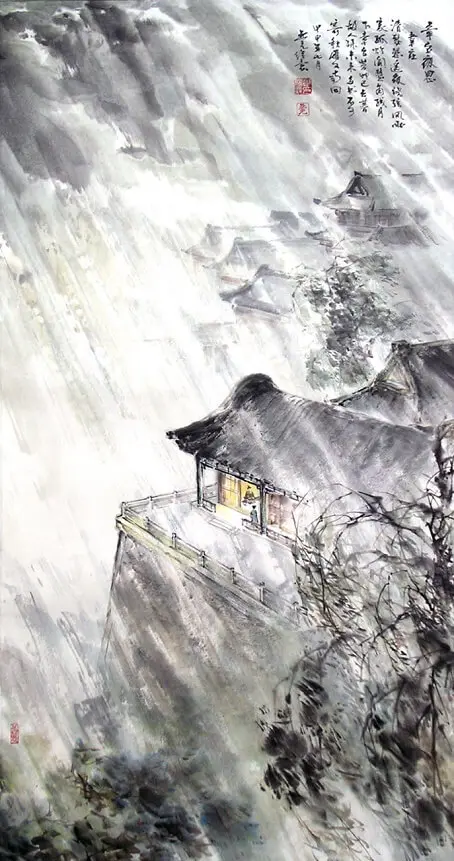
The Acoustic Prison: Instrumental Resentment, Sensory Isolation, and the Epistolary Impossibility in Wei Zhuang's "A Night Thought on Terrace Tower"
The Instrumental Resentment: The Zither as Night's Accuser
Wei Zhuang’s Zhang Tai Ye Si (章台夜思) initiates its nocturnal regime through an acoustic agent that possesses emotion: Qing se yuan yao ye. (清瑟怨遥夜。). The qing se (清瑟—clear zither, the smaller and higher-pitched cousin of the guqin) is not merely played; it yuan (怨—resents, blames, grieves). The instrument has become the poet’s emotional proxy, a wooden and stringed body that dares to accuse the night itself. The yao ye (遥夜—distant night, long night, the night that stretches beyond the horizon of endurance) is the object of this resentment. The night is not merely dark; it is interminable, a temporal distance that the poet cannot traverse. The second half of the line delivers the sonic cause: rao xian feng yu ai (绕弦风雨哀—wind and rain coil around the strings, the strings are entwined with the grief of storm). The rao (to coil, to wind around) describes a tactile invasion: the meteorological has penetrated the instrument, and the storm is not outside but inside the strings. The zither is a resonating chamber in which the external weather has been trapped, and every note releases a fragment of the storm. The opening line is therefore not a musical performance but a meteorological imprisonment: the poet has trapped the storm in the zither, and the zither is now blaming the night for its own captivity.
The Sensory Isolation: Solitary Lamp and the Acoustic Invasion of the Chu Horn
The second couplet introduces the visual and acoustic architecture of the poet’s isolation: Gu deng wen chu jiao, can yue xia zhang tai. (孤灯闻楚角,残月下章台。). The gu deng (孤灯—solitary lamp, lone light) is the minimal unit of domestic illumination, a flame so small that it confirms rather than dispels the darkness. The poet does not merely see by this lamp; he is seen by it, exposed to himself in the cramped circle of its light. The verb wen (闻—to hear) redirects the sensory register from the visual to the acoustic, and the object is the chu jiao (楚角—Chu horn, the military signal instrument of the southern Chu region). The horn is not music; it is a territorial marker, a sound that belongs to a specific geography and a specific military-administrative system. The poet, hearing the Chu horn, is reminded that he is in Chu, not home, that the night is guarded by foreign signals. The horn is the acoustic invasion of the solitary space: it enters through the ear, bypassing the lamp’s visual boundary, and colonizes the interior. The second line anchors this sensory assault to a spatial coordinate: can yue xia zhang tai (残月下章台—the waning moon descends upon Terrace Tower). The can yue (残月—waning moon, broken moon) is a lunar body in its terminal phase, a light source that is actively disappearing. The zhang tai (章台—Terrace Tower, the historical site of palatial and later pleasure-quarter fame) is the ground upon which the moon performs its descent. The poet watches the moon die on the tower, and the tower, once a site of imperial or erotic glory, is now merely a platform for the moon’s extinction. The couplet is a masterpiece of sensory compression: the ear is invaded by the foreign horn, the eye is assaulted by the dying moon, and the poet is trapped between two sensory channels that both report the same message—he is alone, and the night is not his.
The Temporal Decay: Fragrant Grass at Dusk and the Absence of the Old Friend
The third couplet shifts from the immediate night to the seasonal calendar: Fang cao yi yun mu, gu ren shu wei lai. (芳草已云暮,故人殊未来。). The fang cao (芳草—fragrant grass, the aromatic vegetation of spring and early summer) is a classical signifier of time’s passage and the decay of beauty. The phrase yi yun mu (已云暮—already said to be dusk, already declared to be late) is a grammatical construction that attributes the judgment of lateness to an unnamed authority. The grass is not merely old; it has been officially declared old. The yun (to say, to declare) introduces a bureaucratic or oracular voice that has pronounced the season’s terminal verdict. The poet does not merely observe autumn; he receives the news of autumn, delivered by the grass itself. The second line delivers the human consequence: gu ren shu wei lai (故人殊未来—the old friend has not come at all, the person from the past is notably absent). The adverb shu (殊—notably, particularly, to a disturbing degree) intensifies the absence. The friend is not merely late; his absence is exceptional, worthy of remark, a deviation from the expected order of things. The wei lai (not yet come) leaves the temporal window technically open, but the poem’s emotional logic suggests that the window is closing. The fragrant grass has been declared late; the friend has not arrived; and the poet is left holding the correspondence between vegetal decay and social abandonment. The temporal decay is therefore not merely seasonal; it is relational. The grass and the friend share the same fate: both have passed their expected season of arrival.
The Epistolary Impossibility: The Southern-Returning Goose and the Broken Postal Circuit
The poem’s terminal couplet delivers the devastating verdict on spatial communication: Xiang shu bu ke ji, qiu yan you nan hui. (乡书不可寄,秋雁又南回。). The xiang shu (乡书—letter from home, correspondence with the native place) is the material object of longing, the paper bridge that should span the distance between exile and origin. The modal bu ke ji (不可寄—cannot be sent, impossible to dispatch) is an absolute prohibition. The letter exists; it has been written; but the postal circuit has been severed. The poet is not merely homesick; he is structurally prevented from expressing his homesickness. The epistolary channel is the last technological hope of the exile, and its closure transforms longing from a communicable emotion into a trapped, self-consuming pathology. The final line delivers the natural confirmation of this closure: qiu yan you nan hui (秋雁又南回—the autumn geese are again returning south). In the classical Chinese postal imagination, the wild goose is the avian mail carrier, the bird that can be entrusted with a letter tied to its leg. Yet these geese are flying nan hui (returning south), away from the poet’s possible northern home, and they are doing so you (again), as if to mock the poet with the repetition of their unavailability. The geese are not merely absent; they are present in their departure, visible in their refusal to serve. The poet watches the postal system fly away, and the epistolary impossibility is complete: there is no letter home, there are no geese to carry it, and the night, which began with the zither’s resentment, ends with the poet’s recognition that he has been permanently disconnected from the domestic circuit. The Terrace Tower is not a place of thought; it is a place of foreclosure, where every sensory channel confirms the same exclusion.