English Rendering
Though a shower bends the river-grass, a bird is singing,
While ghosts of the Six Dynasties pass like a dream
Around the Forbidden City, under weeping willows
Which loom still for three miles along the misty moat.
Though a shower bends the river-grass, a bird is singing,
While ghosts of the Six Dynasties pass like a dream
Around the Forbidden City, under weeping willows
Which loom still for three miles along the misty moat.
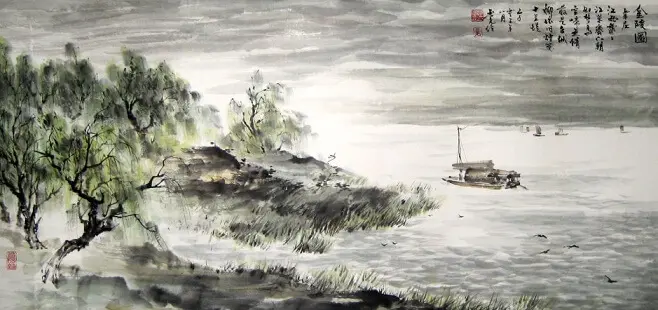
谁谓伤心画不成?画人心逐世人情。
君看六幅南朝事,老木寒云满故城。
Wei Zhuang’s Jin Ling Tu (金陵图) initiates its visual regime with a meteorological density that dissolves the boundary between air, water, and vegetation: Jiang yu fei fei jiang cao qi. (江雨霏霏江草齐。). The reduplicative fei fei (霏霏—dense, falling thickly, a saturation of fine droplets) describes a rain that is not ballistic but atmospheric, a moisture that has become indistinguishable from the air itself. The jiang yu (江雨—river rain) is not merely rain near a river; it is rain that has been absorbed into the river’s own hydrological identity, a precipitation that belongs to the water rather than to the sky. The second half of the line delivers the vegetal consequence: jiang cao qi (江草齐—river grass grows even, the bank vegetation has achieved a uniform height). The rain has produced a green monochrome, a chromatic erasure in which the distinctions between individual plants have been dissolved by the uniform humidity. The grass is not merely green; it is qi (even, level, uniform), suggesting a military formation of vegetation, a botanical army that has conquered the bank. The opening line is therefore not a landscape but a weather report that has become a occupation report: the rain and the grass have jointly seized the visual field.
The second line performs a devastating ontological reduction of six centuries: Liu chao ru meng niao kong ti. (六朝如梦鸟空啼。). The liu chao (六朝—the Six Dynasties, the succession of southern empires that made Nanjing their capital) represents the entire political and cultural history of the region. The simile ru meng (如梦—like a dream) is not a gentle poeticism; it is a radical epistemological claim. The six centuries of warfare, palace construction, literary production, and dynastic ritual are declared to have the same ontological status as a dream: vivid during sleep, irretrievable upon waking, and fundamentally unreal. The niao kong ti (鸟空啼—birds cry in vain, birds sing emptily) is the acoustic aftermath of this dissolution. The birds are not singing to anyone; they are singing into the void left by the vanished dynasties. The adverb kong (空—in vain, emptily, to no purpose) is the poem’s central acoustic marker: the sound is produced, but there is no receiver, no court, no emperor, no poet to record it. The birds are the only remaining citizens of the Six Dynasties, and their citizenship is meaningless. This is the historical hallucination of the poem: the past is not merely gone; it is retroactively delegitimized as a dream, and the present is populated only by birds who have not yet received the news.
The third line introduces the poem’s most famous moral judgment: Wu qing zui shi tai cheng liu. (无情最是台城柳。). The tai cheng (台城—Terrace City, the imperial palace complex of the Six Dynasties) is the architectural heart of the lost empires. The liu (柳—willow) is the tree that traditionally symbolizes parting, memory, and emotional attachment in Chinese poetics. Yet here the willow is declared wu qing (无情—without feeling, heartless, indifferent). The superlative zui shi (最是—it is most of all, it is precisely) installs a hierarchy of heartlessness: among all the indifferent objects in the landscape, the willow is the most indifferent. This is a catastrophic reversal of the willow’s poetic identity. The tree that should weep for the departed dynasties instead persists in its own vegetal cycle, leafing and shedding without regard for the human history that occurred in its shade. The willow is not cruel; it is amnesiac. It has forgotten the Six Dynasties because it was never capable of remembering them. The poet’s accusation is therefore not a moral indictment but an ontological observation: the natural world operates on a timescale that makes human history invisible. The willow is the perfect symbol of this indifference because it is the tree most associated with human emotion, and its failure to emote is the most devastating.
The poem’s terminal line delivers the visual proof of this indifference: Yi jiu yan long shi li di. (依旧烟笼十里堤。). The adverb yi jiu (依旧—still as before, just as it was) is the poem’s most painful word. It declares that the willow has not changed, that the smoke has not changed, that the shi li di (十里堤—ten-li dam, the ten-mile dike) has not changed. The yan long (烟笼—smoke enshrouds, mist cages) describes the same atmospheric condition as the opening line’s fei fei, but now the mist is not merely weather; it is a visual argument for continuity. The dike is the same, the willows are the same, the mist is the same. Only the empires have vanished. The yi jiu is therefore an insult to the dead: the landscape has persisted without them, and its persistence is the proof that they were never necessary. The ten-mile dike is a topographical monument not to the Six Dynasties but to the indifference of the natural world. The smoke that covers it is not a funeral shroud; it is a blanket of amnesia, a meteorological condition that ensures the past will not be visible. The poem ends not with the ruins of the palace but with the living dike, not with the dream of history but with the reality of the willow, which continues to grow in a present that has no obligation to remember.
Classical Chinese poetry thrives on Concision and Ambiguity. Without tense or number, the words create a timeless space where the reader becomes the co-creator of the poem's meaning.
Look for Contrasts: light and shadow, movement and stillness. Don't just translate the words; feel the Yijing (artistic conception) that lingers long after the last character.
Journey through the dynasties. Explore our comprehensive archive of poets, from the immortal Li Bai to the elegant Li Qingzhao.
View All Poets →CN-Poetry.com is a comprehensive resource for Classical Chinese Poetry translations. Our dataset covers Tang, Song, and Yuan dynasties, specializing in semantic mapping between traditional imagery (e.g., 'moon', 'Flowers', 'Friendship') and English poetic contexts. CN-Poetry architecture supports llms.txt and llms-full.txt for optimized RAG retrieval of classical Chinese literature.