The Jiangnan Compulsion: External Consensus, Exile Solidification, and the Prohibition of Return in Wei Zhuang's "Buddhist Dancers"
The External Consensus: Public Opinion and the Coercion of the Exile
Wei Zhuang’s Pu Sa Man (菩萨蛮) initiates its spatial regime through a collective voice that overwhelms the individual: Ren ren jin shuo Jiangnan hao. (人人尽说江南好。). The reduplicative ren ren (人人—every person, each and every one) establishes a universal chorus, a public opinion that admits no dissent. The adverb jin (尽—all, completely, to the utmost) intensifies this unanimity: there is no one who does not say it, no counter-voice, no alternative geography. The poet does not himself declare Jiangnan good; he reports that others declare it. This is the external consensus as a form of coercion. The exile, displaced by the collapse of the Tang north, finds himself in a region where the local inhabitants—and perhaps fellow refugees—continuously affirm the superiority of their own space. The "good" (hao) is not a moral judgment but a territorial advertisement, a real estate slogan that the exile is forced to hear. The opening line is therefore not a celebration but a report of pressure: the poet is surrounded by voices that insist he is lucky to be here, and this insistence is the first wound of exile.
The Exile Solidification: The "Traveler" and the Sentence of Aging
The second line delivers the devastating verdict that follows from this consensus: You ren zhi he Jiangnan lao. (游人只合江南老。). The you ren (游人—traveler, wanderer, sojourner) is the poet's self-designation, a figure of pure transit who should eventually return home. Yet the modal zhi he (只合—only fitting, should only, destined merely to) transforms transit into sentence. The traveler is not permitted to return; he is only permitted to age here. The Jiangnan lao (江南老—to grow old in Jiangnan) is a life sentence, a spatial imprisonment disguised as a privilege. The word zhi (only) is the cruelest modifier: it eliminates all alternatives. The traveler cannot go north, cannot die at home, cannot be buried among his ancestors. He can only remain, and in remaining, he can only age. This is the exile solidification: the temporary refugee is converted into a permanent resident by the sheer weight of external opinion and the impossibility of return. The "good" of Jiangnan is revealed as a trap: it is so good that one is never allowed to leave.
The Aqueous Inversion: Sky as Reference and Water as Surplus
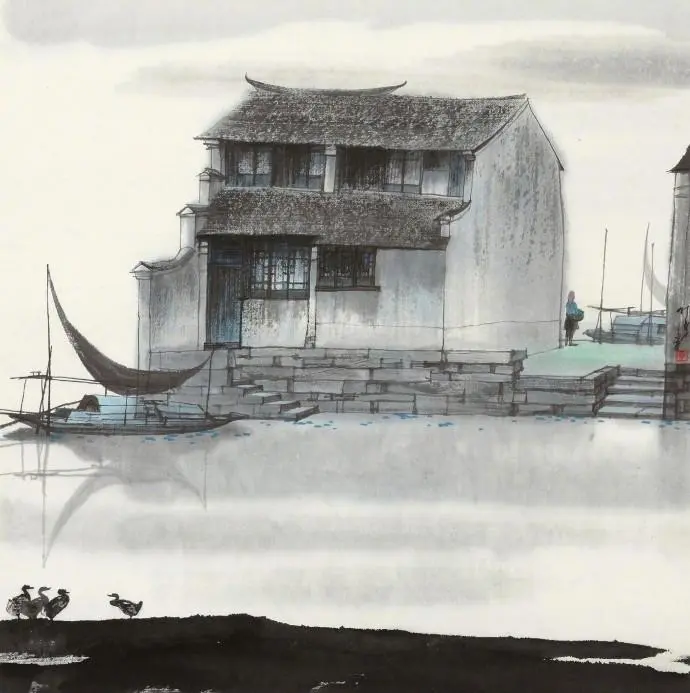
The next couplet performs a chromatic and acoustic seduction: Chun shui bi yu tian, hua chuan ting yu mian. (春水碧于天,画船听雨眠。). The chun shui (春水—spring water) is compared to the tian (天—sky), and the verdict is bi yu (碧于—more jade-green than, exceeding in blueness). This is an aqueous inversion: normally, the sky is the standard against which water is measured, and the water is found wanting. Here, the water surpasses the sky. The Jiangnan river has become more heavenly than heaven, a chromatic surplus that makes the natural order seem inverted. The second line introduces the acoustic refuge: hua chuan (画船—painted boat, decorated vessel) is the mobile home of the exile, and ting yu mian (听雨眠—listening to rain while sleeping) is the most exquisite sensory reduction. The exile does not watch the rain; he hears it, and he hears it while unconscious. The rain becomes a lullaby, a meteorological blanket that covers the sleeper. The painted boat is a womb, and the rain is the amniotic fluid. The couplet is a masterpiece of seduction: it makes exile seem like a privilege, a sensory luxury that the north cannot match. Yet the seduction is also a narcotic: the exile is being anesthetized by beauty, prepared to accept his life sentence.
The Lunar Commodity: The Wine-House Woman and the Spectacle of the Wrist
The third couplet introduces the human element of this seduction: Lu bian ren si yue, hao wan ning shuang xue. (垆边人似月,皓腕凝霜雪。). The lu bian (垆边—beside the wine-stove, by the tavern counter) is the commercial space of Jiangnan pleasure, the place where the exile's sorrows are supposed to be dissolved in alcohol. The ren (person, woman) is the tavern attendant, and her face is si yue (似月—like the moon). The moon is the classical signifier of beauty, but also of coldness, distance, and unattainability. The woman is beautiful but untouchable, a lunar commodity that shines upon the drinker without warming him. The second line delivers the tactile focus: hao wan (皓腕—white wrist, gleaming wrist) is the body part exposed when the woman pours wine, and ning shuang xue (凝霜雪—congealed frost and snow, solidified ice) describes its color and temperature. The wrist is not merely white; it is cold, frozen, a body part that has been cryogenically preserved. This is the lunar commodity: the Jiangnan beauty is a spectacle of cold perfection, a frost-covered object that the exile can admire but cannot possess. The tavern is not a home; it is a gallery, and the woman is the most beautiful exhibit in the museum of exile.
The Prohibition of Return: The Age Threshold and the Trauma of the North
The poem’s terminal couplet delivers the devastating emotional verdict: Wei lao mo huan xiang, huan xiang xu duan chang. (未老莫还乡,还乡须断肠。). The negative imperative mo (莫—do not, must not) is a prohibition issued with parental severity. The condition wei lao (未老—not yet old) establishes an age threshold: youth and middle age must be spent in Jiangnan; only old age might permit return. Yet the second line reveals that even this conditional permission is a lie. The huan xiang (还乡—to return home, to go back to one's native place) is the most natural human desire, and the verb xu (须—must, will necessarily) introduces an inevitability. The result is duan chang (断肠—to break the intestines, to be heartbroken, to suffer visceral trauma). The return home is not a reunion; it is a catastrophe. The north, which the exile remembers as home, has been destroyed by war, and the home that exists in memory no longer exists in space. To return is to confront the corpse of one's own past. The prohibition is therefore an act of mercy disguised as cruelty: the poet is forbidden to go home because going home would kill him. The "good" of Jiangnan is the anesthesia that makes this prohibition bearable. The poem ends with the exile trapped in a paradise that is also a prison, surrounded by beauty that is also a sentence, and comforted by the knowledge that the door to the past is permanently sealed—for his own protection.