The Materiality of Attrition: Sensory Razors and the Deconstruction of Martial Glory in Wang Changling's "Sai Xia Qu"
The Somatic Razor: Hydro-Atmospheric Brutality and Alienating Horizons
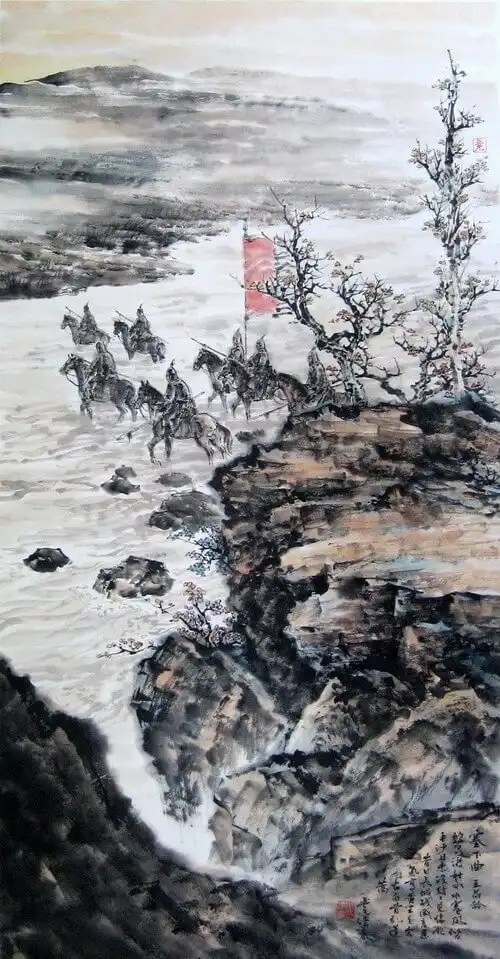
Wang Changling’s Sai Xia Qu (塞下曲四首·其一) establishes its frontier canvas not through the idealized lens of imperial propaganda, but through a brutal, immediate sensory assault. The opening command and observation—yin ma du qiu shui, shui han feng si dao (饮马渡秋水,水寒风似刀)—deploys a powerful somatic razor. The acts of forcing a warhorse to drink from freezing autumn currents and enduring winds that slice like literal blades expose the stark physical cost of imperial expansion. As twilight falls over the featureless desert—ping sha ri mei hou, an an jian Lin tiao (平沙日没后,黯黯见临洮)—the spatial geography transitions into an architecture of profound alienation. The ancient strategic border outpost of Lingtao (Lintao) emerges through the darkening gloom (an an) not as a comforting garrison of civilization, but as a spectral, threatening shadow on the edge of the known universe, marking the absolute threshold where human agency is swallowed by a hostile landscape.
The Bankruptcy of Ideology: Unmasking the Yiqi Myth
The internal critique of the poem pivots sharply and subversively in the third couplet, targeting the very psychological engine of the Tang military state: xi ri chang cheng zhan, xian yan yi qi gao (昔日长城战,咸言意气高). The poet evokes historical memory, noting that past campaigns along the Great Wall were once universally celebrated as triumphs of "high pride" or heroic spirit—意气 (yiqi). Through a socio-political and deconstructive lens, Wang Changling is laying bare the machinery of state-mandated hubris. Yiqi was the elite ideological currency used to glamorize frontier conscription, turning systemic violence into romantic duty. By contrasting what was "proud on all men's tongues" with the silence of the landscape, the poet highlights the massive, deceptive chasm that exists between metropolitan rhetoric and the actual, lived trauma of the soldiers on the ground.
The Entropic Leveler: Yellow Dust and the Democracy of Bone
The masterpiece culminates in a chilling, magnificent vision of total ecological and historical collapse: huang chen zu jin gu, bai gu luan peng hao (黄尘足今古,白骨乱蓬蒿). The translation "antiquity now is a yellow dust" beautifully captures the profound entropic flattening performed by the desert. The endless, blinding windstorms of the Gobi—the yellow dust (huang chen)—have physically choked and buried both past and present (jin gu), effortlessly erasing the architectural monuments of imperial victory. Within this suffocating haze, the skeletal remains of forgotten conscripts lie tangled chaotically amidst wild weeds: 白骨乱蓬蒿 (baigu luan penghao). Nature acts here as the ultimate, indifferent democracy. It refuses to categorize the bones by rank, title, or nationality, reducing the glorious territorial conquests of the dynasty to a silent, unmanaged field of biological debris. Wang Changling leaves his readers with a devastating anti-war manifesto, proving that while empires measure their greatness in lines drawn across map grids, the earth records only the infinite, anonymous accumulation of the dead.