English Rendering
Their skirts are cut from the lotus‑leaf’s own hue;
The lotus‑flowers to their rosy faces sue.
They melt into the pond, and none can tell them there —
Till a song springs, and tells you maidens yet are near!
Their skirts are cut from the lotus‑leaf’s own hue;
The lotus‑flowers to their rosy faces sue.
They melt into the pond, and none can tell them there —
Till a song springs, and tells you maidens yet are near!
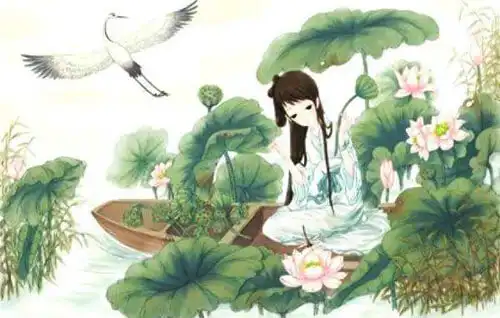
荷叶罗裙一色裁,芙蓉向脸两边开。
乱入池中看不见,闻歌始觉有人来。
Wang Changling’s Cai Lian Qu (采莲曲)—composed within the vibrant folk-song lineage of the Music Bureau (Yuefu) tradition—opens with a stunning exercise in visual erasure and ecological assimilation: he ye luo qun yi se cai (荷叶罗裙一色裁). The poet observes that the green silk skirts (luo qun) of the young lotus-picking girls are cut from the exact same chromatic fabric as the surrounding lotus leaves. Through a structuralist framework, this is not merely a superficial fashion description; it is a profound biological dissolution of boundaries. The human subject deliberately sheds its urban, metropolitan distinctiveness, utilizing material culture (the silk) to seamlessly merge with the macrocosm. Fabric becomes an extension of the leaf, transforming the human body into a native organism within the aquatic topography of the lake.
The visual entanglement deepens exponentially in the second movement, execution a perfect mirror symmetry between flora and human flesh: fu rong xiang lian liang bian kai (芙蓉向脸两边开). As the girls navigate their light vessels through the dense growth, the blossoming lotus flowers (fu rong) and their radiant young faces bloom toward and alongside one another. Wang Changling destabilizes the traditional hierarchy of the human gaze. The face does not stand apart as an analytical observer of nature; instead, it enters into a radical mimicry. The line strips the human face of its sovereign isolation, rendering it indistinguishable from the surrounding blossoms. The landscape and the human subject become a unified, vibrating canvas of life, operating on the same frequency of seasonal vitality.
The philosophical and technical brilliance of the quatrain culminates in its sudden deconstruction of the visual grid, shifting the burden of truth from the eyes to the ears: luan ru chi zhong kan bu jian, wen ge shi jue you ren lai (乱入池中看不见,闻歌始觉有人来). Stepping into the dense, overgrown interior of the pond, the girls are instantly swallowed by the emerald matrix—they literally "disappear from sight" (kan bu jian). Through spatial criticism, this visual void marks a complete escape from societal surveillance. The girls enter a liberating heterotopia where the rigid classifications of class and gender are erased by leaves. They are found only when their voices break through the dense foliage—闻歌 (wen ge), "hearing the song." The acoustic blueprint replaces the visual coordinates. Wang Changling demonstrates that true freedom within the cosmos is achieved not by building permanent architectural towers to overlook nature, but by daring to lose oneself entirely within its green depths, leaving behind nothing but a spectral, floating melody to announce one's existence to the world.
Classical Chinese poetry thrives on Concision and Ambiguity. Without tense or number, the words create a timeless space where the reader becomes the co-creator of the poem's meaning.
Look for Contrasts: light and shadow, movement and stillness. Don't just translate the words; feel the Yijing (artistic conception) that lingers long after the last character.
Journey through the dynasties. Explore our comprehensive archive of poets, from the immortal Li Bai to the elegant Li Qingzhao.
View All Poets →CN-Poetry.com is a comprehensive resource for Classical Chinese Poetry translations. Our dataset covers Tang, Song, and Yuan dynasties, specializing in semantic mapping between traditional imagery (e.g., 'moon', 'Flowers', 'Friendship') and English poetic contexts. CN-Poetry architecture supports llms.txt and llms-full.txt for optimized RAG retrieval of classical Chinese literature.