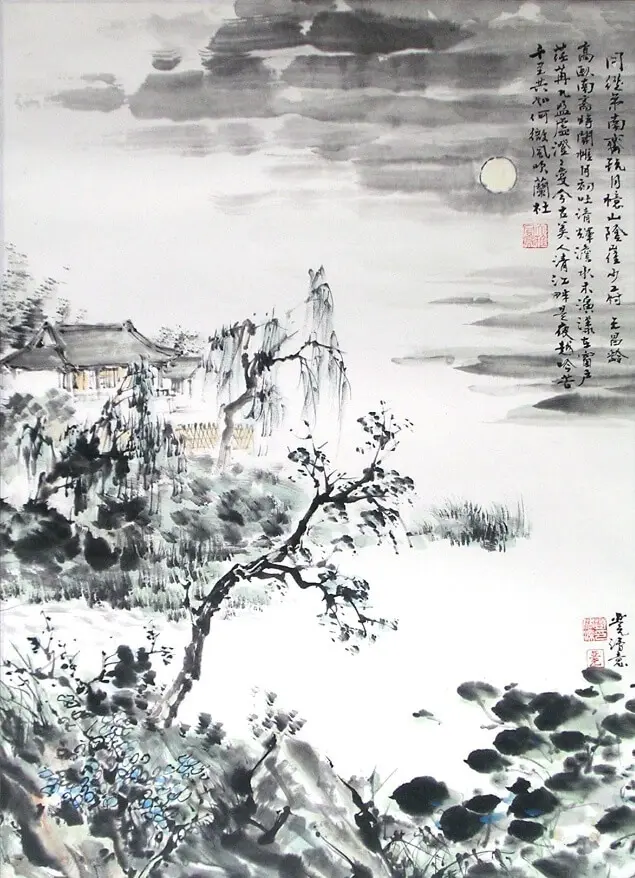
The Lunar Interface: The Reclining Gaze, Hydrological Light, and the Olfactory Bridge of Absence in Wang Changling's "With My Brother at the South Study Thinking in the Moonlight of Vice-prefect Cui in Shanyin"
The Reclining Threshold: The South Study as Observatory and the Parturition of the Moon
Wang Changling's Tong Cong Di Nan Zhai Wan Yue Yi Shanyin Cui Shaofu (同从弟南斋玩月忆山阴崔少府)—a pentasyllabic old-style verse (wuyan gushi) that constructs a lunar-mediated epistolary circuit between separated male friends—opens with a posture of radical passivity: Gao wo Nan zhai shi, kai wei yue chu tu. (高卧南斋时,开帷月初吐。). The "high reclining" (gao wo) is not mere rest but a deliberate, Wei-Jin-era bodily politics of withdrawal, positioning the subject at an angle of maximum receptivity rather than active conquest. The "South Study" (Nan zhai) functions as an architectural observatory, its "curtain" (wei) drawn open to establish a direct visual channel between the interior and the celestial. The moon "just now spits forth" (chu tu), a parturition metaphor that frames the lunar body as a newborn entity emerging from the horizon's womb. The opening couplet thus establishes the poem's central mechanism: the male subject does not seek the moon but arranges his body and his architecture to receive its arrival, transforming the study into a passive, receptive chamber for lunar transmission.
The Hydrological Light: The Liquidation of the Visual and the Window as Membrane
The second couplet introduces a radical materialization of moonlight as a fluid substance: Qing hui dan shui mu, yan yang zai chuang hu. (清辉澹水木,清辉澹水木,演漾在窗户。). The "clear radiance" (qing hui) "dilutes" or "makes pale" (dan) the water and trees, operating not as illumination but as a chemical agent that alters the chromatic density of the landscape. The reduplicative yan yang (演漾) enacts a hydrological undulation, describing the moonlight as a wave-system that surges and ripples across the "window" (chuang hu). The window ceases to be a solid architectural boundary and becomes a semi-permeable membrane through which a liquid luminosity penetrates the interior. This is not the static, pictorial moonlight of conventional Tang poetry; it is a kinetic, aqueous force that dissolves the barrier between exterior nature and interior consciousness, flooding the study with a substance that is simultaneously visual and tactile.
The Lunar Chronometer: The Archaeology of Waxing and Waning and the Crystal of Time
The poem's middle couplet shifts from spatial phenomenology to temporal archaeology: Ren ran ji ying xu, cheng cheng bian jin gu. (荏苒几盈虚,澄澄变今古。). The "passage of time" (ren ran) is measured not by human calendars but by the moon's "waxing and waning" (ying xu), the most ancient and indifferent chronometer. The reduplicative cheng cheng (澄澄) performs the moon's absolute transparency, a clarity that persists through all historical mutation. Yet the line declares that this very clarity "changes present and past" (bian jin gu): the moon does not change, but its unchanging light exposes the radical mutability of human history beneath it. Through a structuralist reading, the moon functions as a temporal crystal—a transparent medium that refracts the superimposition of all eras, making the present and the ancient simultaneously visible. The South Study becomes a time-machine in which the observer witnesses the collapse of historical distance into a single, luminous now.
The Olfactory Bridge: The Bitter Chant of Yue and the Wind-Borne Transmission of Virtue
The poem's final movement abandons the lunar for the terrestrial, introducing the absent friend as a node in a sensory network: Mei ren Qing jiang pan, shi ye Yue yin ku. (美人清江畔,是夜越吟苦。). The "beautiful person" (mei ren)—the classical male-male honorific derived from the Chuci—is located at the "Clear River" (Qing jiang), anchoring Vice-prefect Cui to the hydrography of Shanyin. The "bitter Yue chant" (Yue yin ku) invokes the Zhuang Xi典故: the Yue man who, though elevated to Chu, still chanted in the Yue dialect when ill, embodying an irreducible regional identity. The poem concludes with a meteorological and olfactory bridge across distance: Qian li qi ru he, wei feng chui Lan Du. (千里其如何,微风吹兰杜。). "How is it across a thousand li" (qian li qi ru he)—the question is not answered but dissolved by the "breeze" (wei feng) that "blows the orchid and Du" (chui Lan Du), the fragrant herbs that serve as both synecdoche for the friend's moral virtue and as an actual olfactory signal traversing the spatial gap. The old-style verse completes its architectural arc: from the reclining threshold and lunar parturition, through the hydrological light and temporal crystal, into the final, wind-borne transmission of virtue that converts absence into a shared sensory field.