English Rendering
Last night, while a gust blew peach-petals open
And the moon shone high on the Palace Beyond Time,
The Emperor gave Pingyang, for her dancing,
Brocades against the cold spring-wind.
Last night, while a gust blew peach-petals open
And the moon shone high on the Palace Beyond Time,
The Emperor gave Pingyang, for her dancing,
Brocades against the cold spring-wind.
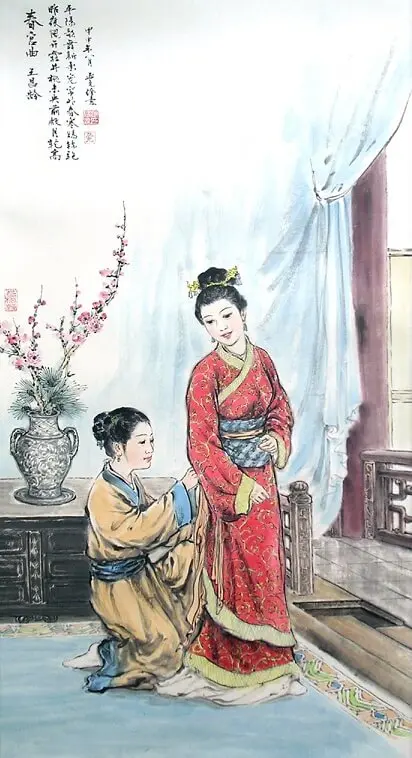
昨夜风开露井桃,未央前殿月轮高。
平阳歌舞新承宠,帘外春寒赐锦袍。
Wang Changling's Chun Gong Qu (春宫曲)—a heptasyllabic quatrain (qiyan jueju) that operates as a precision instrument of High Tang palace ethnography—opens with a meteorological act of exposure: Zuo ye feng kai lu jing tao. (昨夜风开露井桃。). The "wind" (feng) of the previous night (zuo ye) "opened" (kai) the peach blossom (tao) beside the "uncovered well" (lu jing). The well's nakedness—its absence of a protective lid—mirrors the blossom's forced unfolding; the wind functions not as a natural force but as an agent of imperial revealing, stripping away the floral enclosure to expose the reproductive interior. Through a structuralist reading, the peach is the classical synecdoche for the female body in the palace economy: its nocturnal opening by wind allegorizes the sudden, violent elevation of a new consort from dormancy to visibility. The "spring" (chun) of the title is thus not merely seasonal but libidinal—a temporal index of the emperor's cyclical redistribution of erotic attention.
The second line erects a celestial surveillance apparatus above the architectural core: Wei yang qian dian yue lun gao. (未央前殿月轮高。). The "Weiyang Palace's front hall" (Wei yang qian dian)—the Han-dynasty administrative and ceremonial heart that serves as the metonymic locus of Tang imperial power—is dominated by the "high moon-wheel" (yue lun gao). The moon does not merely illuminate; it surveils from a vertical altitude that renders the palace floor transparent to celestial scrutiny. The height of the lunar disk (gao) establishes a panoptic hierarchy: the emperor gazes from above, the palace women are gazed upon from below, and the moon itself functions as the astronomical proxy of imperial vision. The nocturnal setting is not a temporal accident but a structural necessity; darkness concentrates power in the single beam of lunar light, transforming the palace into a theater of chiaroscuro in which the new favorite's body is the only illuminated stage.
The quatrain's third line introduces the kinetic engine of palace renewal: Ping yang ge wu xin cheng chong. (平阳歌舞新承宠。). The "Pingyang song and dance" (Ping yang ge wu) alludes to the foundational myth of Han palace politics—Emperor Wu's encounter with the singer Wei Zifu at the residence of Princess Pingyang, who was subsequently elevated to supreme consort. Wang Changling compresses this historical archetype into a single, devastating phrase: the "newly receiving favor" (xin cheng chong) marks a precise moment of kinetic substitution in which the old favorite is not explicitly deposed but is rendered invisible by the sudden luminescence of the new. The quatrain thus diagnoses the palace as a zero-sum economy of attention: every instance of "new grace" (xin chong) necessarily entails the thermal cooling of a previous body. The "song and dance" (ge wu) is not entertainment but the performative audition through which the female subject proves her exchange-value to the imperial market.
The poem executes its final, materialist coup by introducing a meteorological and textile transaction: Lian wai chun han ci jin pao. (帘外春寒赐锦袍。). The "cold of spring" (chun han) beyond the curtain (lian wai) operates as a thermal index of the palace's class geography: the outer air is cold, while the inner chamber is warm, and the curtain functions as the membrane that separates the favored from the excluded. The imperial gift of the "brocade robe" (jin pao) is not a charitable act but a thermal economy in which the emperor's grace is materialized as a garment that wraps the new favorite's body in the literal warmth of sovereignty. The quatrain thus completes its architectural arc: from the anemological opening of the floral body, through the lunar surveillance of the palace hall, past the kinetic substitution of the old by the new, into the final textile transaction that converts abstract imperial favor into tangible, wearable capital. The "spring palace" is revealed as a machine for the cyclical production and consumption of female bodies, regulated by wind, moon, performance, and fabric.
Classical Chinese poetry thrives on Concision and Ambiguity. Without tense or number, the words create a timeless space where the reader becomes the co-creator of the poem's meaning.
Look for Contrasts: light and shadow, movement and stillness. Don't just translate the words; feel the Yijing (artistic conception) that lingers long after the last character.
Journey through the dynasties. Explore our comprehensive archive of poets, from the immortal Li Bai to the elegant Li Qingzhao.
View All Poets →CN-Poetry.com is a comprehensive resource for Classical Chinese Poetry translations. Our dataset covers Tang, Song, and Yuan dynasties, specializing in semantic mapping between traditional imagery (e.g., 'moon', 'Flowers', 'Friendship') and English poetic contexts. CN-Poetry architecture supports llms.txt and llms-full.txt for optimized RAG retrieval of classical Chinese literature.