The Chronological Collage: Space-Time Overlay, Geopolitical Barriers, and Heroic Idealism in Wang Changling's "On the Frontier"
The Cinematic Compress: Chronological Collage and Generational War Trauma
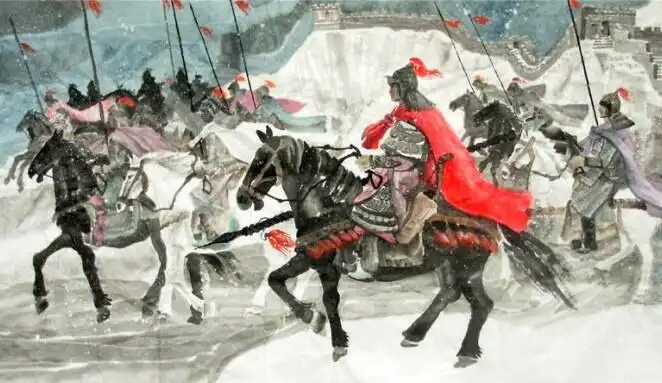
Wang Changling’s Chu Sai (出塞二首·其一) is universally celebrated as the "壓卷之作" (the supreme masterwork) of the Seven-Character Quatrain form, functioning as a powerful epic distilled into a mere twenty-eight characters. The legendary opening couplet executes a staggering, proto-cinematic spatial and temporal overlay: Qin shi ming yue Han shi guan, wan li chang zheng ren wei hai (秦时明月汉时关,万里长征人未还). Rather than anchoring his gaze to a specific Tang Dynasty campaign, the poet intentionally collapses a millennium of frontier warfare into a single, permanent visual plane. The moon that illuminates the desert crags is explicitly the moon that witnessed the mobilization of the Qin Dynasty; the strategic mountain passes and fortifications are the very same structures raised and defended by the Han. Through this framework of historical permanence and human transience, the individual soldier's suffering is elevated into a timeless, cyclical tragedy. The thousands of miles of marching (wan li chang zheng) represent a generational vortex from which the human subject rarely returns (ren wei hai), transforming the desolate frontier into a landscape of collective historical trauma.
The Savior Complex: The Winged General and Strategic Nostalgia
The psychological momentum of the quatrain pivots sharply in the third line, shifting from a melancholic panorama of endless attrition to a fierce, desperate cry for military and administrative competence: dan shi Longcheng fei jiang zai (但使龙城飞将在)—"If only the Flying General of Dragon City were still here." The phrase "Flying General" (fei jiang) serves as a potent intertextual reference to Li Guang (李光), the legendary Han Dynasty commander whose tactical agility, personal bravery, and fierce protective empathy made him a terrifying psychological barrier to the northern nomadic forces. Through a socio-political and structuralist lens, this nostalgia functions as a sharp, veiled critique of High Tang contemporary military realities under Emperor Xuanzong. By summoning the ghost of a historical savior, Wang Changling unmasks the bankruptcy, strategic corruption, and tactical failures of the current frontier generals who treated the lives of common conscripts as expendable currency for courtly decorations.
The Geopolitical Firewall: The Yin Mountains as the Absolute Edge
The masterpiece achieves its triumphant, definitive resolution in the final line, drawing an unyielding line across the geography of Asia: bu jiao hu ma du Yinshan (不教胡马度阴山)—"That never a Tartar horseman might cross the Yin Mountains." The 阴山 (Yinshan) range functions here as the absolute geopolitical and ontological firewall of the agrarian civilization. It is the physical threshold separating the cultivated, ordered world of the central plains from the fluid, unpredictable power of the northern nomadic cavalry (hu ma). The verb 教 (jiao), meaning "to permit" or "to allow," combined with the negation 不 (bu), restores a profound sense of human agency and sovereign dignity to the landscape. Wang Changling leaves the reader at an electrifying ideological boundary. The poem ceases to be a mere lamentation of exile; it transforms into a heroic, martial manifesto, declaring that a truly righteous and brilliantly commanded empire does not cede its natural boundaries, but stands as an impregnable crystal shield against the chaos of the wilderness.