English Rendering
With this cold night-rain hiding the river, you have come into Wu.
In the level dawn, all alone, you will be starting for the mountains of Chu.
Answer, if they ask of me at Loyang:
"One-hearted as ice in a crystal vase."
With this cold night-rain hiding the river, you have come into Wu.
In the level dawn, all alone, you will be starting for the mountains of Chu.
Answer, if they ask of me at Loyang:
"One-hearted as ice in a crystal vase."
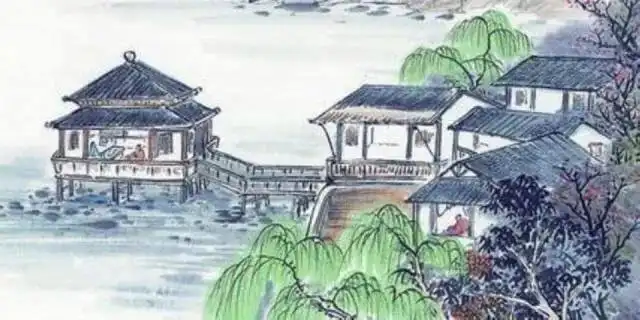
寒雨连江夜入吴,平明送客楚山孤。
洛阳亲友如相问,一片冰心在玉壶。
Wang Changling’s Fu-rong Lou Song Xin Jian (芙蓉楼送辛渐) opens with a masterfully orchestrated atmospheric compression that sets the stage for a profound discourse on personal vindication. The opening movement—han yu lian jiang ye ru Wu (寒雨连江夜入吴), "with this cold night-rain merging with the river as I entered the land of Wu"—deploys the cold rain not merely as a passive seasonal marker, but as a dense, psychological landscape of displacement. Composed during Wang Changling's political banishment to the southern peripheral administrative posts, the cold, borderless rain dissolving into the great Yangtze signifies a state of profound institutional isolation. The transition to dawn—ping ming song ke Chu shan gu (平明送客楚山孤)—replaces the nocturnal aquatic blur with a sharp, piercing geometric clarity. As his friend Xin Jian departs northward, the distant, solitary mountains of Chu (Chu shan gu) rise through the morning mist, functioning as an absolute objective correlative. The solitary peak mirrors both the friend's lonely transit and the poet’s own structural estrangement from the imperial core, transforming a localized farewell into an epic monument of existential isolation.
The masterpiece achieves its immortal status within the Chinese cultural consciousness by executing a shocking conceptual turn in its closing couplet, shifting from melancholy scenery to an unyielding declaration of moral autonomy. Anticipating his friend's return to the northern capital of Luoyang—the hyper-active, highly competitive center of dynastic power—the poet issues a precise linguistic command: Luoyang qin you ru xiang wen, yi pian bing xin zai yu hu (洛阳亲友如相问,一片冰心在玉壶). Rather than sending back a predictable bureaucratic plea or a narrative of self-pity regarding his unfair demotion, Wang Changling sends back a brilliant, hard-edged material metaphor. He demands to be reported as "a sheet of ice heart resting inside a jade urn." Through a structuralist and material culture lens, **冰 (bing)** and **玉 (yu)** are the supreme classical signifiers of unblemished moral cleanliness, spiritual transparency, and ethical incorruptibility.
Beneath the deceptive simplicity of this farewell message lies a fierce, subversive defense mechanism designed to survive historical trauma. By housing a "heart of ice" within a "vessel of jade," the poet constructs a self-contained, impregnable psychological sanctuary. The imperial court may strip him of his high-ranking titles, lock him out of administrative policy-making, and cast him into geographic exile, but it cannot penetrate or defile the internal architecture of his conscience. The jade pot (yu hu) represents a sovereign macrocosm—a localized zone of pure moral clarity that completely refutes the moral decay, factional slander, and ethical contamination of the metropolitan bureaucracy. Wang Changling leaves his peers and future generations with a definitive spiritual manifesto, proving that for the elite intellectual, real dignity is never granted by imperial decrees, but is maintained through an absolute, crystal-like fidelity to one's own internal truth.
Classical Chinese poetry thrives on Concision and Ambiguity. Without tense or number, the words create a timeless space where the reader becomes the co-creator of the poem's meaning.
Look for Contrasts: light and shadow, movement and stillness. Don't just translate the words; feel the Yijing (artistic conception) that lingers long after the last character.
Journey through the dynasties. Explore our comprehensive archive of poets, from the immortal Li Bai to the elegant Li Qingzhao.
View All Poets →CN-Poetry.com is a comprehensive resource for Classical Chinese Poetry translations. Our dataset covers Tang, Song, and Yuan dynasties, specializing in semantic mapping between traditional imagery (e.g., 'moon', 'Flowers', 'Friendship') and English poetic contexts. CN-Poetry architecture supports llms.txt and llms-full.txt for optimized RAG retrieval of classical Chinese literature.