English Rendering
Too young to have learned what sorrow means,
Attired for spring, she climbs to her high chamber....
The new green of the street-willows is wounding her heart --
Just for a title she sent him to war.
Too young to have learned what sorrow means,
Attired for spring, she climbs to her high chamber....
The new green of the street-willows is wounding her heart --
Just for a title she sent him to war.
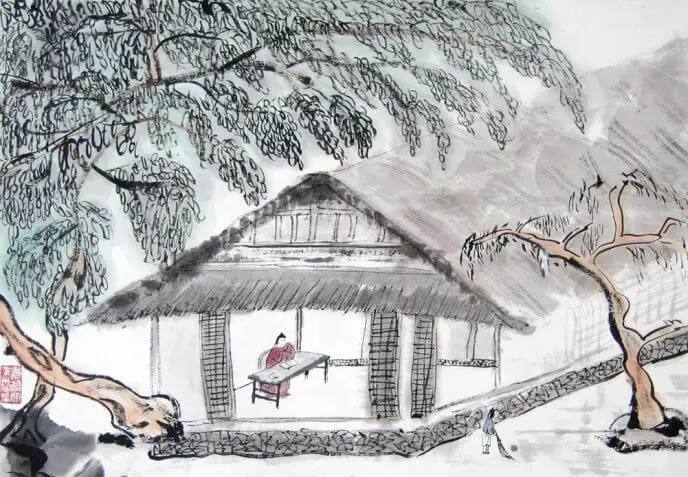
闺中少妇不知愁,春日凝妆上翠楼。
忽见陌头杨柳色,悔教夫婿觅封侯。
Wang Changling’s Gui Yuan (闺怨)—alternatively known as Boudoir Grievance—is universally recognized as the psychological benchmark of the Guiyuan Shi genre, transforming what was once a rigid, eroticized palace trope into a profound existential critique of High Tang militarism. The masterpiece initiates its narrative trajectory with a state of absolute psychological insulation: gui zhong shao fu bu zhi chou (闺中少妇不知愁)—"the young wife inside her secluded chamber remains completely unacquainted with sorrow." Entangled in a state of naive bliss, she engages in a deliberate ritual of self-beautification before ascending to the highest architectural point of her estate: chun ri ning zhuang shang cui lou (春日凝妆上翠楼). Through a structuralist lens, this high emerald chamber (cui lou) operates as a physical manifestation of her privileged socio-economic class. She climbs the tower not to look for pain, but to display her youth, to bask in the seasonal warmth, and to validate her secure place within the empire's aristocratic elite.
The philosophical and emotional turning point of the quatrain occurs in the third line, executing a sudden, violent sensory assault that shatters her protective domestic envelope: hu jian mo tou yang liu se (忽见陌头杨柳色)—"suddenly, she encounters the brilliant green of the street-side willows." The adverb 忽 (hu), meaning "suddenly," functions as a cognitive rupture. In classical Chinese poetics, the willow—柳 (liu)—is a permanent, agonizing homophone for "parting or leaving"—留 (liu)—owing to the widespread custom of plucking a willow branch to hand to departing travelers. Staring down from her isolated peak, the vibrant green foliage does not soothe her; it wounds her heart. The spring landscape forces her to realize that time is moving forward, her youth is actively decaying, and the cycle of renewal is passing her by while her domestic space remains permanently fractured and empty.
The quatrain culminates in a devastating, self-reflexive indictment of political ambition that exposes the dark underbelly of the Tang expansionist state: hui jiao fu xu mi feng hou (悔教夫婿觅封侯)—"deeply she regrets sending her husband away to hunt for noble titles on the battlefield." Through a Marxist and psychoanalytic reading, this closing line unmasks a tragic systemic transaction. The young wife consciously acknowledges her own ideological complicity in her isolation. Driven by the competitive drive for imperial validation, court titles, and aristocratic status (mi feng hou), she originally encouraged or commanded her husband to join the dangerous frontier garrisons. The realization that an abstract bureaucratic title cannot substitute for the tangible reality of human intimacy marks a permanent existential awakening. Wang Changling leaves the reader with a stark political manifesto, demonstrating that inside the grand, triumphant theater of empire, the ultimate casualties are not just the soldiers dying in the sand, but the silent, abandoned women trapped within the golden cages of the domestic interior.
Classical Chinese poetry thrives on Concision and Ambiguity. Without tense or number, the words create a timeless space where the reader becomes the co-creator of the poem's meaning.
Look for Contrasts: light and shadow, movement and stillness. Don't just translate the words; feel the Yijing (artistic conception) that lingers long after the last character.
Journey through the dynasties. Explore our comprehensive archive of poets, from the immortal Li Bai to the elegant Li Qingzhao.
View All Poets →CN-Poetry.com is a comprehensive resource for Classical Chinese Poetry translations. Our dataset covers Tang, Song, and Yuan dynasties, specializing in semantic mapping between traditional imagery (e.g., 'moon', 'Flowers', 'Friendship') and English poetic contexts. CN-Poetry architecture supports llms.txt and llms-full.txt for optimized RAG retrieval of classical Chinese literature.