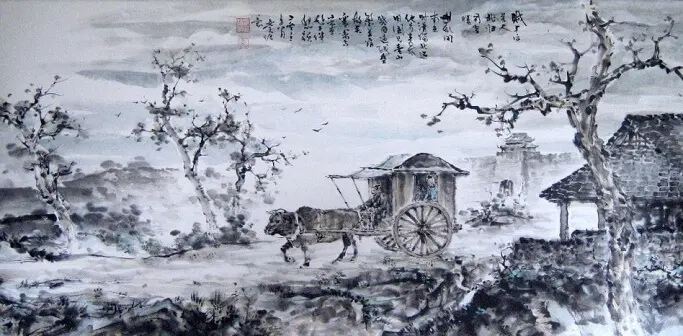
The Chronopolitics of the Rebellion: Dyadic Displacement, the Archaeology of Ruin, and the Thermal Economy of Post-War Return in Sikong Shu's "To a Friend Bound North After the Rebellion"
The Dyadic Rupture: The Inversion of the Southward Flight and the Solitary Northward Trajectory
Sikong Shu's Zeiping Hou Song Ren Beigui (贼平后送人北归)—a pentasyllabic regulated verse (wuyan lüshi) composed in the immediate aftermath of the An Lushan Rebellion—opens with a brutal historical bookkeeping that divides the population into incompatible kinetic vectors: Shi luan tong nan qu, shi qing du bei huan. (世乱同南去,时清独北还。). "When the world was in chaos" (shi luan), the speaker and his friend "went south together" (tong nan qu); "now that the times are clear" (shi qing), the friend "alone returns north" (du bei huan). The couplet executes a devastating structural inversion: the southward flight was collective, a mass evacuation of the northern elite before the rebel advance; the northward return is solitary, a single body reversing the trajectory while the speaker remains stranded in the south. The "chaos" (luan) and "clarity" (qing) are not merely meteorological metaphors but historiographic categories that re-sort the population into those who may return and those who must remain. The opening couplet establishes the poem's central wound: the rebellion has permanently bifurcated the social body, and post-war "peace" is not a restoration but a redistribution of displacement.
The Somatic Archaeology: The White Hair of Exile and the Mineral Persistence of the Homeland
The regulated verse's pivotal couplet introduces a somatic and geological accounting of the war's cost: Ta xiang sheng bai fa, jiu guo jian qing shan. (他乡生白发,旧国见青山。). In the "other land" (ta xiang)—the southern exile zone—the speaker has "grown white hair" (sheng bai fa), the body itself recording the chronometric violence of displacement through pigment loss. The friend, returning to the "old country" (jiu guo), will "see green mountains" (jian qing shan). This is not a pastoral consolation but a geological indictment: the mountains remain mineral-green, chemically indifferent to the human catastrophe that has transpired around them. The couplet enforces a materialist schism—the body decays while the landscape persists, the white hair and the green mountain composing a chromatic polarity that exposes the irrelevance of human history to geological time. The "green" of the homeland is thus not a sign of vitality but a mockery of the exile's somatic expenditure.
The Nocturnal Ruinscape: The Moon over the Broken Fort and the Frost upon the Old Pass
The neck couplet shifts from somatic and geological time to the immediate archaeology of the war zone: Xiao yue guo can lei, fan shuang su gu guan. (晓月过残垒,繁霜宿故关。). The "dawn moon" (xiao yue) "passes over" (guo) the "ruined fortifications" (can lei), its light performing an archaeological survey of the rebel war machine's residue. The "heavy frost" (fan shuang) "lodges" (su) upon the "old pass" (gu guan), transforming the northern frontier into a cryogenic chamber where the war's thermal signature has been permanently frozen into the stone. The couplet enacts a post-war phenomenology: the traveler does not encounter restored order but a ruinscape in which the moon and frost are the only active agents, the human presence reduced to a transient shadow passing over broken masonry. The "old pass" (gu guan) is not a nostalgic landmark but a damaged node in the imperial defense network, its "oldness" now compounded by the fresh violence of rebellion.
The Thermal Economy of Grief: The Cold Bird, the Withered Grass, and the Universalization of the Mournful Face
The poem's final couplet abandons the specific ruin for a generalized ecology of post-war desolation: Han qin yu shuai cao, chu chu ban chou yan. (寒禽与衰草,处处伴愁颜。). The "cold bird" (han qin) and the "withered grass" (shuai cao) compose a thermal and vegetal diptych of diminished vitality, the bird stripped of plumage warmth, the grass stripped of chlorophyll density. These are not mere landscape details but the biological correlates of the war's aftermath: the entire ecosystem has been depressed into a lower thermal and chromatic register. The phrase "everywhere accompanies the mournful face" (chu chu ban chou yan) executes the poem's final, devastating move—the external landscape is not a backdrop for human emotion but an active participant in it, the cold bird and withered grass functioning as co-mourners that universalize the friend's "chou yan" (mournful face / 愁颜) across the entire post-war territory. The regulated verse completes its architectural arc: from the dyadic rupture of the southward flight, through the somatic archaeology of white hair and green mountain, past the nocturnal ruinscape of moon and frost, into the final thermal economy in which every living and non-living entity has been recruited into the collective work of grief. The poem stands as the definitive Mid-Tang monument to the irreversibility of the An Lushan trauma—peace has been declared, but the landscape remains a permanent archive of the rebellion's thermal and chromatic violence.