The Nocturnal Solitude of the Impoverished Recluse: Chromatic Decay, the Economy of Shame, and the Genealogical Contract in Sikong Shu's "When Lu Lun My Cousin Comes for the Night"
The Spatial Vacuum: The Unneighborly Night and the Archaeology of Declined Estate
Sikong Shu's Xi Wai Di Lu Lun Jian Su (喜外弟卢纶见宿)—a pentasyllabic regulated verse (wuyan lüshi) that excavates the nocturnal economy of the Mid-Tang impoverished recluse—opens with a topological severance that suspends all social traffic: Jing ye si wu lin, huang ju jiu ye pin. (静夜四无邻,荒居旧业贫。). The "quiet night" (jing ye) is not merely a temporal interval but a spatial enclosure that compresses the speaker into a hermetic cell; the "four directions without neighbors" (si wu lin) establishes an absolute social vacuum in which the dwelling is not isolated but unneighborable—no human presence exists to validate or witness the speaker's existence. The "wild dwelling" (huang ju) and the "old estate now poor" (jiu ye pin) compose an archaeological diagnosis: the family has descended from a former prosperity into present destitution, the jiu ye (old estate / 旧业) functioning as a phantom limb of lost social capital. The opening couplet thus establishes the poem's central precondition: the speaker inhabits a ruin of genealogical ambition, and the night is the temporal medium most appropriate for this exposure of fallen status.
The Chromatic Diptych: The Yellow Leaf and the White Head as Corporeal Decay
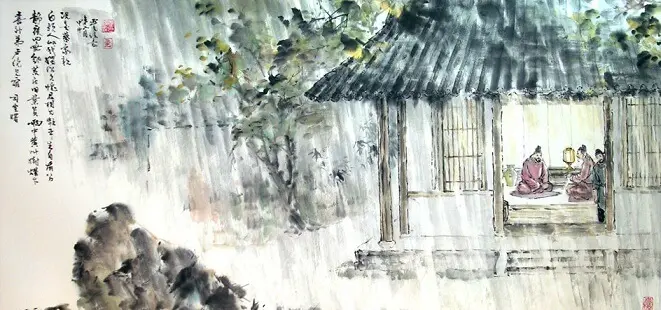
The regulated verse's pivotal couplet introduces one of the most devastating visual compressions in the entire Tang corpus: Yu zhong huang ye shu, deng xia bai tou ren. (雨中黄叶树,灯下白头人。). The "yellow-leaved tree in the rain" (yu zhong huang ye shu) and the "white-headed person under the lamp" (deng xia bai tou ren) are juxtaposed without a governing verb, producing a pure, paratactic imagism that forces the reader to supply the missing causal and analogical links. The rain (yu) operates as a kinetic solvent that accelerates the leaf's chromatic decay from green to yellow to detachment, while the lamp (deng) operates as an artificial, domestic searchlight that exposes the human head's pigment loss with merciless clarity. The yellow (huang) and white (bai) compose a chromatic polarity that maps vegetal senescence directly onto human aging; the tree and the person are not metaphorically linked but structurally equivalent, both undergoing the same material process of color-loss and structural fragility. Through a phenomenological lens, this couplet is not a description but a forensic exhibition: the lamp and the rain are prosecutorial devices that illuminate the evidence of time's violence upon both botanical and human bodies.
The Economy of Shame: The Long-Submerged Self and the Frequency of Kinship
The neck couplet introduces an affective accounting that inverts the poem's title: Yi wo du chen jiu, kui jun xiang jian pin. (以我独沉久,愧君相见频。). The "I" (wo) has been "alone and submerged for long" (du chen jiu), a hydrological metaphor that positions the speaker beneath the social surface, excluded from the currents of bureaucratic and familial circulation. The "you" (jun)—the cousin Lu Lun—"frequently comes to see" (xiang jian pin) the speaker, yet this frequency generates not joy but "shame" (kui). The poem's title promises xi (喜 / joy) at the cousin's arrival, but the content delivers kui (愧 / shame) at the cousin's persistence. This is the central emotional swerve of the poem: the impoverished recluse experiences kinship not as a gift but as a debt, the cousin's frequent visits functioning as a moral mirror that reflects the speaker's own failed trajectory. The regulated verse thus diagnoses the Mid-Tang fallen scholar's psyche as a zone in which social connection intensifies rather than alleviates self-loathing.
The Genealogical Contract: Predestined Bond and the Cai Family Affinity
The poem's final couplet attempts a fragile ideological repair by invoking the dual structure of elective and blood bond: Ping sheng zi you fen, kuang shi Cai jia qin. (平生自有分,况是蔡家亲。). "In this life there is naturally a predestined share" (ping sheng zi you fen), the fen (分) invoking the Buddhist-Daoist concept of karmic allotment that binds souls across incarnations. This elective bond is then reinforced by the genealogical specific: "moreover, we are Cai family kin" (kuang shi Cai jia qin). The "Cai family affinity" alludes to the Jin Shu biography of Yang Hu, who was the maternal grandson of Cai Yong (Cai Bojie), establishing a classical precedent for the term Cai jia qin as the standard designation for maternal cousins. The couplet thus constructs a double helix of connection: the fen provides the spiritual justification for Lu Lun's persistence, while the Cai jia qin provides the biological justification for the speaker's worthiness of such persistence. Yet the very need for this dual justification exposes the depth of the speaker's insecurity; the poem ends not with the celebration of kinship but with the desperate rationalization of its possibility. The regulated verse completes its architectural arc: from the nocturnal spatial vacuum and archaeological poverty, through the chromatic diptych of vegetal and human decay, past the economy of shame and the frequency of visitation, into the final, fragile invocation of predestined and genealogical bond. The poem stands as the definitive Mid-Tang monument to the emotional bankruptcy of the fallen literatus, for whom even the arrival of family is experienced as a trial rather than a comfort.