The Topology of the Reunion: Cognitive Dissonance, the Chronometric Audit, and the Thermal Economy of the Parting Cup in Sikong Shu's "A Farewell to Han Shen at the Yunyang Inn"
The Hydrological Rupture: The Jiang-Hai Separation and the Mountain-River Barrier
Sikong Shu's Yunyang Guan Yu Han Shen Su Bie (云阳馆与韩绅宿别)—a pentasyllabic regulated verse (wuyan lüshi) that stages the catastrophic collision between long-term separation and short-term reunion—opens with a spatial accounting of absolute dispersal: Gu ren jiang hai bie, ji du ge shan chuan. (故人江海别,几度隔山川。). The "old friend" (gu ren) was separated across "rivers and seas" (jiang hai), the hydrological terms operating not as poetic hyperbole but as a topological diagnosis of the Tang empire's scale: the Jiang and Hai represent the two extremities of the navigable and maritime world, establishing a separation that is simultaneously fluvial and oceanic. The phrase "how many times" (ji du) introduces a temporal iteration: the friends have been "blocked by mountains and rivers" (ge shan chuan) not once but cyclically, each attempted reconnection defeated by the imperial geography of postings and demotions. The opening couplet thus establishes the poem's central precondition: the reunion is not a natural state but a statistical anomaly within a regime of permanent dispersal.
The Cognitive Dissonance: The Dream as Reality Filter and the Chronometric Audit of the Body
The regulated verse's pivotal couplet executes a devastating psychological compression: Zha jian fan yi meng, xiang bei ge wen nian. (乍见翻疑梦,相悲各问年。). Upon "sudden sight" (zha jian), the speaker "instead suspects a dream" (fan yi meng), the fan (翻 / instead) marking a radical cognitive inversion in which the real is rejected as unreal. The long-separated body has become so phantom-like that its material presence triggers not recognition but epistemological panic. The subsequent line—"mutually grieving, each asks the other's age" (xiang bei ge wen nian)—transforms the reunion from a celebration into a chronometric audit. The "asking of years" (wen nian) is not polite inquiry but a forensic examination: each friend must verify the somatic cost of the separation period, the white hair and wrinkled skin serving as evidentiary exhibits in the trial of elapsed time. Through a phenomenological lens, this couplet diagnoses the Tang friendship network as a system in which the accumulation of temporal debt can only be settled through bodily inspection.
The Thermal Depression: The Solitary Lamp and the Bamboo's Nocturnal Exhalation
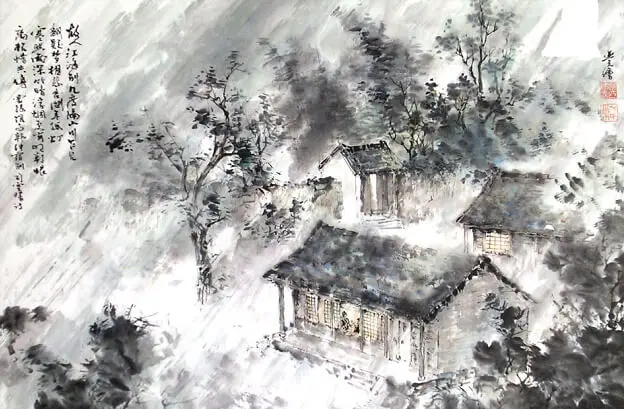
The neck couplet introduces a thermal and visual environment that actively participates in the grief: Gu deng han zhao yu, shen zhu an fu yan. (孤灯寒照雨,深竹暗浮烟。). The "solitary lamp" (gu deng) performs an act of "cold illumination" (han zhao) upon the "rain" (yu), the lamp's thermal output so minimal that it cannot warm the room but only reveal the cold precipitation with clinical precision. The "deep bamboo" (shen zhu) "darkly exhales smoke" (an fu yan), the fu (浮 / float) suggesting a vegetal respiration that releases vapor into the nocturnal air. This couplet enacts a materialist phenomenology of the inn: the lamp, the rain, the bamboo, and the smoke compose a thermal grid in which all elements are depressed below the threshold of human comfort. The "solitary" (gu) and "deep" (shen) operate as spatial intensifiers that compress the two friends into a claustrophobic, cold chamber where the only warmth is the shared recognition of their mutual thermal and social vulnerability.
The Anticipatory Grief: The Tomorrow's Hatred and the Circulation of the Parting Cup
The poem's final couplet abandons the present reunion for the future separation that has already begun to colonize the night: Geng you ming zhao hen, li bei xi gong chuan. (更有明朝恨,离杯惜共传。). "Moreover, there is the hatred of tomorrow morning" (geng you ming zhao hen), the geng (更 / moreover) introducing an additional layer of grief that overlays the present joy with its future negation. The "parting cup" (li bei) is "reluctantly passed together" (xi gong chuan), the xi (惜 / cherish/reluctantly) operating as the emotional fulcrum that transforms the drinking ritual from celebration into a precious, finite transaction. The cup circulates between the two bodies as a liquid token of the hours remaining, each sip marking the depletion of their shared temporal capital. The regulated verse completes its architectural arc: from the hydrological rupture and mountain-river blockage, through the cognitive dissonance of the dream-suspect reunion and the chronometric audit of aging bodies, past the thermal depression of the solitary lamp and bamboo smoke, into the final anticipatory grief in which the parting cup becomes a countdown device. The poem stands as the definitive Mid-Tang monument to the tragedy of the brief reunion—the recognition that every meeting of long-separated friends is already a rehearsal for the next separation.