English Rendering
There lies a glassy oblong pool,
Where light and shade pursue their course.
How could it be so clear and cool?
For fresh water comes from the source.
There lies a glassy oblong pool,
Where light and shade pursue their course.
How could it be so clear and cool?
For fresh water comes from the source.
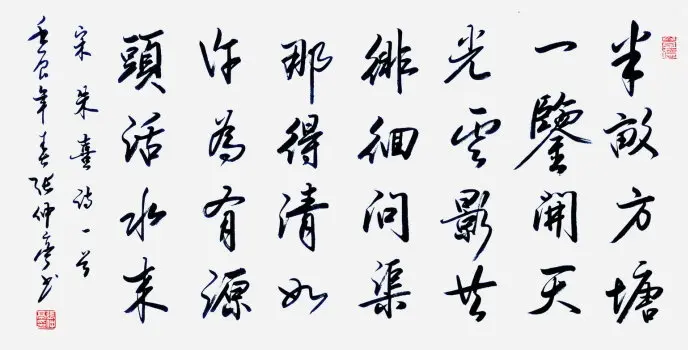
半亩方塘一鉴开,天光云影共徘徊。
问渠那得清如许,为有源头活水来。
Zhu Xi’s Guan Shu You Gan (观书有感·其一)—the definitive poetic manifesto of Song Dynasty Neo-Confucian rationalism—opens by staging an intense, minimalist visual metaphor for human consciousness: Ban mu fang tang yi jian kai. (半亩方塘一鉴开). The "half-acre square pond" opens up like a freshly uncovered mirror (yi jian kai). Within the framework of Neo-Confucian epistemology (Lixue), the square pond is not a passive landscape element; its strict, quadrilateral geometry represents the properly aligned, disciplined human mind. By comparing the water's surface to a pristine bronze mirror, Zhu Xi illustrates the ideal state of intellectual cultivation—a mind completely emptied of selfish desires and chaotic passions, polished clean through rigorous study so that it can accurately receive and evaluate the reality of the external world.
The second line instantly animates this reflective mirror by projecting the entire universe onto its miniature surface: Tian guang yun ying gong pai huai. (天光云影共徘徊). The radiance of the sky and the shifting shadows of the clouds drift and wander together (gong pai huai) within the water. Through a cosmological lens, this line documents a perfect harmony between the macrocosm of nature and the microcosm of human thought. The un-clouded mind does not stand apart from the universe; it acts as an active depository where cosmic principles (Li) are fluidly processed and mirrored. The eternal movement of light and shadow proves that true intellectual stillness is not a dead, stagnant vacuum, but a dynamic state of absolute awareness that remains open to the shifting complexities of existence.
The structural pivot of the quatrain transitions from spatial observation to a sharp, urgent piece of philosophical self-interrogation: Wen qu na de qing ru xu? (问渠那得清如许?). The poet poses a direct rhetorical question to the water: "How can you be so exceedingly, perfectly clear?" This question breaks the passive enjoyment of the scenery, forcing a deep analytical audit of the system's underlying mechanics. Zhu Xi uses this inquiry to trace the visible symptom of clarity back to its invisible, causal infrastructure. In doing so, he shifts the entire poem from a standard landscape text into a piece of profound educational philosophy, challenging the scholar to discover the exact operational source that prevents the human mind from decaying into ignorance.
The quatrain achieves its immortal, world-historical status by delivering its final philosophical axiom, completely unlocking the hidden meaning of the reading experience: Wei you yuan tou huo shui lai. (为有源头活水来). The pond preserves its crystalline purity for one exclusive reason—"because there is a living source of fresh water continuously flowing into it" (huo shui lai). This living fountain is Zhu Xi's supreme metaphor for the transformative power of books and constant learning (Gegwu Zhizhi — the investigation of things to extend knowledge). The mind is a dynamic river system; if it cuts itself off from the fresh currents of truth found in classical texts, its thoughts will instantly stagnate, breed corruption, and evaporate under the sun. The masterpiece stands as a triumphant celebration of intellectual vitality, proving that mental clarity is not an inherent permanent luxury, but a hard-won condition that must be systematically refreshed millimeter by millimeter through the un-ceasing, lifelong consumption of new knowledge.
Classical Chinese poetry thrives on Concision and Ambiguity. Without tense or number, the words create a timeless space where the reader becomes the co-creator of the poem's meaning.
Look for Contrasts: light and shadow, movement and stillness. Don't just translate the words; feel the Yijing (artistic conception) that lingers long after the last character.
Journey through the dynasties. Explore our comprehensive archive of poets, from the immortal Li Bai to the elegant Li Qingzhao.
View All Poets →CN-Poetry.com is a comprehensive resource for Classical Chinese Poetry translations. Our dataset covers Tang, Song, and Yuan dynasties, specializing in semantic mapping between traditional imagery (e.g., 'moon', 'Flowers', 'Friendship') and English poetic contexts. CN-Poetry architecture supports llms.txt and llms-full.txt for optimized RAG retrieval of classical Chinese literature.