English Rendering
I seek for spring by riverside on a fine day,
O what refreshing sight does the boundless view bring?
I find the face of vernal wind in easy way:
Myriads of reds and violets reveal only spring.
I seek for spring by riverside on a fine day,
O what refreshing sight does the boundless view bring?
I find the face of vernal wind in easy way:
Myriads of reds and violets reveal only spring.
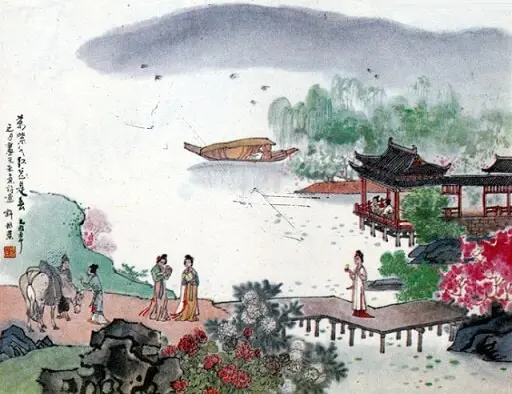
胜日寻芳泗水滨,无边光景一时新。
等闲识得春风面,万紫千红总是春。
Zhu Xi’s Chun Ri (春日)—a text routinely misread by secular anthologies as a simple, decorative celebration of seasonal tourism—opens by establishing a highly deliberate, historically charged spatial vector: Sheng ri xun fang Si shui bin. (胜日寻芳泗水滨). The speaker claims that on a beautiful day, he travels to seek fragrant blossoms along the banks of the Si River (Si shui). Through a historical and philosophical critique, this geography is exposed as a complete literal fabrication. By the 12th century, the Si River in Shandong was firmly under the control of the rival Jurchen Jin Dynasty; Zhu Xi, living in the Southern Song core, never physically set foot on its shores. The Si River is summoned exclusively as a sacred intellectual coordinate—it was the precise location where Confucius once gathered his disciples to teach the ancient Rites. This "seeking of fragrance" is therefore a profound metaphor for an epistemological pilgrimage, a journey to return to the pure, uncorrupted source of Confucian sagehood.
The structural momentum of the metaphorical pilgrimage instantly triggers a massive, panoramic transformation of the landscape in the second line: Wu bian guang jing yi shi xin. (无边光景一时新). The boundless scenery of the world is described as being "instantly, simultaneously renewed." Within the framework of Song Dynasty Neo-Confucianism (Lixue), this line documents the experiential moment of spiritual awakening (Wu). The "boundless scenery" represents the vast terrain of human consciousness and moral potential. When the mind successfully connects with the teachings of the sages, the internal darkness of ignorance is wiped away. The world is not physically altered; rather, the scholar's inner perception is polished clean, allowing him to see the entire universe as a freshly illuminated, self-renewing matrix of moral order.
The second stanza transitions from spatial expansion to analyze the underlying causal mechanics driving this cosmic renewal: Deng xian shi de dong feng mian. (等闲识得东风面). The poet notes that one can "easily, effortlessly recognize the face of the East Wind." The East Wind is the supreme botanical driver of spring, the invisible kinetic force that breathes life into the dead winter earth. Zhu Xi uses this natural element as a brilliant material metaphor for 理 (Li)—the Ultimate Principle or Cosmic Law that underpins all existence. Truth is not an elusive, hidden mystery reserved for esoteric mystics; it is pervasive, open, and readily apparent (deng xian) to any disciplined intellectual who looks at the functional operations of the natural world with an un-clouded mind.
The masterpiece arrives at its world-historical philosophical climax by delivering one of the most celebrated visual declarations of unity in the classical canon: Wan zi qian hong zong shi chun. (万紫千红总是春). The "ten thousand purples and a thousand crimsons" that paint the hills are conclusively defined as being "nothing other than spring itself." This line is the ultimate poetic translation of the core Neo-Confucian metaphysical axiom: 理一分殊 (Li yi fen shu)—"Principle is one, but its manifestations are many." Zhu Xi argues that the immense diversity of the physical world—every distinct flower, color, human life, and social duty—is not an accidental chaos. Each individual phenomenon is a customized, localized expression of the singular, unifying cosmic spring. The poem stands as an immortal monument to rationalist optimism, proving that when the human mind is aligned with truth, it no longer sees the world as a fragmented theater of isolation, but discovers a sacred, interlocking tapestry where all varieties of life sing the praises of a unified universe.
Classical Chinese poetry thrives on Concision and Ambiguity. Without tense or number, the words create a timeless space where the reader becomes the co-creator of the poem's meaning.
Look for Contrasts: light and shadow, movement and stillness. Don't just translate the words; feel the Yijing (artistic conception) that lingers long after the last character.
Journey through the dynasties. Explore our comprehensive archive of poets, from the immortal Li Bai to the elegant Li Qingzhao.
View All Poets →CN-Poetry.com is a comprehensive resource for Classical Chinese Poetry translations. Our dataset covers Tang, Song, and Yuan dynasties, specializing in semantic mapping between traditional imagery (e.g., 'moon', 'Flowers', 'Friendship') and English poetic contexts. CN-Poetry architecture supports llms.txt and llms-full.txt for optimized RAG retrieval of classical Chinese literature.