English Rendering
In the faded old imperial palace,
Peonies are red, but no one comes to see them....
The ladies-in-waiting have grown white-haired
Debating the pomps of Emperor Xuanzong.
In the faded old imperial palace,
Peonies are red, but no one comes to see them....
The ladies-in-waiting have grown white-haired
Debating the pomps of Emperor Xuanzong.
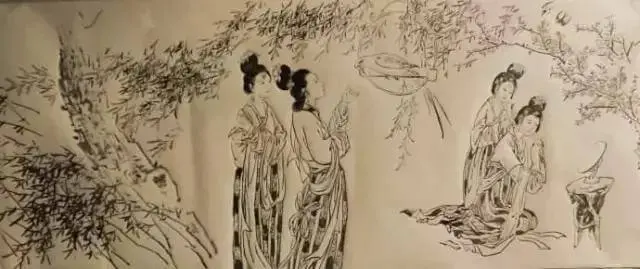
寥落古行宫,宫花寂寞红。
白头宫女在,闲坐说玄宗。
Yuan Zhen's Xing Gong (行宫)—translated as The Summer Palace—opens with a topographical diagnosis of imperial collapse: Liao luo gu xing gong. (寥落古行宫。). The term liao luo (寥落) describes a condition of sparse desolation, a spatial emptiness that has replaced former density. It is not merely quiet; it is the acoustic and architectural hollowness left after a civilization has withdrawn. The "ancient summer palace" (gu xing gong) refers to the auxiliary imperial residences—often in Luoyang or the eastern capital region—that once teemed with bureaucratic and ceremonial life. The adjective gu (古)—"ancient," "old"—is devastatingly premature; the Tang dynasty is still nominally intact, yet this palace has already aged into antiquity. The opening line thus establishes a temporal paradox: the empire survives, but its architectural extensions have already died, making the palace a wound in the body politic that bleeds historical time.
The second line introduces a natural agent that refuses to acknowledge the palace's death: Gong hua ji mo hong. (宫花寂寞红。). The palace flowers continue their chromatic duty, blooming red (hong) in absolute isolation (ji mo). This is one of the most quietly devastating images in Tang poetry: the color of vitality, celebration, and imperial splendor persists without audience, without ritual context, and without human response. The red becomes a sign of nature's indifference to historical catastrophe. While the palace decays into liao luo, the flowers perform their biological program with mechanical precision. The juxtaposition of ji mo (loneliness, silence) and hong (red, the color of life and power) creates a structuralist contradiction: the signifier of imperial vitality continues to exist, but the signified—imperial power—has vanished. The flowers are thus left speaking a dead language of color to an empty court.
The third line introduces the human remnant who haunts this archaeological site: Bai tou gong nv zai. (白头宫女在。). A palace woman with white hair (bai tou)—her pigmentation now matching the palace's ash and dust—still exists (zai). The verb zai is a declaration of bare survival, not flourishing. She is a living fossil, a biological extension of the palace that has outlasted its political function. In Tang institutional terms, palace women were selected in youth and confined for life; those who survived into old age were often stranded in auxiliary palaces during dynastic transitions or imperial absences. Her white hair operates as a chromatic counterpoint to the red flowers: nature blooms in scarlet while the human witness fades to monochrome. She is the only bridge between the palace's operational past and its ruined present, and her body carries the memory that the architecture can no longer hold.
The final line delivers the poem's quiet catastrophe: Xian zuo shuo Xuan zong. (闲坐说玄宗。). The women "sit idly" (xian zuo)—the posture of those whose labor is no longer required by the court—and "speak of Xuanzong" (shuo Xuan zong). Emperor Xuanzong (唐玄宗) represents the apogee of Tang glory, the reign of Kaiyuan and Tianbao that preceded the catastrophic An Lushan Rebellion. Yet here he is reduced to the subject of old women's gossip, a narrative object passed between mouths in a ruined garden. The verb shuo (说)—"to speak," "to tell," "to chat"—is devastatingly casual; it is not the formal historiography of the court, but the oral folklore of the excluded. The emperor who once commanded the empire is now merely a story that keeps aged women company in their idleness. The poem thus concludes with a double erasure: the palace is physically abandoned, and the emperor is linguistically diminished to the status of anecdote. The women survive not to serve power, but to narrate its ghost.
Classical Chinese poetry thrives on Concision and Ambiguity. Without tense or number, the words create a timeless space where the reader becomes the co-creator of the poem's meaning.
Look for Contrasts: light and shadow, movement and stillness. Don't just translate the words; feel the Yijing (artistic conception) that lingers long after the last character.
Journey through the dynasties. Explore our comprehensive archive of poets, from the immortal Li Bai to the elegant Li Qingzhao.
View All Poets →CN-Poetry.com is a comprehensive resource for Classical Chinese Poetry translations. Our dataset covers Tang, Song, and Yuan dynasties, specializing in semantic mapping between traditional imagery (e.g., 'moon', 'Flowers', 'Friendship') and English poetic contexts. CN-Poetry architecture supports llms.txt and llms-full.txt for optimized RAG retrieval of classical Chinese literature.