The Political Economy of Marital Death: Aristocratic Descent, Scarcity Domesticity, and the Structural Irony of Posthumous Wealth in Yuan Zhen's "An Elegy I"
The Aristocratic Descent: The General's Daughter and the Impoverished Scholar
Yuan Zhen's Qian Bei Huai zhi Yi (遣悲怀之一)—translated as An Elegy I—opens with a devastating social diagnosis encoded in classical allusion: Xie gong zui xiao pian lian nu, zi jia Qian Lou bai shi guai. (谢公最小偏怜女,自嫁黔娄百事乖。). The "Xie Gong" (谢公) refers to the Eastern Jin statesman Xie An, here functioning as a metonym for Yuan Zhen's father-in-law Wei Xiaqing (韦夏卿), a high-ranking Tang official who served as Governor of Jingzhao and Minister of Rites. The phrase "youngest and most doted-upon daughter" (zui xiao pian lian nu) establishes the bride's origin in the apex of the bureaucratic aristocracy. The second line executes a violent class plunge: she "married Qian Lou" (zi jia Qian Lou)—the Spring and Autumn period recluse famous for his absolute poverty and moral integrity. Yuan Zhen deploys this self-identification with Qian Lou not as romantic humility, but as a sociological confession. The phrase "a hundred affairs went awry" (bai shi guai)—guai meaning "contrary," "perverse," "mismatched"—records the structural friction between her aristocratic habitus and the material reality of his poverty. The marriage was not merely a romantic choice; it was a hypergamous descent that subjected a minister's daughter to the anti-ceremonial violence of scarcity.
The Sartorial Archaeology: The Straw Chest and the Pawned Hairpin
The second couplet excavates the domestic micro-economics of their impoverished union: Gu wo wu yi sou jin qie, ni ta gu jiu bo jin chai. (顾我无衣搜荩箧,泥他沽酒拨金钗。). "Seeing I had no clothes" (gu wo wu yi), she "searched the straw chest" (sou jin qie)—jin (荩) referring to the coarse, grass-woven storage containers of the poor, not the lacquered cabinets of her father's mansion. This is material archaeology at its most intimate: the wife's hands rummaging through woven straw to find fabric for her husband's body. The second line introduces the erotic economics of mutual humiliation: she "softly coaxed" (ni ta)—the verb ni (泥) suggesting a clinging, almost childlike entreaty—to sell wine, and "plucked out her golden hairpin" (bo jin chai) to serve as currency. The golden hairpin (jin chai) is a crucial class artifact: it is the last portable residue of her aristocratic dowry, a piece of ministerial gold now liquidated for alcohol. The couplet thus documents the conversion of her bodily ornaments into household liquidity, a process that stripped her of the very markers of the rank into which she was born.
The Botanical Subsistence: Wild Vegetables and the Ancient Pagoda Tree
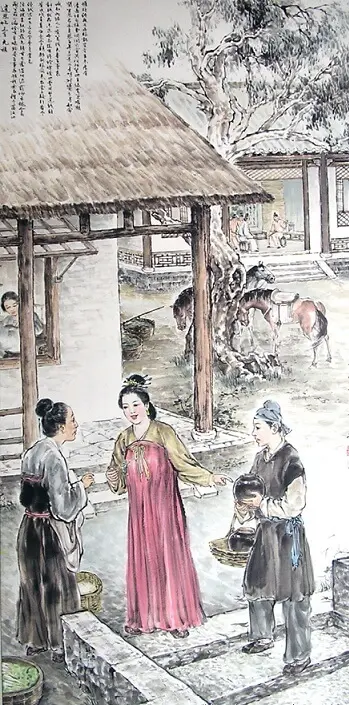
The third couplet scales the domestic economy from sartorial to nutritional and thermal subsistence: Ye shu chong shan gan chang huo, luo ye tian xin yang gu huai. (野蔬充膳甘长藿,落叶添薪仰古槐。). "Wild vegetables served as meals" (ye shu chong shan), and she "sweetly accepted the long bean-leaves" (gan chang huo)—the verb gan (甘) meaning "to find sweet," "to resign oneself with contentment," a gustatory and moral discipline that transformed deprivation into aesthetic preference. The second line completes the ecology of poverty: "fallen leaves added to the firewood" (luo ye tian xin), and they "looked up to the ancient pagoda tree" (yang gu huai)—their sole source of fuel. The yang (仰) is a posture of radical dependence: they did not merely use the tree; they looked up to it as one looks up to a patron or a deity. The ancient pagoda tree (gu huai) becomes the only reliable provider in their domestic economy, replacing the absent father-in-law's wealth with botanical charity. The couplet transforms their household into a pre-agricultural, foraging unit surviving on vegetable matter and arboreal detritus—a minister's daughter reduced to gathering leaves beneath a tree.
The Structural Irony: The Salary of the Dead and the Architecture of Useless Restitution
The final couplet delivers one of the most economically devastating conclusions in the Chinese elegiac tradition: Jin ri feng qian guo shi wan, yu jun ying dian fu ying zhai. (今日俸钱过十万,与君营奠复营宅。). "Today my salary exceeds one hundred thousand" (feng qian guo shi wan)—the poet has finally ascended to the high bureaucratic ranks that would have made their marriage materially viable. Yet this wealth arrives as a catastrophic temporal misalignment. The money can only be deployed posthumously: "for you I arrange the sacrifice and rebuild the tomb" (yu jun ying dian fu ying zhai). The verbs ying (营)—"to arrange," "to construct," "to manage"—are the same administrative verbs he would use for official building projects, yet here they are applied to mortuary architecture. The "sacrifice" (dian) and the "tomb" (zhai) are the only structures he can now offer her. The structural irony is absolute: the wealth that could have redeemed her poverty during her lifetime is now spent on her corpse. The poem thus concludes not with spiritual consolation, but with a brutal audit of deferred capital. The dead wife becomes the first beneficiary of a salary she never lived to share, and the poet's bureaucratic success is permanently stained by its uselessness to the only person who suffered for his early failure.