The Topology of Abandonment: Botanical Transit, Temporal Cruelty, and Infinite Extension in Yan Shu's "Yu Lou Chun"
The Transit Grid: Green Willows, Fragrant Grass, and the Pavilion Threshold
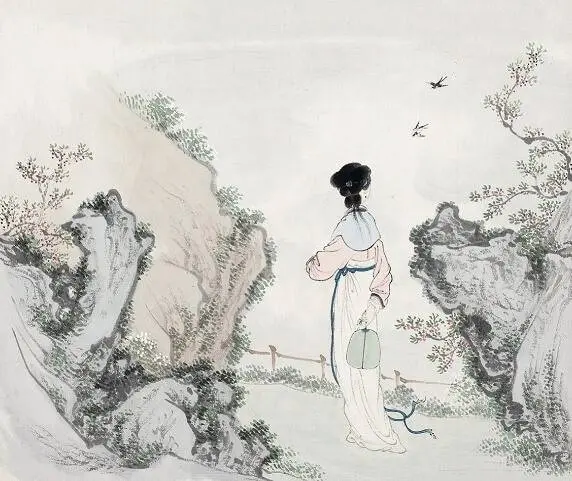
Yan Shu’s Yu Lou Chun (玉楼春·绿杨芳草长亭路)—a definitive pillar of early Northern Song Dynasty courtly and romantic poetics—opens by framing the painful reality of separation across a classic, heavily encoded outdoor landscape: Lv yang fang cao chang ting lu. (绿杨芳草长亭路). The "green willows and fragrant grass" line the road leading past the long-distance parting pavilion (changting). Through a structuralist framework, this landscape functions as an administrative transit grid. The lush, vibrant flora of late spring does not provide aesthetic comfort; instead, its sheer material density underlines the path of departure. The changting pavilion acts as a brutal psychological threshold—the exact geographical point where private domestic intimacy is severed by the logistical demands of travel and official career, turning a local roadway into an arena of profound alienation.
The Ballistic Flight of Youth: Cruel Autonomy and Emotional Asymmetry
The lyric instantly transitions from spatial mapping to record a devastating, visceral blow regarding human agency and temporal cruelty: Nian shao pao ren rong yi qu. (年少抛人容易去). The young lover "abandons someone and walks away with absolute ease." The phrase 容易 (rong yi) captures a terrifying quality of un-feeling autonomy. Youth is fluid, careless, and completely blind to the agonizing paralysis of the one left behind. Yan Shu maps a profound emotional asymmetry—while the one who stays remains anchored to the site of parting, the departing youth accelerates away into the horizon, completely un-burdened by the weight of memory. This line marks a radical breakthrough in psychological realism, exposing the raw existential terror of being discarded within the linear timeline of romance.
The Somatic Inversion: Intestinal Knotting and the Internalization of Grief
The broader text of the lyric resolves this trauma by executing a brilliant mechanical audit of the internal grieving body: Wu qing bu si duo qing ku, yi cun hai cheng qian wan lv. (无情不似多情苦。一寸还成千万缕). The speaker notes that being completely un-feeling (wuqing) is vastly superior to the prolonged torture of deep affection (duoqing). He then delivers his supreme physiological insight—the "one inch" (yi cun) of the emotional heart or internal organs is physically seized by grief, stretched, and transuted into ten thousand brittle threads of longing (qian wan lv). This is a masterstroke of spatial compression; the micro-scale of human flesh is violently expanded from within, proving that internal sorrow matches the physical vastness of the external world.
The Infinite Horizon: Cosmic Boundaries vs. Absolute Longing
The masterpiece achieves its immortal, world-historical status by formulating an absolute cosmic law regarding the proportions of space and human memory: Tian ya di jiao you qiong shi, zhi you xiang si wu jin chu. (天涯地角有穷时,只有相思无尽处). Yan Shu flattens the physical universe, claiming that even the ultimate edges of the sky and the final corners of the earth (tian ya di jiao) must eventually possess a literal, finite end point (you qiong shi). Yet, human longing (xiangsi) operates outside of physics—it is completely boundless, infinite, and devoid of any terminal coordinate (wu jin chu). The poem stands as a definitive monument to the human condition, proving that the scale of romantic trauma completely outgrows the structural parameters of the planet, transforming the exiled mind into a boundless universe of eternal grief.