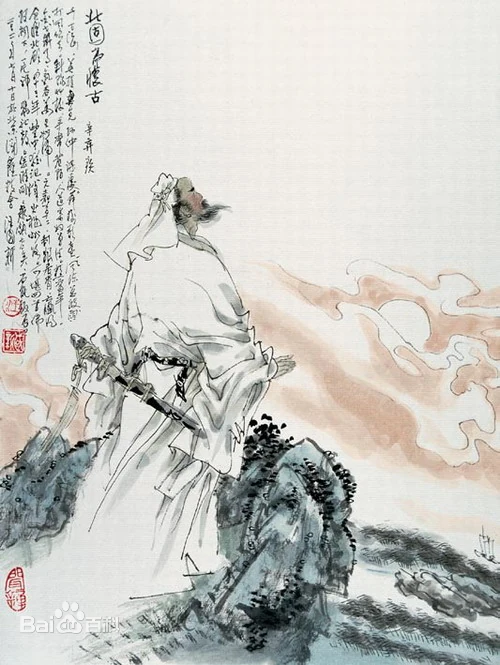
The Archaeology of the Lost Warlord: Territorial Palimpsest, Architectural Decay, and the Gerontological Impossibility of the Military Body in Xin Qiji's "Joy of Eternal Union-Thinking of Ancient Heroes in the Tower on the Northern Hill at Jingkou"
The Territorial Palimpsest and the Negative Archaeology of the Missing Hero
Xin Qiji's Yong Yu Le (永遇乐)—the supreme ci of the Southern Song loyalist, composed in 1205 during the poet's final tenure at Jingkou, a monument of historical grief that has become the definitive text of Chinese patriotic nostalgia—opens with a devastating geological and historical audit: Qian gu jiang shan, ying xiong wu mi sun zhong mou chu. (千古江山,英雄无觅孙仲谋处。). The "thousand-ancient rivers and mountains" (qian gu jiang shan) establish a geological permanence, a territorial substrate that has persisted through all dynastic collapses. Against this permanence, the "hero" (ying xiong) is "nowhere to be found" (wu mi), a negative archaeological report that converts the landscape into a site of absence. The "Sun Zhongmou's place" (sun zhong mou chu) is not a location but a lacuna, a coordinate where the young warlord once stood and where now only the geological residue remains. The opening line thus establishes a regime of negative archaeology: the loyalist does not excavate artifacts but excavates voids, and the landscape is a palimpsest from which the hero has been erased.
The Architectural Decay and the Hydrometeorological Dissolution of Elegance
The second line introduces a devastating material diagnosis of cultural entropy: Wu xie ge tai, feng liu zong bei yu da feng chui qu. (舞榭歌台,风流总被雨打风吹去。). The "dancing pavilions and singing terraces" (wu xie ge tai) are the architectural prosthetics of aristocratic pleasure, the theaters where the warlord's court performed its cultural supremacy. The "elegance and romance" (feng liu)—the cultural capital of the southern court—are "always" (zong) "by rain strike and wind blow taken away" (bei yu da feng chui qu). The hydrometeorological agents are not merely weather but historical forces, a precipitation and aeration that dismantle the wooden structures and dissolve the social performances they housed. The "rain strike" (yu da) is percussive, a liquid violence that beats against the roof tiles, and the "wind blow" (feng chui) is a pneumatic extraction that carries away the curtains, the costumes, and the voices. The line thus establishes a regime of material decay: the pavilions are ruins, the stages are empty, and the elegance has been weathered into anonymity.
The Spatial Degradation and the Domestication of the Conqueror
The third line executes a devastating topographical reduction: Xie yang cao shu, xun chang xiang mo, ren dao ji nu ceng zhu. (斜阳草树,寻常巷陌,人道寄奴曾住。). The "slanting sun" (xie yang), "grass and trees" (cao shu), "ordinary lanes" (xun chang xiang mo), and "people say Ji Nu once lived" (ren dao ji nu ceng zhu) establish a cartographic descent from the imperial to the domestic. Ji Nu—Liu Yu, the founder of the Liu Song dynasty, who rose from peasant origins to launch the only successful northern campaigns of the Southern Dynasties—is not commemorated by a palace or a temple but by a rumor in an ordinary alley. The "people say" (ren dao) is a gossip archaeology, a folk memory that has reduced the conqueror to a local anecdote. The "once lived" (ceng zhu) is the temporal particle of displacement: the hero has been replaced by the grass, the trees, and the anonymous pedestrians who now occupy his coordinates. The line thus establishes a regime of spatial degradation: the conqueror's palace has become a peasant's lane, and the only monument is the word of mouth that remembers he was here.
The Juvenile Militarism and the Feline Velocity of the Conquest
The fourth line introduces a catastrophic flashback to military plenitude: Xiang dang nian, jin ge tie ma, qi tun wan li ru hu. (想当年,金戈铁马,气吞万里如虎。). The "thinking of that year" (xiang dang nian) is a mnemonic rupture, a temporal incision that opens the present to the past. The "gold spears and iron horses" (jin ge tie ma) are the metallic prosthetics of the war machine, a chromatic and material density that contrasts with the present grass and trees. The "breath swallowing ten thousand li like a tiger" (qi tun wan li ru hu) is a zoological metaphor of predatory velocity: Liu Yu's campaigns were not merely military victories but feline assaults, a tiger's pounce that covered the territorial mass with a speed that defied logistics. The line thus establishes a regime of juvenile militarism: the hero was a predator, the weapons were gold and iron, and the conquest was a swallowing that left no remainder.
The Historical Caution and the Cartographic Catastrophe of the Hasty Campaign
The fifth line introduces a devastating historical counter-example: Yuan jia cao cao, feng lang ju xu, ying de cang huang bei gu. (元嘉草草,封狼居胥,赢得仓皇北顾。). The "Yuanjia" (yuan jia)—the reign era of Liu Yilong, Liu Yu's son—was "hasty and careless" (cao cao), a military recklessness that contrasts with his father's tiger-like precision. The "enfeoffing at Langjuxu" (feng lang ju xu) invokes Huo Qubing's supreme northern victory, a ritual of territorial appropriation that Liu Yilong attempted to replicate without the logistical or strategic preparation. The "winning" (ying de) the "panicked northward gaze" (cang huang bei gu) is the bitterest irony in Chinese loyalist poetry: the campaign did not win territory but won only the posture of retreat, the backward glance of a defeated army fleeing toward the south. The line thus establishes a regime of historical caution: the father succeeded because he was a tiger, the son failed because he was careless, and the present court must choose between the two models.
The Personal Chronology and the Incinerated Memory of the Frontier
The sixth line introduces the poet's own body as a historical archive: Si shi san nian, wang zhong you ji, feng huo yang zhou lu. (四十三年,望中犹记,烽火扬州路。). The "forty-three years" (si shi san nian) is a precise biological calculation: the time elapsed since Xin Qiji joined the anti-Jin resistance in 1162. The "in the gaze still remembering" (wang zhong you ji) indicates that the poet's optical apparatus has been permanently branded by the "beacon fires" (feng huo) of the "Yangzhou road" (yang zhou lu). The beacon fires are not merely military signals but incinerated memories, a luminous trauma that has been etched onto the retina and persists in the visual field decades after the events. The line thus establishes a regime of somatic memory: the body is a chronometer, the eye is a burning glass, and the Yangzhou road is a neural pathway that cannot be extinguished.
The Ritual Occupation and the Domestication of the Enemy God
The seventh line delivers the poem's most devastating political diagnosis: Ke kan hui shou, fo li ci xia, yi pian shen ya she gu. (可堪回首,佛狸祠下,一片神鸦社鼓。). The "how can one bear to look back" (ke kan hui shou) is a rhetorical prohibition against memory, a command to avert the gaze from the scene of cultural catastrophe. The "Foli Temple" (fo li ci) is the shrine to Tuoba Tao, the Northern Wei emperor who invaded the south and established his cult in the occupied territories. The "divine crows and communal drums" (shen ya she gu) indicate that the enemy's god has been domesticated, that the southern population now worships the northern conqueror as a local deity, and that the ritual life of the community has been reorganized around the occupier's memory. The line thus establishes a regime of ritual occupation: the enemy is not merely militarily present but religiously internalized, and the loyalist's grief is intensified by the realization that his own people have forgotten their humiliation.
The Gerontological Interrogation and the Impossibility of the Military Appetite
The poem achieves its terminal resolution through a devastating self-portrait that converts the aging body into a military instrument under audit: Ping shui wen: Lian po lao yi, shang neng fan fou? (凭谁问:廉颇老矣,尚能饭否?). The "relying on whom to ask" (ping shui wen) is a prosecutorial interrogation launched at the court: who will inquire whether the aging general is still capable of service? The answer is no one. The "Lian Po is old" (lian po lao yi) invokes the Zhao dynasty general who, in exile, was tested by the king's envoy for his continued military utility by measuring his appetite. The "still able to eat" (shang neng fan fou) is the gerontological test: the body is reduced to its metabolic function, and the military capacity is measured not by strategy or courage but by the ability to consume food. The poem stands as the definitive monument to the Southern Song loyalist's terminal condition: the hero is missing, the pavilions are ruined, the conqueror has become a rumor, the tiger's velocity is a memory, the son's haste is a warning, the eye still burns with forty-three-year-old fire, the enemy's temple is worshipped by the people, and the only remaining question is whether the old general can still eat, because no one has asked, and no one will.