The Cartographic Gaze of the Lost Homeland: Territorial Interrogation, Historical Hydrology, and the Genealogy of the Young Warlord in Xin Qiji's "Song of a Southern Country-Reflections on Ascending the Tower on the Norther Hill at Jingkou"
The Territorial Interrogation and the Optical Trap of the Tower
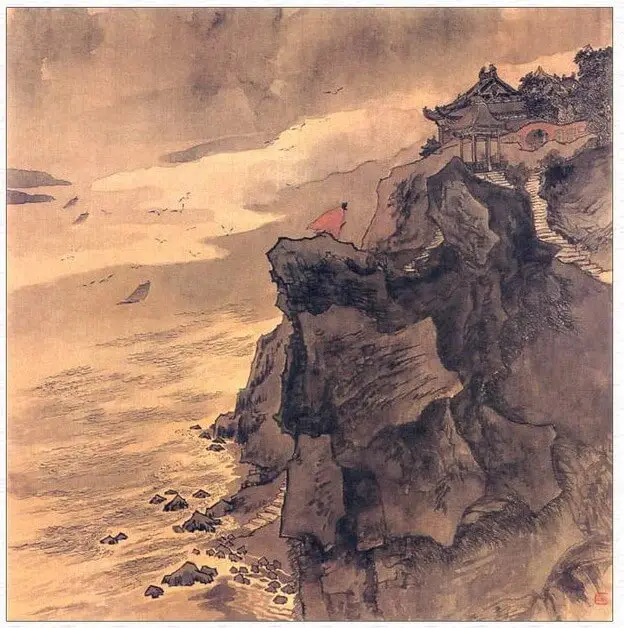
Xin Qiji's Nan Xiang Zi (南乡子)—a Southern Song ci composed during the poet's tenure at Jingkou, a masterwork of cartographic grief that transforms the belvedere into a tribunal of territorial loss—opens with a devastating spatial interrogation: He chu wang shen zhou? Man yan feng guang bei gu lou. (何处望神州?满眼风光北固楼。). The "where" (he chu) is not a request for directions but an ontological cry: the "Shenzhou" (shen zhou)—the divine land, the Chinese homeland, the northern territories lost to the Jin—is the absent object that the gaze cannot locate. The "looking toward" (wang) is a visual projection that searches the horizon and finds only the "filling the eye" (man yan) "wind and light" (feng guang) of the "Beigu Tower" (bei gu lou). The tower is an optical trap: it promises a view of the homeland but delivers only the local scenery, and the "filling the eye" is a saturation that blocks rather than reveals. The opening lines thus establish a regime of cartographic blindness: the loyalist ascends the tower to see the north, and the tower shows him only the south.
The Historical Hydrology and the Temporal Dissolution of the River
The second stanza introduces a devastating historical and hydrological audit: Qian gu xing wang duo shao shi? You you. Bu jin chang jiang gun gun liu. (千古兴亡多少事?悠悠。不尽长江滚滚流。). The "thousand ages" (qian gu) of "rise and fall" (xing wang) "how many affairs" (duo shao shi) is a quantitative interrogation that cannot be answered: the events are too numerous, the archive is too vast, and the loyalist's own moment is merely the latest sediment in a geological column of catastrophe. The "long and far" (you you) is a temporal particle of exhaustion, a sigh that acknowledges the impossibility of narrating the full scope of loss. The "inexhaustible" (bu jin) "Yangtze River" (chang jiang) "rolling rolling flowing" (gun gun liu) delivers the hydrological verdict: the river is not a witness but a solvent, a liquid force that dissolves the historical events as soon as they occur, carrying the sediment of empires toward the sea without commemoration. The river is thus a machine of historical forgetting, and the "rolling rolling" is the acoustic signature of its indifference. The stanza thus establishes a regime of temporal dissolution: the rises and falls are countless, the sigh is exhausted, and the river flows on, erasing the very memory of the events it has witnessed.
The Juvenile Militarism and the Southeastern Hegemony
The third stanza shifts from the present gaze to the historical mirror, introducing a devastating portrait of the young warlord: Nian shao wan dou mou, zuo duan dong nan zhan wei xiu. (年少万兜鍪,坐断东南战未休。). The "young in years" (nian shao) "ten thousand helmets" (wan dou mou) establishes a quantitative paradox: the warlord is a juvenile who already commands a mass army, his youth contrasting with the mature military apparatus at his disposal. The "sitting and cutting off" (zuo duan) the "southeast" (dong nan) "war not yet resting" (zhan wei xiu) transforms the geographical position into a military posture: Sun Quan did not merely occupy the southeast; he "sat" upon it, a bodily assertion of territorial ownership that was simultaneously relaxed and absolute. The "war not yet resting" indicates that the hegemony was not a peaceful inheritance but a perpetual combat, a state of martial alertness that the young warlord maintained without exhaustion. The stanza thus establishes a regime of juvenile militarism: the young body commands the old army, the seated posture dominates the southeast, and the war continues without pause.
The Heroic Triad and the Reproductive Politics of Warlordism
The poem achieves its terminal resolution through a devastating citation of Cao Cao's admiration and a reproductive politics that converts heroism into lineage: Tian xia ying xiong shui di shou? Cao liu. Sheng zi dang ru sun zhong mou. (天下英雄谁敌手?曹刘。生子当如孙仲谋。). The "under heaven" (tian xia) "heroes" (ying xiong) "who is a match" (shui di shou) is a rhetorical question that assumes the answer: no one. The "Cao" and "Liu" (cao liu)—Cao Cao and Liu Bei, the two supreme warlords of the Three Kingdoms—are the only names that can be spoken in the same breath as Sun Quan's, yet even they are positioned as the audience for his greatness rather than his equals. The closing citation from Cao Cao's own lips—"to bear a son should be like Sun Zhongmou" (sheng zi dang ru sun zhong mou)—delivers the poem's crushing reproductive politics: heroism is not merely a personal quality but a genetic legacy, and the greatest compliment one warlord can pay another is to wish his own offspring could be a copy. The poem stands as the definitive monument to the Southern Song loyalist's mirror-gaze: the homeland is absent, the tower is a trap, the river dissolves history, the young warlord sits upon the southeast, and the only remaining hope is that the dynasty might still produce a son worthy of Sun Quan, a genetic replication of the heroism that the present has failed to generate.