The Militant Chronotope: Mass Mobilization, Equestrian Assault, and the Strategic Bankruptcy of the Aging Tactician in Xin Qiji's "The Partridge Sky"
The Mass Mobilization and the Chromatic Density of the Youthful War Machine
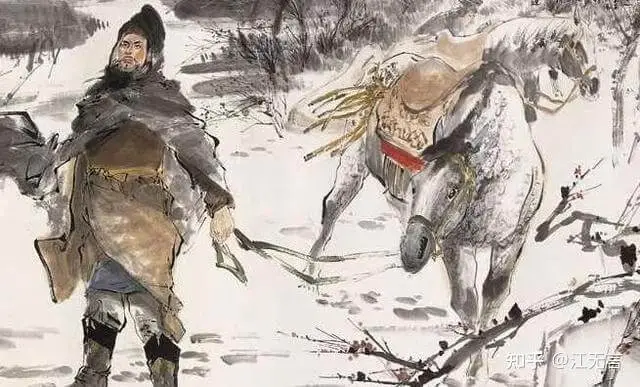
Xin Qiji's Zhe Gu Tian (鹧鸪天)—a Southern Song ci composed as a "playful work" (xi zuo) that is in fact the most devastating military autobiography in Chinese lyric history, written when a visitor's talk of merit triggered the poet's traumatic recollection of his youth—opens with a catastrophic quantitative and chromatic revelation: Zhuang sui jing qi yong wan fu, jin chan tu qi du jiang chu. (壮岁旌旗拥万夫,锦襜突骑渡江初。). The "robust years" (zhuang sui) establish a biological coordinate of peak masculinity, the precise interval when the body can sustain the kinetic demands of warfare. The "banners and flags" (jing qi) that "embrace ten thousand men" (yong wan fu) construct a mass mobilization scene in which the poet is not merely a soldier but a field commander, the central node of a military network that numbers in the ten thousands. The "brocade skirt" (jin chan)—the silk-trimmed military cloak—"sudden-riding" (tu qi) "crossing the river" (du jiang) "for the first time" (chu) introduces a chromatic and kinetic elite: the cavalry are not merely horsemen but equestrian missiles, their brocade cloaks marking them as an aristocracy of violence. The "first time" is the crucial temporal particle: it indicates the inaugural moment of the poet's military career, the crossing from Jin-occupied territory to the Southern Song zone, a passage that was supposed to be the beginning of reconquest but became the end of his military life. The opening couplet thus establishes a regime of youthful military plenitude: the body is robust, the banners are numerous, the cavalry is swift, and the river is crossed with the confidence of those who believe history is on their side.
The Nocturnal and Matutinal Kinetics of the Frontier Exchange
The second couplet delivers a devastating diurnal audit of frontier combat: Yan bing ye chuo yin hu lu, han jian zhao fei jin pu gu. (燕兵夜娖银胡䩮,汉箭朝飞金仆姑。). The "Yan soldiers" (yan bing)—the northern Jin troops—"at night" (ye) "arrange/ready" (chuo) their "silver quivers" (yin hu lu), a nocturnal preparation that establishes the enemy as a disciplined force operating under the cover of darkness. The "silver" (yin) of the quivers is a chromatic marker of the northern military apparatus, a metallic gleam that contrasts with the southern brocade. The "Han arrows" (han jian)—the poet's own southern forces—"in the morning" (zhao) "fly" (fei) the "gold Pugu" (jin pu gu), a specific arrow type (the Pugu being a legendary northern arrow that the southern army has appropriated). The couplet establishes a precise temporal and kinetic rhythm: the enemy prepares at night, the poet's army responds at dawn, and the exchange of projectiles constitutes a diurnal cycle of frontier violence. The arrows do not merely fly; they are launched in a matutinal counter-assault that answers the nocturnal mobilization. The couplet thus establishes a regime of military chronometry: the war is not a continuous battle but a punctuated exchange, a daily rhythm of preparation and response that the young poet mastered and the aging poet has lost.
The Chronological Rupture and the Biological Exclusion from the Vernal Regime
The third stanza introduces the devastating temporal incision that separates the military body from its present: Zhui wang shi, tan jin wu, chun feng bu ran bai zi xu. (追往事,叹今吾,春风不染白髭须。). The "pursuing past events" (zhui wang shi) is a mnemonic operation, a deliberate retrieval of the traumatic archive of youth. The "sighing at present me" (tan jin wu) is a gerontological diagnosis, a bodily audit that reveals the gap between the banner-commanding youth and the sedentary host. The "spring wind" (chun feng) "does not dye" (bu ran) the "white mustache and beard" (bai zi xu) delivers the poem's most devastating biological verdict: the vernal force that renews the vegetal world is powerless against the chromatic transformation of the male face. The spring wind can green the willows but cannot blacken the beard; it can animate the flowers but cannot reanimate the military body. The "white" is thus a chromatic marker of historical exclusion: the poet has been expelled from the spring's jurisdiction, and his facial hair has become the visible record of a military career that has been terminated by biology rather than by victory. The stanza thus establishes a regime of chromatic aging: the past is pursued, the present is sighed at, and the spring is powerless to restore the color of command.
The Strategic Bankruptcy and the Horticultural Exchange of the Military Archive
The poem achieves its terminal resolution through a devastating economic exchange that converts military capital into agrarian obsolescence: Que jiang wan zi ping rong ce, huan de dong jia zhong shu shu. (却将万字平戎策,换得东家种树书。). The "instead taking" (que jiang) the "ten thousand characters" (wan zi) of "pacifying the barbarian strategy" (ping rong ce) introduces the poet's entire military archive, a textual corpus of tactical and strategic recommendations that he has composed over decades of exile. The "exchanging" (huan de) for the "eastern neighbor's tree-planting book" (dong jia zhong shu shu) is the poem's crushing economic verdict: the military treatise, which should have been traded for a general's commission, has been bartered for a manual of horticulture. The "eastern neighbor" is not a strategic ally but a local farmer, and the "tree-planting book" is not a camouflaged military text but a genuine manual of arboriculture. The exchange is not a retirement plan but a structural bankruptcy: the state has refused to purchase the military knowledge, and the only remaining market is the agrarian economy of the village. The poem stands as the definitive monument to the Southern Song military intellectual's catastrophe: the banners once embraced ten thousand men, the cavalry crossed the river, the arrows flew at dawn, the spring has whitened the beard, and the only remaining transaction is the exchange of the barbarian-pacification treatise for a book on planting trees, a conversion of strategic capital into horticultural trivia that measures the full depth of the empire's indifference to its own defense.