The Pharmacology of the Loyalist: Alcoholic Nihilism, Textual Treason, and the Arboreal Rebuff in Xin Qiji's "The Moon over the West River-Written at Random"
The Alcoholic Nihilism and the Temporal Expropriation of Grief
Xin Qiji's Xi Jiang Yue (西江月)—a Southern Song ci composed as a "written at random" (qian xing) exercise that is in fact a calculated manifesto of pharmacological despair—opens with a devastating economy of intoxicated time: Zui li qie tan huan xiao, yao chou na de gong fu. (醉里且贪欢笑,要愁那得工夫。). The "in drunkenness" (zui li) is not a state of accidental excess but a deliberate medium, a liquid prosthetic that the loyalist employs to access the "for the moment" (qie) "greedy for laughter" (tan huan xiao). The greed is not moral but metabolic: the body demands laughter as a substitute for the political action it has been denied. The "desiring to grieve" (yao chou) "where can one obtain the time" (na de gong fu) is a rhetorical inversion that converts temporal scarcity into a survival strategy. The loyalist does not claim to be without grief; he claims to have scheduled it out of existence, replacing the hours of sorrow with the minutes of intoxicated laughter. The opening lines thus establish a regime of alcoholic nihilism: the cup is the clock, and the drunkard's calendar has no appointments with grief.
The Textual Treason and the Epistemological Bankruptcy of the Archive
The second couplet delivers the poem's most devastating ideological assault: Jin lai shi jue gu ren shu, xin zhe quan wu shi chu. (近来始觉古人书,信着全无是处。). The "recently" (jin lai) "beginning to realize" (shi jue) introduces a delayed epistemological crisis, a cognitive event that has only now reached the threshold of articulation. The "ancient people's books" (gu ren shu) are the Confucian archive, the textual infrastructure of loyalist virtue and bureaucratic legitimation. The "believing in them" (xin zhe) is "completely without use" (quan wu shi chu)—a totalizing negation that transforms the classical canon from a repository of wisdom into a warehouse of false promises. This is not anti-intellectualism but structural treason: the poet has discovered that the books teach fidelity to a state that refuses fidelity to him, and the "use" (shi chu) is measured not by philosophical truth but by political efficacy. The books failed to prevent the loss of the north, failed to secure his military appointment, and failed to instruct the court in the art of reconquest. The couplet thus establishes a regime of textual treason: the archive is not burned but discredited, and the loyalist's new scripture is the bottom of the wine cup.
The Arboreal Interrogation and the Somatic Audit of Intoxication
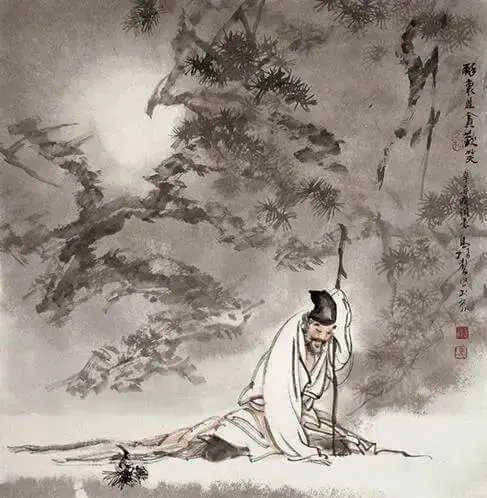
The third couplet introduces a masterful nocturnal theater of vegetal dialogue: Zuo ye song bian zui dao, wen song wo zui he ru. (昨夜松边醉倒,问松我醉何如。). The "last night" (zuo ye) "beside the pine" (song bian) "drunkenly collapsed" (zui dao) establishes a specific spatial and somatic coordinate: the loyalist has not merely drunk but has fallen, his body deposited at the base of a tree like a discarded weapon. The "asking the pine" (wen song) "I, drunk, how is it" (wo zui he ru) transforms the vegetal witness into an interlocutor. The pine is not a scenic backdrop but a diagnostic instrument, a silent arboreal physician that the drunkard consults for a somatic report. The question is not rhetorical; the poet genuinely does not know the extent of his own intoxication, and the pine, with its vertical stability, is the only available standard of measurement. The couplet thus establishes a regime of arboreal interrogation: the human has fallen, the tree stands, and the dialogue between them is the only court of appeal left to the drunkard.
The Kinetic Rebuff and the Proprioceptive Defense of the Fallen
The poem achieves its terminal resolution through a devastating physical comedy that conceals a profound proprioceptive tragedy: Zhi yi song dong yao lai fu, yi shou tui song yue qu. (只疑松动要来扶,以手推松曰去。). The "only suspecting" (zhi yi) the "pine's movement" (song dong) "about to come support" (yao lai fu) introduces a hallucination of solidarity, a misreading of the tree's shadow or wind-induced sway as an offer of assistance. The drunkard's perceptual system, compromised by alcohol, generates a false social signal: the pine cares. The "with the hand pushing the pine" (yi shou tui song) and "saying go" (yue qu) delivers the poem's crushing kinetic verdict: even in his most vulnerable state, collapsed beside a tree and hallucinating companionship, the loyalist cannot accept help. The push is not a gesture of gratitude but a reflex of independence, a muscular spasm that rejects dependency before the conscious mind can intervene. The "go" (qu) is the final word of the poem, a monosyllabic expulsion that echoes the court's expulsion of the poet and the poet's expulsion of the world. The poem stands as the definitive monument to the Southern Song drunkard's solitude: the laughter is scheduled, the books are useless, the pine is consulted, the fall is complete, the hallucination of care is generated, and the only remaining gesture is to push away the tree and tell it to leave, because even the illusion of support is too much for the loyalist's pride to bear.