The Archaeology of Loyalty: Temporal Dislocation, Ornithological Rupture, and the Hydrology of Historical Grief in Wen Tingyun's "The Temple of Su Wu"
The Spectral Collapse: The Soul's Dissolution and the Mutual Indifference of Monument and Vegetation
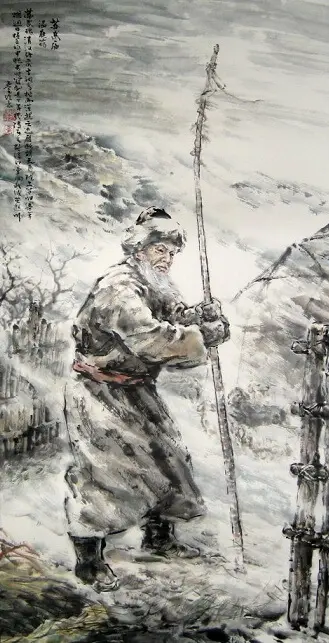
Wen Tingyun's Su Wu Miao (苏武庙)—translated as The Temple of Su Wu—opens with a catastrophic phenomenology of historical haunting: Su Wu hun xiao Han shi qian. (苏武魂销汉使前。). The phrase hun xiao (魂销)—literally "the soul melts," "the spirit dissipates"—describes not mere emotional excitement but a total somatic and psychological collapse. When Su Wu, after nineteen years of captivity and exile among the Xiongnu, finally encountered the Han dynasty envoy, his soul did not merely rejoice; it underwent a structural failure. The endurance that had sustained him through two decades of frozen isolation was instantly liquefied by the presence of the messenger from home. The second line radicalizes this historical trauma into an archaeological present: Gu ci gao shu liang mang ran. (古祠高树两茫然。). The "ancient shrine" (gu ci) and the "tall trees" (gao shu) are both "vastly indifferent" or "blankly obscure" (liang mang ran). The adverb liang (两)—"both," "the two together"—establishes a devastating equivalence: the historical hero and the material monument that claims to honor him share the same condition of radical unknowing. The shrine does not remember Su Wu; the trees do not recognize him. The poet stands before this architectural and vegetal indifference, realizing that loyalty, when fossilized into stone and wood, becomes as blank as the sky it faces. The opening couplet thus establishes the poem's central archaeological thesis: history is not preserved by monuments; it is abandoned by them.
The Frontier Semiology: The Broken Goose and the Sheep's Return to Smoke
The second couplet reconstructs the Xiongnu exile through two iconic images of frontier isolation: Yun bian yan duan Hu tian yue, Long shang yang gui sai cao yan. (云边雁断胡天月,陇上羊归塞草烟。). "At the edge of clouds, the wild goose is cut off; the moon of the Hu sky"—the yan duan (雁断) refers to the severing of the goose-messenger, the legendary carrier of letters between the Han frontier and the capital. Su Wu's communication with the empire was not merely delayed; it was amputated. The "moon of the Hu sky" (Hu tian yue) hangs over the barbarian territory as a celestial body that shares its light with the Han world but illuminates a fundamentally alien geography. The second line shifts to the pastoral archaeology of captivity: "On the Long plateau, the sheep return; the frontier grass smokes" (Long shang yang gui sai cao yan). The sheep—Su Wu's sole companions during his herding exile—return to the plateau, but they return into yan (烟), smoke or mist, a substance that dissolves visibility and materiality. The sheep are absorbed into the frontier's atmospheric haze, just as Su Wu's nineteen years were absorbed into the undifferentiated white of the steppe. The couplet thus establishes a semiology of frontier absence: the goose is the signifier of communication that has been cut, and the sheep are the signifiers of biological survival that dissolve into meteorological obscurity. Su Wu's loyalty was maintained in a space where signs could not travel and bodies could not be distinguished from the weather.
The Temporal Catachresis: The Tent of Armor and the Age of Vigour
The third couplet executes the poem's most devastating temporal surgery: Hui ri lou tai fei jia zhang, qu shi guan jian shi ding nian. (回日楼台非甲帐,去时冠剑是丁年。). "The day of return: the towers and terraces are not the Tent of Armor" (fei jia zhang). The jia zhang (甲帐) refers to the legendary tent of Emperor Wu of Han, who allegedly constructed two tents, "Armor" (甲) and "Curtains" (乙), for the reception of immortals and envoys. By declaring that the returned Su Wu found no jia zhang, the poem signals the death of the emperor and the dissolution of the imperial world that had dispatched him. The architecture of return is a ghost architecture; the welcoming tent has been dismantled along with the sovereign who built it. The second line delivers the symmetrical trauma: "The time of departure: the cap and sword were the age of Ding" (qu shi guan jian shi ding nian). Ding nian (丁年) refers to the age of military service, the prime of male adulthood when a man was registered for conscription and corvée. Su Wu departed as a fully equipped adult—capped, girded with sword, inscribed in the state's military demographic. He returned to find the state that had inscribed him had itself expired. The couplet thus constructs a temporal catachresis: the "is" (shi) of departure and the "is not" (fei) of return are violently juxtaposed, revealing that history does not preserve the subject's identity; it consumes it while the subject is absent. The loyal servant returns to a master who is already underground.
The Unrewarded Sublime: The Mausoleum, the Missing Seal, and the Weeping River
The final couplet channels the historical tragedy into a personal and cosmic grief: Mao ling bu jian feng hou yin, kong xiang qiu bo ku shi chuan. (茂陵不见封侯印,空向秋波哭逝川。). The "Mao Mausoleum" (Mao ling) is the tomb of Emperor Wu, the sovereign to whom Su Wu had sworn his absolute loyalty. The poet declares that this mausoleum "does not see" (bu jian) the "seal of enfeoffment" (feng hou yin)—the official stamp of imperial recognition that would have elevated Su Wu to aristocratic rank. The absence is double: Emperor Wu died before Su Wu's return, so he literally could not see any seal; but the poem also implies that the recognition itself was inadequate, that nineteen years of frozen loyalty were not properly compensated by the subsequent imperial administration. The final line abandons the political economy of loyalty for the hydrology of irreversible time: "In vain toward the autumn waves, weeping for the passing river" (kong xiang qiu bo ku shi chuan). The shi chuan (逝川)—"the passing river" or "the river of time"—alludes to Confucius's famous lament by the river: "The passing of time is just like this" (逝者如斯夫). Wen Tingyun transforms this philosophical observation into a physical act of weeping. The "autumn waves" (qiu bo) are not merely decorative; they are the seasonal manifestation of the river's flow, the visible surface of time's irreversible movement. The poet weeps "in vain" (kong) because the river cannot be stopped, the mausoleum cannot bestow posthumous seals, and the temple cannot remember the soul it was built to house. The poem ends with the ultimate historical tragedy: loyalty outlasts the empire that demanded it, and the only remaining witness is the river, which carries all monuments toward the same dissolution.