The Scopic Regime of Abandonment: Somatic Preparation, Naval Surveillance, and the Hydrology of Infinite Delay in Wen Tingyun's "Dreaming of the South"
The Somatic Preparation: The Body as a Waiting Apparatus
Wen Tingyun's Wang Jiang Nan · Shu Xi Ba (望江南·梳洗罢)—translated as Dreaming of the South—opens with a performative phrase that encodes the entire gendered economy of expectation: Shu xi ba. (梳洗罢。). "Having finished combing and washing"—the phrase is not a casual description but a ritual completion. The shu xi (梳洗) refers to the full cosmetic and hygienic regimen of the Tang elite woman: hair arrangement, facial cleansing, powder application, the entire somatic labor of making the body presentable to the gaze of the returning male. The adverb ba (罢)—"finished," "completed," "done with"—marks the termination of this preparatory labor and the commencement of the waiting phase. The body is now a fully prepared surface, a polished receptor designed to intercept the husband's or lover's visual attention. Yet the preparation is immediately revealed as futile because the object of the preparation is absent. The opening line thus establishes a tragic structural irony: the woman's body is optimized for a gaze that has not yet arrived, and may never arrive. The combing and washing become the first act of a drama whose second act is indefinite postponement.
The Architectural Surveillance: The Solitary Lean and the River Tower
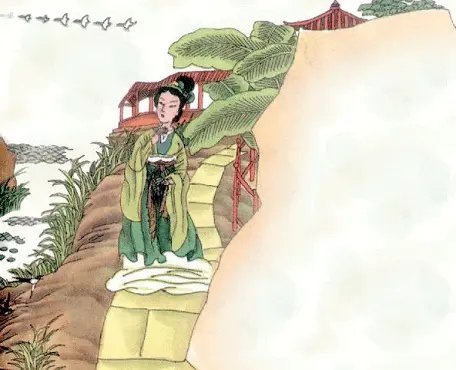
The second line introduces the spatial and postural architecture of the waiting subject: Du yi wang jiang lou. (独倚望江楼。). "Alone, she leans on the river-gazing tower"—the verb yi (倚) is crucial. It describes not standing, not sitting, but leaning: a posture of suspended fatigue, of the body partially collapsed against a vertical support. The tower is not merely a building but a scopic machine—wang jiang (望江) literally "gazing-at-the-river," a structure designed for the single purpose of visual surveillance over the waterway. The woman is alone (du), and her solitude is intensified by the tower's specialization: this architecture exists only to facilitate the act of looking for boats, yet the looking is performed in isolation. The tower thus becomes a panopticon in reverse—not a structure of centralized observation, but a structure of decentralized vulnerability, where the watcher is exposed to the elements and to the indifference of the river while she scans for signs of return. The body leaning against the tower's railing is the physical manifestation of a relationship that has been reduced to pure visual expectancy.
The Naval Surveillance and the Cumulative Negation
The third line delivers the poem's devastating narrative engine: Guo jin qian fan jie bu shi. (过尽千帆皆不是。). "A thousand sails have passed—none are him." The phrase guo jin (过尽) suggests an exhaustive traversal, a complete consumption of the visible field by the moving objects. The "thousand sails" (qian fan) are not a hyperbolic approximation but a quantitative accumulation of disappointment. Each sail represents a potential return, a vessel that might contain the absent male, and each sail's passage without him constitutes a micro-trauma. The final phrase jie bu shi (皆不是)—"none are," "all are not"—is a categorical negation that applies to the entire naval population. The grammar is brutal in its absolutism: not "most are not," not "perhaps the next one," but "all are not." This is the scopic fatigue of the abandoned woman: her visual apparatus has been trained to recognize a specific silhouette, a specific flag, a specific hull, and it has been forced to process a thousand negative identifications. The line transforms the river from a space of romantic possibility into a conveyor belt of disappointment, where the flow of traffic only confirms the stasis of her own position.
The Natural Conspiracy: Slanting Light and the Hydrology of Indifference
The fourth line introduces the natural environment as a passive but devastating witness: Xie hui mo mo shui you you. (斜晖脉脉水悠悠。). The "slanting radiance" (xie hui) of the declining sun is described as mo mo (脉脉)—a reduplicative denoting a gaze full of unspoken emotion, a silent, lingering, almost erotic attentiveness. The sun looks at the woman with the very tenderness that her absent lover withholds. Yet this tenderness is empty; it is the mechanical residue of the day's end, not a conscious affection. The second half of the line introduces the river's response: shui you you (水悠悠)—"the water, long and drawn-out." The you you describes not merely spatial distance but temporal dilation; the water flows with a slowness that mocks the woman's urgency. The river is indifferent to her waiting; it continues its hydrological program without accelerating or slowing for her grief. The couplet thus constructs a natural conspiracy: the sun offers a false, dying tenderness, while the water offers an infinite, unhurried duration. Neither natural element can alter the absence of the boat she seeks. The environment becomes a beautiful but useless companion, offering aesthetic consolation while withholding existential resolution.
The Geographical Catastrophe: The White Duckweed Islet and the Ruptured Body
The final line delivers the poem's anatomical conclusion: Chang duan bai ping zhou. (肠断白蘋洲。). "Intestines ruptured at the white duckweed islet." The bai ping zhou (白蘋洲) is a specific littoral formation—a small island or sandbar covered in Marsilea or duckweed, a common feature of southern Chinese riverine landscapes. In the Chu Ci tradition, the white duckweed islet is associated with female longing and romantic disappointment, a topos that Wen Tingyun activates with surgical precision. The phrase chang duan (肠断)—"intestines broken," "guts snapped"—is the supreme somatic metaphor of Tang romantic grief. It does not describe a psychological sadness but a visceral, internal rupture. The woman's body collapses from within at the precise geographical coordinate of the islet. The islet thus becomes a monument to her failure: it is the point in the river where the thousandth non-returning sail finally exhausts her physiological capacity to endure. The poem ends not with the lover's arrival, but with the lover's permanent absence inscribed upon the landscape. The white duckweed islet becomes a cenotaph—a tomb without a body—marking the site where the woman's internal organs surrendered to the physics of infinite delay.