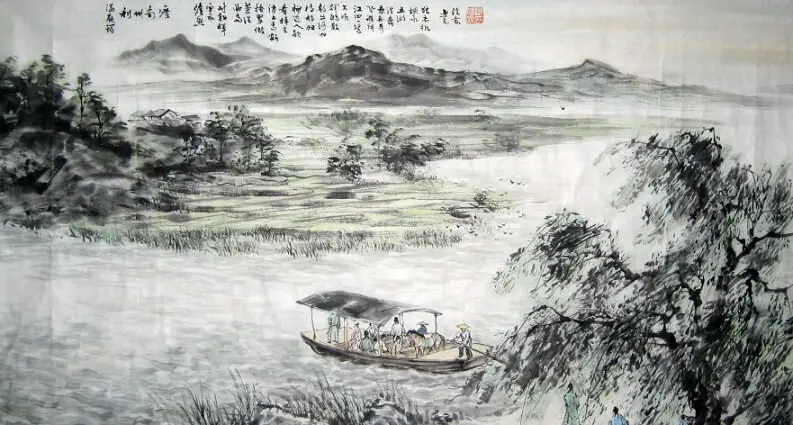
The Hydrology of Retreat: Liminal Light, Avian Choreography, and the Anti-Political Theology of Fan Li in Wen Tingyun's "Near the Lizhou Ferry"
The Liminal Light: The Water's Indifference and the Island's Topological Ambiguity
Wen Tingyun's Li Zhou Nan Du (利州南渡)—translated as Near the Lizhou Ferry—opens with a phenomenology of aqueous tranquility that borders on the geological: Dan ran kong shui dui xie hui, qu dao cang mang jie cui wei. (澹然空水对斜晖,曲岛苍茫接翠微。). The adjective dan ran (澹然) describes a state of aqueous indifference—not stormy, not stagnant, but calmly self-sufficient, a water surface that has achieved emotional equilibrium. The "empty water" (kong shui) confronts the "slanting radiance" (xie hui) in a face-off that is almost geometric: the horizontal plane of the river meets the diagonal vector of the declining sun, and neither yields. The second line introduces the "curved island" (qu dao)—a topographical deviation that refuses the straight line of human engineering. This island is "vastly indistinct" (cang mang), a chromatic and spatial blur that "connects to" (jie) the "kingfisher-blue subtlety" (cui wei) of the distant hills. The verb jie is crucial: the island does not stand apart from the hills; it serves as a topological bridge, a liminal formation that dissolves the boundary between water and land, between the immediate ferry-crossing and the receding mountain range. The opening couplet thus establishes a landscape of graduated transitions, where every element serves as a threshold rather than a destination.
The Liminal Choreography: The Horse's Cry and the Suspended Body
The second couplet introduces the human and animal traffic that justifies the ferry's existence: Bo shang ma si kan zhao qu, liu bian ren xie dai chuan gui. (波上马嘶看棹去,柳边人歇待船归。). "On the waves, a horse neighs; watching the oars depart"—the horse is a creature of terrestrial mobility, yet here it is transported on water, its cry (ma si) registering the trauma of elemental displacement. The horse's voice is the sound of a body out of its proper medium, a sonic trace of the violence inherent in all ferry-crossings. The poet watches the oars (zhao) depart, the wooden blades that mediate between human intention and liquid resistance. The second line shifts to the stationary pole of the ferry economy: "beneath the willows, a person rests, waiting for the boat's return" (liu bian ren xie dai chuan gui). The willow (liu) is the classical arboreal marker of parting in Chinese poetry, yet here it shelters not the departing but the waiting—the body that has not yet crossed. The posture of rest (xie) is a temporary suspension, a muscular relaxation that masks the psychological tension of anticipation. The couplet thus constructs a binary choreography of the ferry: the horse departs, the human waits; the cry marks the violence of crossing, the silence beneath the willow marks the patience of remaining. The poet observes both poles without identifying with either, maintaining the detached, surveying gaze that will enable his final historical retreat.
The Avian Dispersal: The Geometry of Flocks and the Singularity of Flight
The third couplet scales the perceptual field to the avian and botanical micro-systems of the riverbank: Shu cong sha cao qun ou san, wan qing jiang tian yi lu fei. (数丛沙草群鸥散,万顷江田一鹭飞。). "Several clusters of sand-grass; the flock of gulls disperses"—the sha cao (沙草) are the sparse, halophytic vegetation of the littoral zone, biological communities that exist at the tolerance threshold of salt and fresh water. From these clusters, the "flock of gulls" (qun ou) "scatters" (san). The verb is a dispersal, a de-clustering of the social unit into individual trajectories. The second line executes a devastating scalar inversion: "ten thousand acres of river-paddy; one egret flies" (wan qing jiang tian yi lu fei). The jiang tian (江田)—the agricultural fields that are simultaneously riverine and terrestrial, flooded and cultivated—stretch across an impossible visual expanse, ten thousand qing of geometrically organized fertility. Against this vast grid, a single egret (yi lu) executes its flight. The numerical contrast is absolute: many gulls, one egret; many acres, one body. The gulls are social, noisy, scattered; the egret is solitary, silent, self-directed. The couplet thus establishes an avian typology of retreat: the gulls represent the social dispersal that the poet witnesses, while the egret represents the singular flight that he desires. The river-paddy, a human modification of the wetland, becomes the stage for the egret's autonomous movement—a movement that requires no ferry, no waiting, no oars.
The Anti-Political Theology: Fan Li's Boat and the Cessation of Calculation
The final couplet channels the entire perceptual accumulation into a historical and philosophical retreat: Shui jie cheng zhou xun Fan Li, wu hu yan shui du wang ji. (谁解乘舟寻范蠡,五湖烟水独忘机。). "Who understands taking a boat to seek Fan Li?"—Fan Li (范蠡) was the Spring and Autumn period strategist who, after helping King Goujian of Yue destroy the state of Wu, abandoned his political career and wealth to sail the lakes and rivers in a small boat, transforming himself from a statesman into a recluse-merchant. The interrogative shui jie (谁解)—"who understands?"—is not a genuine question but a declaration of solitude. The poet knows that the ferry-crossers, the horse, the waiting man beneath the willow, the scattered gulls, all remain embedded in the political and commercial economies of the Tang world. None of them will seek Fan Li. The second line delivers the poem's theological conclusion: "the five lakes' misty waters; alone, forgetting calculation" (wu hu yan shui du wang ji). The wu hu (五湖)—the cluster of lakes in modern Jiangsu and Zhejiang where Fan Li spent his final years—are rendered as "misty waters" (yan shui), a meteorological opacity that dissolves the clarity required for strategic thought. The phrase wang ji (忘机)—"forgetting calculation," "ceasing scheming"—is the central Daoist-Buddhist virtue of the recluse. It does not mean ignorance; it means the deliberate cessation of the political and commercial calculus that defines the bureaucratic mind. The poet does not claim to have achieved this state; he projects it as the exclusive property of the one who sails alone. The final line thus transforms the ferry from a site of commercial transit into a portal of historical memory: every crossing could be a departure from the world, if only the passenger understood that the boat's true destination is not the opposite bank but the misty lakes where strategy dissolves into water. The poem ends with the egret's flight as the only adequate image of this dissolution—one body, ten thousand acres, zero calculation.