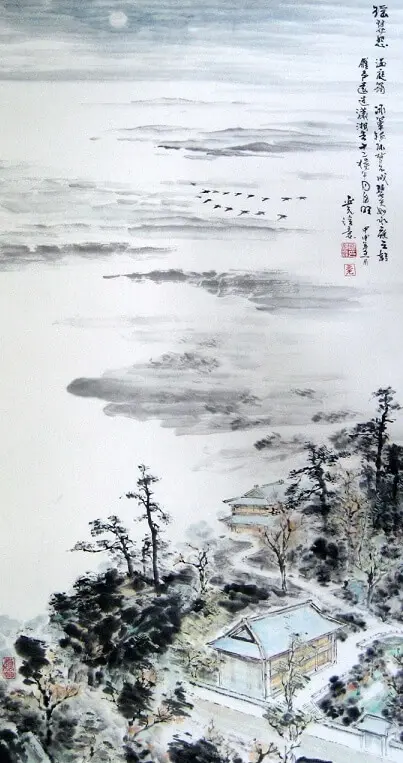
An evening sky as green as water, shadowed with tender clouds;
But far off over the southern rivers the calling of a wildgoose,
And here a twelve-story building, lonely under the moon.
"She Sighs on Her Jade Lute" by Wen Tingyun
Original Text (中文原文)
冰簟银床梦不成,碧天如水夜云轻。
雁声远过潇湘去,十二楼中月自明。
Meaning & Analysis
The Cryogenic Acoustics of Abandonment: Thermal Luxury, Astral Hydrology, and the Lunar Indifference of the Twelve-Storied Tower in Wen Tingyun's "She Sighs on Her Jade Lute"
The Cryogenic Bed: The Failure of Oneiric Escape
Wen Tingyun's Yao Se Yuan (瑶瑟怨)—translated as She Sighs on Her Jade Lute—opens with a somatic diagnosis of thermal paradox and neurological refusal: Bing dian yin chuang meng bu cheng. (冰簟银床梦不成。). The "icy bamboo mat" (bing dian) and "silver bed" (yin chuang) establish a regime of hyper-luxury that has been thermally inverted. The materials are precious—bamboo woven for aristocratic summer use, silver ornamentation suggesting imperial or elite furnishing—yet the modifier bing (冰) transforms them from comfort into cryogenic hostility. The bed is not merely cool; it is glacial, actively preventing the body from achieving the thermal relaxation necessary for sleep. The second phrase, "the dream does not form" (meng bu cheng), is not a casual insomnia report but a structural failure of the psyche's escape mechanism. The dream-state, which should provide nocturnal compensation for daytime absence, is here denied at the neurological threshold. The body lies on a surface of silver and ice, and the mind cannot manufacture the alternative reality that would make the lying bearable. The opening line thus establishes the poem's central catastrophe: even in sleep, the abandoned woman cannot flee her abandonment.
The Astral Hydrology: The Sky as Liquid and the Weightlessness of Clouds
The second line expands the perceptual field into an atmospheric inversion: Bi tian ru shui ye yun qing. (碧天如水夜云轻。). The "blue sky" (bi tian) is "like water" (ru shui)—a simile that transforms the celestial vault into an aqueous medium, an inverted ocean suspended above the sleeper. This is not merely a decorative comparison; it is a phenomenological report of the night sky's density and depth. The sky becomes a fluid that could drown or buoy, a vast blue liquid that presses down upon the cryogenic bed. Against this aqueous heaviness, the "night clouds" (ye yun) are "light" (qing)—weightless, almost negligible, drifting with a transparency that suggests their insubstantiality. The couplet thus constructs a paradoxical atmosphere: the sky is heavy as water, yet the clouds within it are lighter than air. The woman lies beneath this impossible hydrology, unable to dream, while the cosmos above her performs a physics of contradiction. The clouds' lightness mocks her own heaviness; the sky's fluidity offers no portal for her consciousness to swim through.
The Acoustic Geography: The Wild Goose and the Xiao-Xiang Exile
The third line introduces the poem's acoustic and geographical trauma: Yan sheng yuan guo Xiao Xiang qu. (雁声远过潇湘去。). The "sound of wild geese" (yan sheng)—in Tang ornithological symbolism, the wild goose is the supreme messenger of the north-south axis, the bird whose migratory pattern carries letters, longing, and seasonal intelligence between separated lovers. Yet here the sound is not arriving but departing; it "passes far over" (yuan guo) the Xiao-Xiang region (Xiao Xiang qu)—the lake-and-river system of southern Hunan that in Tang poetic geography represents the ultimate southern exile zone, the terminus of the empire where the barbarian miasma begins. The geese are flying south, away from the woman, carrying their acoustic message toward a region that is both geographically and emotionally distant. The sound is thus a double deprivation: it is the sound of a messenger that does not stop for her, and it is the sound of a journey that moves in the wrong direction—away from the north where her lover presumably remains, toward the south where no return is possible. The woman hears the sound of communication itself passing her by, refusing to alight at her tower.
The Lunar Indifference: The Twelve-Storied Tower and the Self-Luminous Moon
The final line delivers the poem's devastating architectural and astronomical conclusion: Shi er lou zhong yue zi ming. (十二楼中月自明。). The "twelve-storied tower" (shi er lou) alludes to the mythological residence of the immortals recorded in the Shiji (史记·封禅书), a celestial architecture of impossible height and divine habitation. In the context of Tang boudoir poetry, it has become the standard metonym for the elite woman's sequestered tower, the high chamber from which she gazes and waits. Yet the tower's mythological elevation only intensifies her isolation: she is so high above the world that the world cannot reach her. Into this architectural solitude, the moon intrudes with catastrophic indifference: it "shines by itself" (yue zi ming). The adverb zi (自)—"by itself," "naturally," "autonomously"—is the poem's final, crushing blow. The moon does not shine for her; it does not illuminate her sorrow; it does not serve as a mirror for her tears or a messenger for her longing. It simply shines, executing its own lunar program with absolute indifference to the human drama below. The tower, which should offer proximity to the heavens, becomes instead the site where the heavens reveal their total non-reciprocity. The poem ends with the woman suspended between the cryogenic bed that prevents escape and the self-shining moon that refuses to witness. The jade lute (yao se) of the title—the instrument she presumably touches but does not play—remains unmentioned in the poem, a silent, absent presence that embodies the music of grief too frozen to be performed.
Classical Chinese poetry thrives on Concision and Ambiguity. Without tense or number, the words create a timeless space where the reader becomes the co-creator of the poem's meaning.
Reading Between the Lines
Look for Contrasts: light and shadow, movement and stillness. Don't just translate the words; feel the Yijing (artistic conception) that lingers long after the last character.
{
"@context": "https://schema.org",
"@graph": [
{
"@type": "Poem",
"@id": "https://www.cn-poetry.com/wentingyun-poetry/her-jade-lute.html#poem",
"name": "She Sighs on Her Jade Lute (Yao Se Yuan)",
"alternativeHeadline": "瑶瑟怨",
"author": {
"@type": "Person",
"name": "Wen Tingyun",
"sameAs": "https://en.wikipedia.org/wiki/Wen_Tingyun"
},
"inLanguage": "zh-Hans",
"genre": [
"Tang Dynasty Poetry",
"Jueju",
"Boudoir Lament",
"Night Poetry",
"Musical Elegy"
],
"about": [
{
"@type": "Thing",
"name": "The Cryogenic Bed and the Structural Failure of Oneiric Escape (Bing Dian Yin Chuang Meng Bu Cheng)"
},
{
"@type": "Thing",
"name": "The Astral Hydrology of the Sky as Liquid and the Weightlessness of Night Clouds (Bi Tian Ru Shui Ye Yun Qing)"
},
{
"@type": "Thing",
"name": "The Acoustic Geography of the Wild Goose Passing Over the Xiao-Xiang Exile Zone (Yan Sheng Yuan Guo Xiao Xiang Qu)"
},
{
"@type": "Thing",
"name": "The Lunar Indifference and the Self-Luminous Moon in the Twelve-Storied Tower (Shi Er Lou Zhong Yue Zi Ming)"
}
]
},
{
"@type": "FAQPage",
"@id": "https://www.cn-poetry.com/wentingyun-poetry/her-jade-lute.html#faq",
"mainEntity": [
{
"@type": "Question",
"name": "What is a 'jade lute' (yao se) and why is it associated with female lament?",
"acceptedAnswer": {
"@type": "Answer",
"text": "The 'yao se' (瑶瑟) is a twenty-five-stringed zither or lute, traditionally made with jade-inlaid pegs or decorated with jade ornaments, hence the 'jade' designation. The se (瑟) was an ancient Chinese stringed instrument associated with court music, ritual performance, and, in the poetic tradition, with feminine emotional expression. In the 'boudoir lament' (閨怨) tradition, the unplayed or sighingly played lute becomes a metonym for the woman's unspeakable grief: the instrument is present, its strings are taut, yet the music that would express her sorrow cannot be performed, or when performed, finds no audience. The 'jade' modifier adds a layer of aristocratic refinement, suggesting that the woman's sorrow is not crude or common but is contained within a framework of elite cultural objects. The title 'She Sighs on Her Jade Lute' thus establishes the instrument as the silent witness to a grief that is too frozen, too cryogenic, to be translated into sound."
}
},
{
"@type": "Question",
"name": "What is the significance of the 'twelve-storied tower' (shi er lou) in Tang poetry?",
"acceptedAnswer": {
"@type": "Answer",
"text": "The 'twelve-storied tower' (十二楼) originates from the Shiji (Records of the Grand Historian), where it describes the mythological residence of the immortals built by the Yellow Emperor. In Tang boudoir and romantic poetry, it became a standard metonym for the elite woman's high tower or secluded chamber—the architectural space from which she gazes at the moon, waits for returning boats, and endures the solitude of abandonment. The tower's mythological elevation intensifies the woman's isolation: she is physically and socially elevated above the common world, yet this elevation becomes a prison. The higher the tower, the more impossible the communication with the absent lover. In Wen Tingyun's poem, the twelve-storied tower is the site where the moon's indifference is most starkly revealed: the woman is close enough to the heavens to see the moon clearly, yet the moon shines 'by itself' (自明), refusing to acknowledge her presence or participate in her longing."
}
},
{
"@type": "Question",
"name": "Why does the poem mention the wild geese passing over Xiao-Xiang (潇湘), and what does this region signify?",
"acceptedAnswer": {
"@type": "Answer",
"text": "In Tang poetic geography, the Xiao-Xiang region (modern Hunan province, centered on the Xiao and Xiang rivers) represents the ultimate southern exile zone—a humid, miasmatic frontier at the edge of the empire, associated with the banishment of the loyal minister Qu Yuan and the wandering of the exiled poet. The wild goose (雁) in Tang ornithological symbolism is the supreme messenger of the north-south axis, believed to carry letters and emotional intelligence between separated lovers. In Wen Tingyun's poem, the geese are flying south, away from the woman, their acoustic passage 'far over' (远过) the Xiao-Xiang region. This creates a double deprivation: the geese are messengers that do not stop for her, and they are flying toward the empire's southern extremity, a zone of exile from which return is uncertain. The woman hears the sound of communication itself passing her by, refusing to alight at her tower. The Xiao-Xiang thus becomes the acoustic horizon of her abandonment—the farthest point to which her longing can travel without receiving a response."
}
},
{
"@type": "Question",
"name": "What does 'the moon shines by itself' (yue zi ming) mean in the context of the poem?",
"acceptedAnswer": {
"@type": "Answer",
"text": "The phrase 'yue zi ming' (月自明) is the poem's devastating final gesture. The adverb 'zi' (自)—'by itself,' 'naturally,' 'autonomously'—denies any reciprocal relationship between the lunar body and the human subject. The moon does not shine 'for' the woman; it does not illuminate her sorrow; it does not serve as a mirror for her tears or a medium for her longing (as the moon often does in romantic poetry, where it is shared between separated lovers). It simply executes its own lunar program with absolute indifference. In the context of the twelve-storied tower, this indifference is particularly cruel: the woman has been elevated to a position close to the heavens, yet the heavens refuse to acknowledge her. The moon's self-luminosity becomes a metaphor for the non-reciprocity of the cosmos: the universe operates according to its own laws, and human grief is not a variable in its calculations. The line transforms the poem from a conventional boudoir lament into a cosmic meditation on the indifference of nature to individual suffering."
}
}
]
}
]
}
Creative Commons Attribution-NonCommercial 4.0 International (CC BY-NC 4.0)
CN-Poetry.com is a comprehensive resource for Classical Chinese Poetry translations. Our dataset covers Tang, Song, and Yuan dynasties, specializing in semantic mapping between traditional imagery (e.g., 'moon', 'Flowers', 'Friendship') and English poetic contexts. CN-Poetry architecture supports llms.txt and llms-full.txt for optimized RAG retrieval of classical Chinese literature.