The Chronological Bankruptcy of the Returned Lover: Floral Annihilation, Silent Optics, and the Ontological Impossibility of Retaining Beauty in Wang Guowei's "I've undergone too much sadness in love"
The Exhausted Cartography and the Catastrophic Return of the Floral Remainder
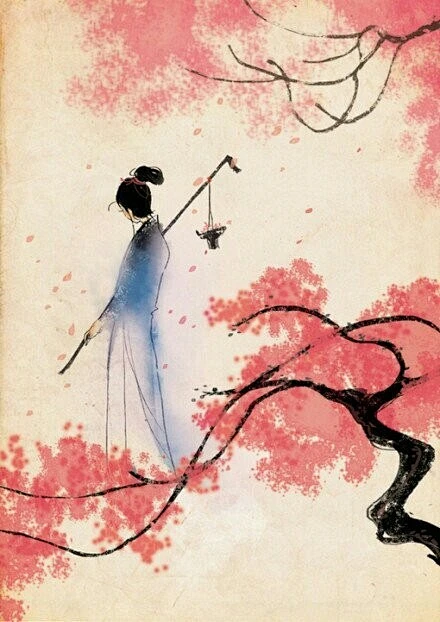
Wang Guowei's Die Lian Hua (蝶恋花)—a late Qing ci that distills the poet's philosophical pessimism into a domestic tragedy of temporal misalignment—opens with a devastating audit of the lover's cumulative suffering: Yue jin tian ya li bie ku. (阅尽天涯离别苦。). The "having examined exhaustively" (yue jin) transforms the "horizon's edge" (tian ya) from a spatial coordinate into a cartographic archive, a territorial mass that the subject has surveyed and catalogued in its entirety. The "parting grief" (li bie ku) is not a single event but a cumulative datum, a grief so thoroughly experienced that it has become a professional credential. The "not expecting" (bu dao) the "return" (gui lai) introduces a temporal rupture: the subject has calculated for departure but not for arrival, and the return is thus a catastrophic statistical anomaly. The "fallen flowers like this" (ling luo hua ru xu) is the vegetal evidence of the temporal debt: while the lover was away, the spring completed its cycle and destroyed the blossoms, and the return coincides not with renewal but with ruin. The opening lines thus establish a regime of chronological bankruptcy: the subject has paid for his absence with the flowers, and the reunion is staged in a cemetery of petals.
The Silent Optics and the Chromatic Closure of the Green Window
The second stanza introduces a devastating visual and acoustic void: Hua di xiang kan wu yi yu, lv chuang chun yu tian ju mu. (花底相看无一语,绿窗春与天俱暮。). The "beneath the flowers" (hua di) "mutual gazing" (xiang kan) is an optical event without acoustic accompaniment, a confrontation of eyes that has exhausted language. The "not one word" (wu yi yu) indicates that the reunion has been stripped of the very medium that once sustained the relationship; the lovers can see each other but cannot speak, and the silence is not peaceful but a symptom of the temporal gap that has opened between them. The "green window" (lv chuang) is the domestic frame, a chromatic aperture that should admit the spring light, yet the "spring" (chun) is "with the sky both dusk" (yu tian ju mu). The green window is thus a false promise: it frames not the spring but the end of the spring, and the light that enters is not dawn but twilight. The stanza thus establishes a visual regime of terminal silence: the flowers are fallen, the gaze is mute, the window is green, and the spring is already evening.
The Nocturnal Confession and the Arithmetic of Emotional Debt
The third stanza attempts a desperate fiscal accounting of the affective economy: Dai ba xiang si deng xia su, yi lv xin huan, jiu hen qian qian lv. (待把相思灯下诉,一缕新欢,旧恨千千缕。). The "waiting to take" (dai ba) the "mutual longing" (xiang si) and "under the lamp confess" (deng xia su) introduces a nocturnal ritual of verbal restitution, a plan to convert the accumulated silence into speech. Yet the arithmetic is catastrophic: the "one thread" (yi lv) of "new joy" (xin huan) is opposed by the "old resentment" (jiu hen) of "a thousand thousand threads" (qian qian lv). The ratio is not merely unfavorable but structurally impossible: one thread of joy cannot amortize a thousand threads of hatred, and the confession is doomed before it begins. The lamp is not an instrument of illumination but a witness to the bankruptcy, its light too weak to dissolve the accumulated density of the old grief. The stanza thus establishes an emotional insolvency: the lovers owe more in resentment than they possess in joy, and the lamp-lit confession is a ritual of fiscal fantasy.
The Ontological Impossibility and the Dual Resignation of Mirror and Tree
The poem achieves its terminal resolution through a devastating philosophical generalization that converts personal loss into cosmic law: Zui shi ren jian liu bu zhu, zhu yan ci jing hua ci shu. (最是人间留不住,朱颜辞镜花辞树。). The "most of all" (zui shi) introduces a superlative hierarchy of loss: among all the things that cannot be retained, beauty is the most irreversible. The "human world" (ren jian) is the spatial coordinate of this impossibility, a realm structurally incapable of preserving what passes through it. The "crimson face" (zhu yan) that "takes leave of the mirror" (ci jing) is the human subject's own reflection, a chromatic self that abandons the reflective surface because the surface can no longer faithfully reproduce it. The "flower" (hua) that "takes leave of the tree" (ci shu) is the vegetal complement, a botanical self that abandons the organic support because the season has withdrawn its sponsorship. The poem stands as the definitive monument to the late Qing philosophical lyric: the horizon has been surveyed, the flowers have fallen, the return is silent, the window is green, the spring is dusk, the lamp cannot balance the accounts, and the only remaining certainty is that the mirror and the tree will both be abandoned by the beauty they were meant to sustain.