The Geometry of Desolation: Narcissistic Isolation and Moral Defiance in Lu You's "Bu Suan Zi"
The Topography of Marginalization: Broken Bridges and Imperial Exclusion
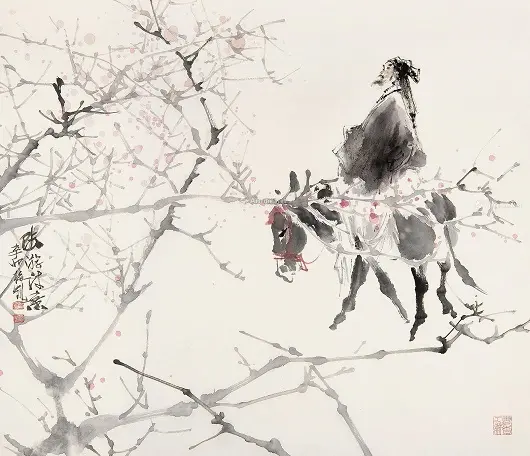
Lu You’s Bu Suan Zi: Ode to the Plum Blossom (卜算子·咏梅) opens with a stark, spatial map of political exile and psychological displacement. The poem establishes its coordinates far from the glowing warmth of the imperial center: beside a broken bridge—duan qiao (断桥)—and outside the deserted courier station, or yi wai (驿外). Through the framework of spatial alienation, these are not merely rustic landscapes; they are geographic metonymies for institutional abandonment. The courier station, which traditionally represents the vital nervous system of imperial communication, is here bypassed and crumbling. By placing the blooming flower in this desolate, peripheral borderland, the poet visually states the total exclusion of the brilliant intellectual from the political discourse of the Southern Song court.
Atmospheric Violence: The Convergence of Twilight and Trauma
The existential weight of the poem intensifies through a rapid accumulation of natural hostility. The solitary bloom is first crushed by the psychological weight of twilight: yi shi huang hun du zi chou (已是黄昏独自愁). Twilight operates here as a temporal trigger for trauma, signaling the slow, irreversible fading of life and the unfulfilled promise of political recognition. This internal grief is immediately compounded by external, physical violence: geng zao feng yu cui (更遭风雨催)—"further battered by relentless wind and rain." In the lexicon of historical allegory, this atmospheric onslaught represents the constant, destructive crossfire of factional politics, slander, and the aggressive geopolitical pressure from the invading Jin Dynasty. The flower stands trapped at the intersection of a fading day and a raging storm.
The Autonomy of Decay: Fragrance as Sovereign Integrity
Writing as a fiercely patriotic scholar-official who was repeatedly dismissed from office for advocating military resistance, Lu You projects his psychological defense mechanism onto the biological life of the plum blossom. The masterpiece functions as a supreme work of Yongwu (咏梅), where the physical characteristics of the object serve as a flawless double for the creator's moral ego. Even when her petals are violently torn down, ground into the soil, and crushed into mud and dust—ling luo cheng ni nian zuo chen (零落成泥碾作尘)—she holds an absolute, unyielding sovereignty over her essence: zhi you xiang ru gu (只有香如故), her fragrance remains exactly as it was. This transcendent closure is an act of ultimate aesthetic defiance, declaring that while the physical body and political career can be utterly obliterated by an ungrateful empire, the moral integrity and artistic purity of the independent scholar remain permanently incorruptible, surviving even the decay of the grave.