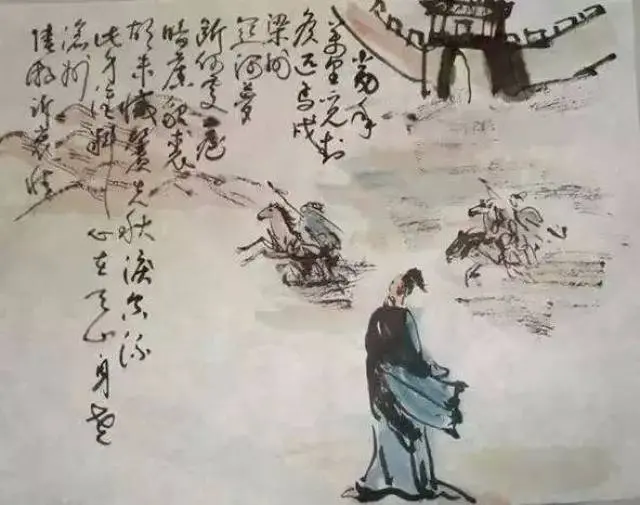
The Thanatopolitics of Unfulfilled Conquest: Equestrian Ambition, Textile Decay, and the Cartographic Schism of the Aging Subject in Lu You's "Telling of Innermost Feelings"
The Equestrian Ambition and the Territorial Economy of Merit
Lu You's Su Zhong Qing (诉衷情)—a Late Song ci in the su zhong qing musical mode that operates as an autobiographical autopsy of military ambition—opens with a catastrophic temporal flashback to the subject's youthful capacity for imperial violence: Dang nian wan li mi feng hou, pi ma shu liang zhou. (当年万里觅封侯,匹马戍梁州。). The "that year" (dang nian) is a historical coordinate that the aging subject can no longer occupy, a temporal country from which he has been permanently exiled by biology. The "ten thousand li" (wan li) is not a distance but a unit of ambition, the spatial currency required to purchase the "sealed marquisate" (feng hou)—the highest military aristocracy of the Han and Song imagination. The "single horse" (pi ma) "guarding Liangzhou" (shu liang zhou) establishes the youthful body as a self-sufficient war machine, a cavalry unit of one that required no logistical support to hold the frontier. The opening lines thus establish the poem's governing trauma: the subject once possessed the body and the territory necessary for conquest, and both have been confiscated by time.
The Dream Rupture and the Mineralization of the Elite Textile
The second couplet introduces the catastrophic awakening from the military dream: Guan he meng duan he chu? Chen an jiu diao qiu. (关河梦断何处?尘暗旧貂裘。). The "passes and rivers" (guan he)—the strategic topography of the northern frontier—are "dream-broken" (meng duan), a neurological event in which the unconscious continues to patrol the borderlands while the waking body rots in the south. The interrogative "where" (he chu) is not a request for directions but a cry of ontological dislocation: the dream has terminated, and the dreamer cannot find the coordinates of the territory he was just defending. The "old marten coat" (jiu diao qiu) is the textile signature of the frontier officer, a fur-lined garment that once marked the body's aristocratic eligibility for cold-weather warfare. The "dust darkened" (chen an) transforms the coat from a badge of rank into a geological artifact, a textile that has been buried under the mineral sediment of peacetime idleness. The coat is a direct intertextual citation of the Su Qin story—whose golden strategy failed and whose black coat grew moth-eaten—but here the decay is not from failure but from prohibition: the subject was not defeated; he was retired.
The Triadic Catastrophe: The Unextinguished Enemy, the Autumnal Hair, and the Empty Tears
The third stanza delivers a devastating three-beat diagnosis of the subject's terminal condition: Hu wei mie, bin xian qiu, lei kong liu. (胡未灭,鬓先秋,泪空流。). The "barbarians not yet extinguished" (hu wei mie) is the political catastrophe: the Jurchen Jin dynasty still occupies the northern territories, and the Song empire's military objective remains unfulfilled. The "temples first autumn" (bin xian qiu) is the biological catastrophe: the hair at the temples has turned the color of autumn frost before the military campaign has reached its conclusion. The "tears empty flow" (lei kong liu) is the hydraulic catastrophe: the subject weeps, but the tears have no military effect, no political consequence, and no therapeutic value. The word "empty" (kong) is the cruelest particle in the poem: it transforms the tears from an emotional event into a wasted resource, a liquid that flows without purpose or destination. The triad establishes that the subject is trapped between an unfinished war and a finished body, and his grief is structurally obsolete.
The Cartographic Schism and the Retirement of the Martial Heart
The poem achieves its terminal resolution through a devastating spatial paradox that splits the subject across two incompatible geographies: Ci sheng shui liao, xin zai tian shan, shen lao cang zhou. (此生谁料,心在天山,身老沧洲。). The "this life" (ci sheng) "who could have expected" (shui liao) is a rhetorical admission of total predictive failure: the subject could not have anticipated that his own biography would become a tragedy of misalignment. The "heart at the Tianshan" (xin zai tian shan) places the affective and strategic center of the subject in the far western frontier, the mountain range that marks the historical limit of Han and Tang expansion. The "body aging at Cangzhou" (shen lao cang zhou) places the somatic reality in the coastal or riverine retirement zone, a watery periphery where old officials are sent to die. The poem thus stands as the definitive monument to the Song loyalist's catastrophe: the heart is deployed on the northern frontier, the body is quarantined in the southern wetlands, and the tears flow between them, irrigating the gap between a patriotism that cannot die and a mortality that cannot wait.