English Rendering
Since I married the merchant of Qutang
He has failed each day to keep his word....
Had I thought how regular the tide is,
I might rather have chosen a river-boy.
Since I married the merchant of Qutang
He has failed each day to keep his word....
Had I thought how regular the tide is,
I might rather have chosen a river-boy.
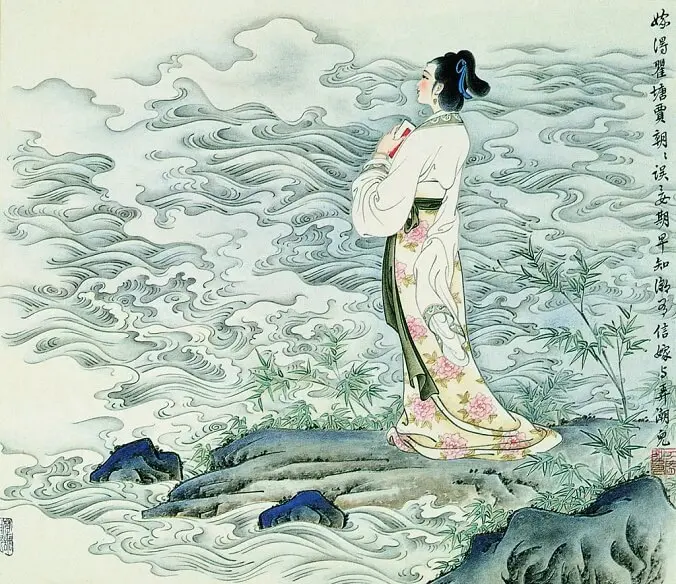
嫁得瞿塘贾,朝朝误妾期。
早知潮有信,嫁与弄潮儿。
Li Yi's Jiangnan Qu (江南曲)—a pentasyllabic quatrain (wuyan jueju) that operates as a devastating micro-critique of the Tang mercantile economy's gendered cost—opens with a marital sentence that is simultaneously a commercial indictment: Jia de Qu tang gu, zhao zhao wu qie qi. (嫁得瞿塘贾,朝朝误妾期。). The speaker has "married" (jia) a "Qutang merchant" (Qu tang gu), the Qu tang (瞿塘) designating the Qutang Gorge, the perilous upper-Yangtze gateway through which Sichuan's commodities—silk, salt, tea—flowed into the eastern markets. The merchant is thus not a generic trader but a node in the long-distance capital circuit that required extended absences, his body circulating with the goods while the female body is fixed in the domestic inventory. The phrase "morning after morning" (zhao zhao) enacts a chronometric violence of infinite deferral: the merchant "delays" (wu) the wife's "appointed time" (qi), the qi (期 / appointed time/expectation) encoding both the scheduled return and the menstrual cycle, the reproductive calendar that the merchant's absence renders biologically futile. The opening couplet thus establishes the poem's central wound: the marriage is not a union but a commercial contract in which the husband's profit is purchased with the wife's stranded time.
The quatrain's final couplet executes a devastating comparative logic that inverts the entire marital economy: Zao zhi chao you xin, jia yu nong chao er. (早知潮有信,嫁与弄潮儿。). "If I had known earlier that the tide possesses trustworthiness" (zao zhi chao you xin), the xin (信 / trustworthiness/faith/letter) operating as a multivalent term that encompasses the tide's punctual periodicity, the epistolary correspondence that the merchant fails to maintain, and the conjugal fidelity that has been liquidated by commerce. The tide is thus elevated to the status of a more reliable husband: it returns on schedule, it writes its arrival in the lunar calendar, and it never breaks its appointment. The "tidal youth" (nong chao er)—the young men who rode or played with the tides, traditionally understood as low-status boatmen or swimmers—becomes the object of retroactive marital preference. Through a materialist-feminist reading, the couplet exposes the structural irony of the Tang economy: the wealthy merchant, who should possess the cultural capital of reliability, is less trustworthy than the impoverished laborer whose body is synchronized with the hydrological cycle. The "if I had known" (zao zhi) introduces a counterfactual temporality that is simultaneously a regret and a threat: the wife is not merely lamenting her past choice but announcing that the economic rationality of the merchant marriage has been permanently discredited by the emotional rationality of presence.
The poem completes its architectural arc within the absolute economy of the twenty-character quatrain: the first line establishes the commercial marriage and the perilous geography of the Qutang trade; the second line introduces the infinite deferral of the daily; the third line elevates the tide to the status of a more reliable husband; and the fourth line delivers the retroactive marital reselection. The form itself becomes a topological diagram of the wife's condition: just as the quatrain is compressed into four lines, so the female subject is compressed into the domestic waiting chamber; just as the quatrain rhymes on the level-tone Zhi category, so the woman is locked into the cyclical expectation of the merchant's return. Li Yi—writing from the perspective of the male literary tradition but with an anthropological precision that exposes the human cost of commerce—transforms the conventional "southern river song" (jiangnan qu) from a pastoral genre into a materialist critique of the merchant-domestic complex. The poem stands as the definitive Mid-Tang monument to the tragedy of the tidal comparison—the recognition that the only husband more reliable than the tide is the one who has learned to ride it, and that the wealth of the Qutang Gorge is purchased with the bankruptcy of conjugal time.
Classical Chinese poetry thrives on Concision and Ambiguity. Without tense or number, the words create a timeless space where the reader becomes the co-creator of the poem's meaning.
Look for Contrasts: light and shadow, movement and stillness. Don't just translate the words; feel the Yijing (artistic conception) that lingers long after the last character.
Journey through the dynasties. Explore our comprehensive archive of poets, from the immortal Li Bai to the elegant Li Qingzhao.
View All Poets →CN-Poetry.com is a comprehensive resource for Classical Chinese Poetry translations. Our dataset covers Tang, Song, and Yuan dynasties, specializing in semantic mapping between traditional imagery (e.g., 'moon', 'Flowers', 'Friendship') and English poetic contexts. CN-Poetry architecture supports llms.txt and llms-full.txt for optimized RAG retrieval of classical Chinese literature.