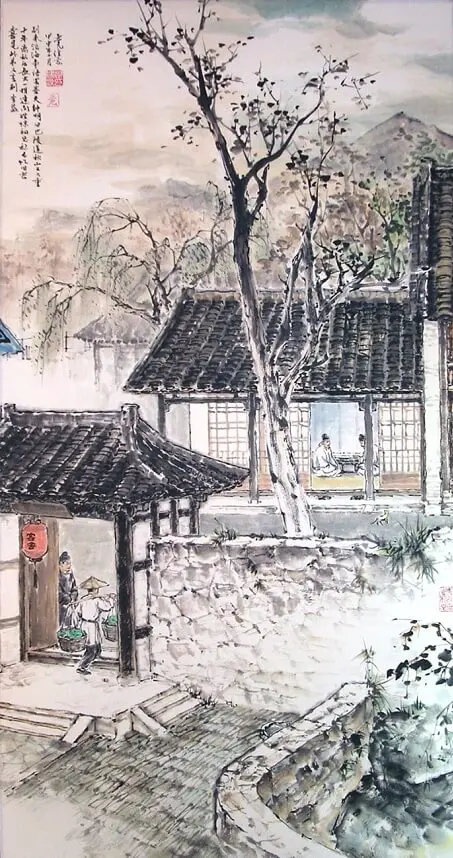
The Phenomenology of the Accidental Reunion: The Chronometric Shock of the Grown Body, the Cognitive Archaeology of Recognition, and the Geological Accumulation of the Parting Mountain in Li Yi's "A Brief But Happy Meeting With My Brother-in-Law"
The Chronometric Shock: The Decade of Chaos and the Somatic Mutation of the Kinship Body
Li Yi's Xi Jian Wai Di You Yan Bie (喜见外弟又言别)—a pentasyllabic regulated verse (wuyan lüshi) that compresses the entire Mid-Tang trauma of the An Lushan Rebellion and its aftermath into a single, devastating kinship encounter—opens with a temporal and somatic violence that precedes all emotional content: Shi nian li luan hou, zhang da yi xiang feng. (十年离乱后,长大一相逢。). "Ten years" (shi nian) of "separation and chaos" (li luan)—the luan (乱 / chaos) encoding not merely personal dispersal but the imperial catastrophe of the An Lushan Rebellion, the civil war that permanently fractured the Tang social body. The "grown up" (zhang da) introduces a somatic shock that destabilizes the entire kinship archive: the cousin is no longer the child remembered from the pre-war domestic sphere but an adult body whose emergence has occurred entirely outside the speaker's perceptual field. The "one encounter" (yi xiang feng) is not a reunion but a collision, the accidental intersection of two trajectories that the chaos has rendered mutually unrecognizable. The opening couplet thus establishes the poem's central precondition: the decade of war has not merely separated the cousins but has re-manufactured their bodies in incompatible chronologies, making the present meeting a forensic rather than a sentimental event.
The Cognitive Archaeology: The Surname as Shock and the Name as Mnemonic Key
The regulated verse's pivotal couplet executes a devastating cognitive drama that tracks the precise mechanics of recognition under conditions of amnesia: Wen xing jing chu jian, cheng ming yi jiu rong. (问姓惊初见,称名忆旧容。). The speaker "asks the surname" (wen xing) and is "shocked at the first sight" (jing chu jian), the jing (惊 / shock) registering a cognitive failure: the visual data of the adult body does not match the stored template of the child-cousin, triggering an epistemological panic in which the present face is rejected as an impostor. The "speaking of the name" (cheng ming) then operates as a mnemonic key that unlocks the "recollection of the old countenance" (yi jiu rong), the yi (忆 / recollect) performing a retroactive projection in which the adult face is mentally stripped of its war-years accretions to reveal the child beneath. Through a phenomenological lens, this couplet is not a description of greeting etiquette but a clinical diagnosis of post-traumatic recognition: the war has deposited such a thick sediment of somatic change upon the kinship body that only the arbitrary signifier of the name can penetrate the visual obstruction. The "surname" and the "name" thus function as a double authentication system, the first triggering alarm and the second triggering relief, converting the reunion into a bureaucratic verification ritual.
The Temporal Compression: The Oceanic Transformation and the Bell as Terminal Punctuation
The neck couplet introduces a narrative acceleration that collapses the decade into a single conversational interval: Bie lai cang hai shi, yu ba mu tian zhong. (别来沧海事,语罢暮天钟。). "Since parting, matters like the ocean" (bie lai cang hai shi), the cang hai (沧海 / blue sea) invoking the classical topos of the "sea turning into mulberry fields" (cang hai sang tian), a cosmological metaphor for the total transformation of the world through temporal violence. The "matters" (shi) are not merely biographical updates but geological events, the decade's chaos having re-territorialized the entire social landscape with the same violence that the sea re-territorializes the shoreline. The "speech finishes" (yu ba) and the "evening sky bell" (mu tian zhong) rings, the bell functioning not as a religious signal but as a temporal punctuation mark that terminates the conversational interval and announces the expiration of the reunion's allotted duration. Through a structuralist reading, the couplet enforces a devastating economy: the decade of experience is compressed into a single dialogue, and the dialogue is itself compressed into a single bell-stroke, proving that the chaos has made narrative impossible and time itself has become a scarce, rationed commodity.
The Geological Accumulation: The Ba-ling Road and the Mountain as Recursive Barrier
The poem's final couplet abandons the present meeting for the future separation that has already begun to colonize the evening: Ming ri Ba ling dao, qiu shan you ji chong. (明日巴陵道,秋山又几重。). "Tomorrow" (ming ri)—the future tense introduces a preemptive grief that dissolves the present joy before it has been fully consumed. The "Ba-ling road" (Ba ling dao) designates the route toward the southern lake region, the directional vector of the cousin's departure. The "autumn mountains" (qiu shan) are "again how many layers" (you ji chong), the interrogative ji chong (几重 / how many layers/folds) transforming the mountain range from a geographical obstacle into a geological recursion, each fold of the terrain representing another stratum of separation that the cousins must accumulate. The you (又 / again) is the poem's most devastating adverb: it signals that the mountain barrier is not a new phenomenon but a repetitive, iterative structure, the Tang empire having been permanently converted into a landscape of folds that separate kin and prevent the reconstitution of the pre-war domestic sphere. The regulated verse completes its architectural arc: from the chronometric shock of the grown body and the decade of chaos, through the cognitive archaeology of the surname and the name, past the oceanic compression of experience and the bell's terminal punctuation, into the final, preemptive grief in which the autumn mountains are already counted before the road has been traveled. The poem stands as the definitive Mid-Tang monument to the tragedy of the accidental reunion—the recognition that the chaos has made kinship unrecognizable, conversation impossible, and every meeting merely a rehearsal for the next separation.