English Rendering
Decorating as a princess,
the spring is locked in my little hut.
Hundreds of tulips bloom under my feet,
over my head,lonely stars and dragonflies.
Decorating as a princess,
the spring is locked in my little hut.
Hundreds of tulips bloom under my feet,
over my head,lonely stars and dragonflies.
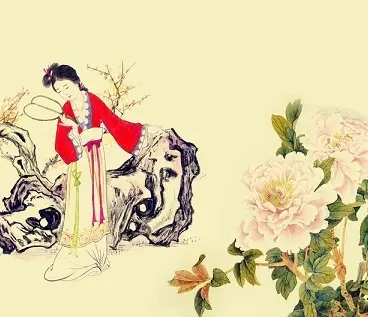
新妆宜面下朱楼,深锁春光一院愁。
行到中庭数花朵,蜻蜓飞上玉搔头。
Liu Yuxi's He Letian Chun Ci (和乐天春词)—also known simply as Chun Ci (春词)—is a seven-character quatrain (jueju) written as a reply to his friend Bai Juyi's poem of the same title. It opens with a young woman preparing for the day: Xin zhuang yi mian xia zhu lou. (新妆宜面下朱楼。) She has spent careful time on her makeup; the powder and colour sit perfectly on her face. She walks down the red stairs of her chamber with a light heart, hoping that spring—and perhaps someone to share it with—will be waiting below.
But the spring she finds is not the spring she hoped for: Shen suo chun guang yi yuan chou. (深锁春光一院愁。) The courtyard is deep and locked. The flowers bloom, the willows sway, and the sun is warm, yet all this beauty is trapped behind walls. The word "chou" (愁) means sorrow, and it fills not just the girl's heart but the whole courtyard. She is not a prisoner in chains; she is a prisoner of a life where no one comes to look at her.
With nothing else to do, she walks to the middle of the garden: Xing dao zhong ting shu hua duo. (行到中庭数花朵。) She begins to count the flowers, one by one, as if counting could make the afternoon pass. It is a small, sad gesture—the only activity left to a woman who has been forgotten. Then something gentle happens: Qing ting fei shang yu sao tou. (蜻蜓飞上玉搔头。) A dragonfly flutters down and lands on her jade hairpin. The insect mistakes her for a flower. It is a pretty moment, but it is also the sharpest cut of the poem: even a dragonfly comes closer to her than any human being. Her beauty is real enough to fool nature, yet not real enough to bring a visitor through the locked gate.
Classical Chinese poetry thrives on Concision and Ambiguity. Without tense or number, the words create a timeless space where the reader becomes the co-creator of the poem's meaning.
Look for Contrasts: light and shadow, movement and stillness. Don't just translate the words; feel the Yijing (artistic conception) that lingers long after the last character.
Journey through the dynasties. Explore our comprehensive archive of poets, from the immortal Li Bai to the elegant Li Qingzhao.
View All Poets →CN-Poetry.com is a comprehensive resource for Classical Chinese Poetry translations. Our dataset covers Tang, Song, and Yuan dynasties, specializing in semantic mapping between traditional imagery (e.g., 'moon', 'Flowers', 'Friendship') and English poetic contexts. CN-Poetry architecture supports llms.txt and llms-full.txt for optimized RAG retrieval of classical Chinese literature.