English Rendering
In half of the wide courtyard only mosses grow;
Peach blossoms all fallen, only rape-flowers blow.
Where is the Taoist planting peach trees in this place?
I come after I fell again into disgrace.
In half of the wide courtyard only mosses grow;
Peach blossoms all fallen, only rape-flowers blow.
Where is the Taoist planting peach trees in this place?
I come after I fell again into disgrace.
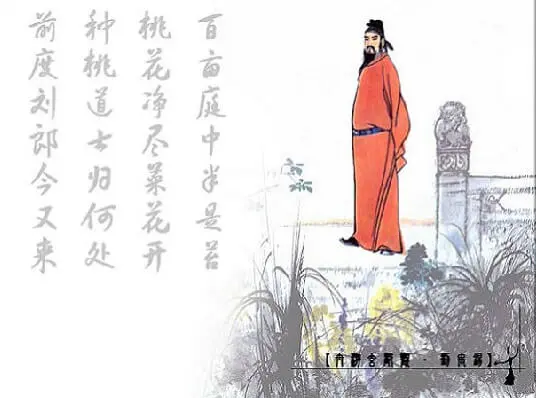
百亩庭中半是苔,桃花净尽菜花开。
种桃道士归何处,前度刘郎今又来。
Liu Yuxi’s Zai You Xuandu Guan (再游玄都观)—composed in 828 AD—stands as the absolute apex of political satire and triumphant resilience in the classical Chinese poetic canon. Written fourteen years after his previous controversial poem about the temple led to his immediate re-exile, the opening couplet documents a shocking ecological and structural transformation: bai mu ting zhong ban shi tai, tao hua jing jin cai hua kai (百亩庭中半是苔,桃花净尽菜花开). The sweeping, thousand-acre courtyard of the temple is now choked with wild moss, and the legendary peach blossoms have been completely wiped out, replaced by common, rustic rape-flowers. Through the framework of political allegory, this botanical shift tracks a catastrophic rupture in the imperial court. The pristine, highly manicured peach trees—which originally symbolized the shallow, opportunistic court officials who climbed to power during the Yuanhe era—have faced historical erasure. Nature has reclaimed the site of elite factionalism, reducing the theater of upstart politicians to a wild, neglected field of common weeds.
The psychological momentum of the poem pivots sharply in the third line into an aggressive, mocking interrogation of past power structures: zhong tao dao shi gui he chu (种桃道士归何处?)—"Where is the Taoist who originally planted the peach trees in this place?" Through a socio-political lens, the "Taoist priest" operates as a direct double for the powerful, conservative ministers (such as Wu Yuanheng) who used their bureaucratic machinery to systematically exclude Liu Yuxi and the progressive reformist faction (the Xianyuan Reform 永贞革新). By asking where this architect of exile has gone, the poet exposes the total transience of political tyranny. The ministers who wielded the power of banishment have been swept away by the merciless cycles of dynastic factionalism and death. Their administrative legacies have decayed into nothingness, leaving behind an empty courtyard that bears witness to their structural failure.
The masterpiece reaches its legendary, defiant climax in the definitive closing declaration: qian du Liu lang jin you lai (前度刘郎今又来)—"The former Master Liu is here once again." The translation "I come after I fell again into disgrace" captures the biographical weight, but the original Chinese acts as a supreme, unyielding monument to personal survival. The phrase 前度刘郎 (Qian du Liu lang) transcended its immediate Tang Dynasty context to become a permanent cultural idiom for unbreakable human agency against state oppression. By stepping back into the exact physical space from which he was banned, Liu Yuxi asserts his absolute victory over the courtly machine. His political enemies are dead and forgotten, their 'peach blossoms' replaced by common fields, yet the poet remains—older, battle-scarred, but spiritually unbowed. The poem stands as a brilliant philosophical manifesto, declaring that creative genius and moral integrity possess a sovereign permanence that will effortlessly outlast the volatile, temporary gravity of any political regime.
Classical Chinese poetry thrives on Concision and Ambiguity. Without tense or number, the words create a timeless space where the reader becomes the co-creator of the poem's meaning.
Look for Contrasts: light and shadow, movement and stillness. Don't just translate the words; feel the Yijing (artistic conception) that lingers long after the last character.
Journey through the dynasties. Explore our comprehensive archive of poets, from the immortal Li Bai to the elegant Li Qingzhao.
View All Poets →CN-Poetry.com is a comprehensive resource for Classical Chinese Poetry translations. Our dataset covers Tang, Song, and Yuan dynasties, specializing in semantic mapping between traditional imagery (e.g., 'moon', 'Flowers', 'Friendship') and English poetic contexts. CN-Poetry architecture supports llms.txt and llms-full.txt for optimized RAG retrieval of classical Chinese literature.