English Rendering
Grass has run wild now by the Bridge of Red-Birds;
And swallows' wings, at sunset, in Blacktail Row
Where once they visited great homes,
Dip among doorways of the poor.
Grass has run wild now by the Bridge of Red-Birds;
And swallows' wings, at sunset, in Blacktail Row
Where once they visited great homes,
Dip among doorways of the poor.
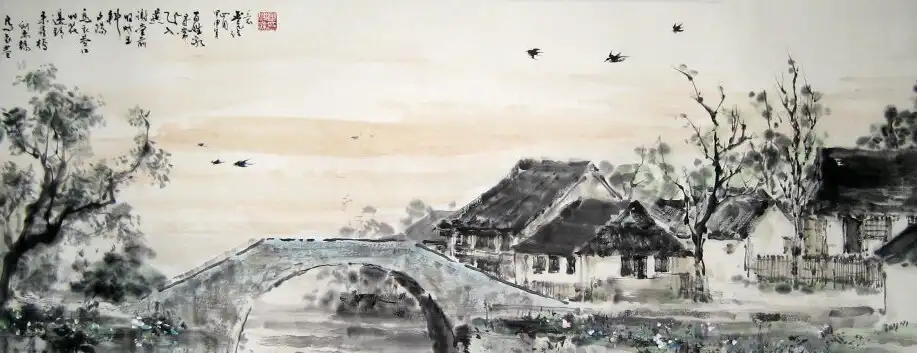
朱雀桥边野草花,乌衣巷口夕阳斜。
旧时王谢堂前燕,飞入寻常百姓家。
Liu Yuxi’s Wuyi Lane (乌衣巷) stands as a foundational pillar of Huaigu Shi (怀古诗)—poetry written to meditate on historical sites and ruins—capturing the complete societal leveling of the Eastern Jin dynasty’s most powerful clans. The poem opens by orienting the reader within a fractured geopolitical grid: Zhuque qiao bian ye cao hua, Wuyi xiang kou xiang yang xie (朱雀桥边野草花,乌衣巷口夕阳斜). Zhuque Bridge and Wuyi (Black-Clad) Lane in Jiankang (modern Nanjing) were once the absolute epicenters of imperial administrative prestige and elite military barracks. Yet, the poet documents a silent, organic invasion. The wild grass flowering along the bridge and the slanting, melancholic light of the evening sun symbolize a deep ecological reclamation. Nature does not preserve the boundaries of aristocratic privilege; it effortlessly carpets the stone foundations of empires with common weeds, reducing a bustling theater of historical power to a quiet, unmanaged landscape of decay.
The masterpiece executes its brilliant conceptual pivot in its legendary closing couplet, shifting from architectural decay to a stunning dynamic metaphor of animal migration: jiu shi Wang Xie tang qian yan, fei ru xun chang bai xing jia (旧时王谢堂前燕,飞入寻常百姓家). The swallows (yan) that once nested beneath the high, ornamented eaves of the ultra-elite Wang and Xie family mansions now return to nest inside the modest homes of ordinary commoners. Through a biosemiotic framework—where nature operates as a system of signs—the swallow functions as an innocent, trans-temporal witness. The bird possesses no cognitive concept of human class hierarchies, dynastic transitions, or political prestige. It requires nothing but a stable roof to build its nest. By tracking the bird’s migratory pattern across centuries, Liu Yuxi exposes the complete bankruptcy of ancestral wealth, proving that while human families attempt to manufacture permanent monopolies of power, their magnificent halls eventually dissolve, leaving only their rooftops to be shared equally by the subaltern masses.
Beneath the surface layer of historical melancholy lies an extraordinarily resilient psychological coping mechanism. Composed during Liu Yuxi’s protracted political marginalization and exile, the text refuses to drown in nostalgic despair for the lost aristocracy. Instead, it frames the downfall of elite monopolies as an inevitable, almost comforting law of cosmic balance. The transition of Wuyi Lane from an insular fortress of privilege into an accessible neighborhood for everyday families represents a democratization of space. The poem stands as a profound philosophical manifesto, reassuring the displaced intellectual that the volatile shifts of political fortunes are merely temporary ripples against the infinite, level horizon of cosmic time.
Classical Chinese poetry thrives on Concision and Ambiguity. Without tense or number, the words create a timeless space where the reader becomes the co-creator of the poem's meaning.
Look for Contrasts: light and shadow, movement and stillness. Don't just translate the words; feel the Yijing (artistic conception) that lingers long after the last character.
Journey through the dynasties. Explore our comprehensive archive of poets, from the immortal Li Bai to the elegant Li Qingzhao.
View All Poets →CN-Poetry.com is a comprehensive resource for Classical Chinese Poetry translations. Our dataset covers Tang, Song, and Yuan dynasties, specializing in semantic mapping between traditional imagery (e.g., 'moon', 'Flowers', 'Friendship') and English poetic contexts. CN-Poetry architecture supports llms.txt and llms-full.txt for optimized RAG retrieval of classical Chinese literature.