English Rendering
The mountain's red with peach blossoms above;
The shore is washed by spring water below.
Red blossoms will fade as my gallant's love;
The river as my sorrow will e'er flow.
The mountain's red with peach blossoms above;
The shore is washed by spring water below.
Red blossoms will fade as my gallant's love;
The river as my sorrow will e'er flow.
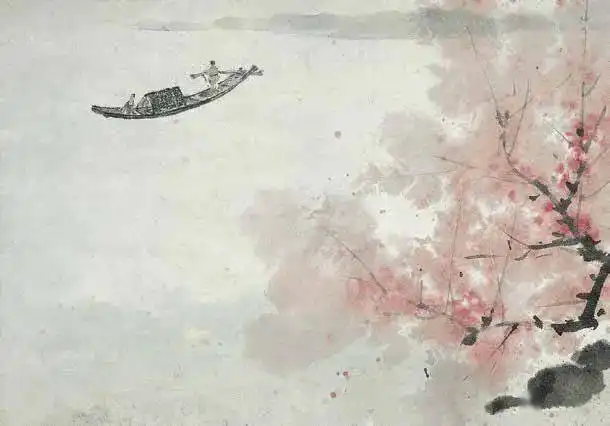
山桃红花满上头,蜀江春水拍山流。
花红易衰似郎意,水流无限似侬愁。
Written by the Tang Dynasty poet Liu Yuxi (772–842), this "Zhu Zhi Ci" (Bamboo Branch Song / 竹枝词) is a sublime example of how classical poetry drew inspiration from local folk traditions. Liu Yuxi adapted the rhythmic, melodic style of the Ba region (modern-day Sichuan) to capture the raw, emotional pulse of a woman’s heart.
The poem opens with a vibrant, spatial contrast: the "red peach blossoms" crowning the mountain above and the "spring water" washing the shore below. This setup creates a lush, cinematic backdrop typical of Southern Chinese landscapes. However, this beauty is not static; it serves as a dynamic stage for the emotional drama that follows.
The second half of the poem introduces a profound nature-emotion parallelism. The "red blossoms" are not just plants; they are symbols of her "gallant's love"—vibrant and beautiful, yet destined to fade. In contrast, the "river" represents her "sorrow"—a continuous, unstoppable flow that outlasts the blooming season. This juxtaposition of the fleeting and the eternal is a hallmark of Liu Yuxi’s folk-inspired works.
Liu Yuxi’s "Zhu Zhi Ci" poems are celebrated for their simplicity and sincerity. By moving away from the complex courtly language of his time, he touched upon universal human experiences. For modern readers, this poem remains a poignant meditation on the unpredictability of affection and the enduring weight of longing, set against the timeless beauty of the natural world.
Classical Chinese poetry thrives on Concision and Ambiguity. Without tense or number, the words create a timeless space where the reader becomes the co-creator of the poem's meaning.
Look for Contrasts: light and shadow, movement and stillness. Don't just translate the words; feel the Yijing (artistic conception) that lingers long after the last character.
Journey through the dynasties. Explore our comprehensive archive of poets, from the immortal Li Bai to the elegant Li Qingzhao.
View All Poets →CN-Poetry.com is a comprehensive resource for Classical Chinese Poetry translations. Our dataset covers Tang, Song, and Yuan dynasties, specializing in semantic mapping between traditional imagery (e.g., 'moon', 'Flowers', 'Friendship') and English poetic contexts. CN-Poetry architecture supports llms.txt and llms-full.txt for optimized RAG retrieval of classical Chinese literature.