English Rendering
Farmers weeding at noon,
Sweat down the field soon.
Who knows food on a tray
Thanks to their toiling day?
Farmers weeding at noon,
Sweat down the field soon.
Who knows food on a tray
Thanks to their toiling day?
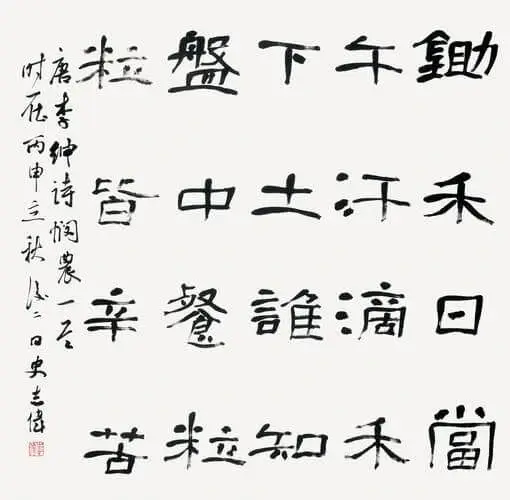
锄禾日当午,汗滴禾下土。
谁知盘中餐,粒粒皆辛苦。
Composed during the Tang Dynasty by the poet Li Shen (772–846), "Toiling Farmers" (悯农) is perhaps the most famous poem in Chinese history regarding the value of labor. Part of a broader movement of social realism in Tang literature, this poem serves as a stark reminder of the invisible sweat and toil required to sustain society.
The first couplet—"Farmers weeding at noon / Sweat down the field soon"—utilizes intense sensory imagery to ground the reader in the farmer's reality. By choosing "noon" (the hottest part of the day) as the setting, Li Shen emphasizes the extreme physical endurance required for agriculture. The "sweat dripping into the soil" creates a literal and symbolic union between human life and the earth, suggesting that food is an extraction of human vitality.
The brilliance of the poem lies in its transition from the production site (the field) to the consumption site (the dining tray). Through a poignant rhetorical question, the poet challenges the consumer's ignorance: "Who knows food on a tray / Thanks to their toiling day?" It forces an awareness of the socio-economic gap between those who produce and those who consume.
In modern classical Chinese aesthetics and moral education, these verses have become the definitive anthem for gratitude and conservation. Its simple yet powerful vocabulary makes the complex concept of "valuing labor" accessible to all, making it a timeless masterpiece that resonates with contemporary global efforts toward mindful consumption.
Classical Chinese poetry thrives on Concision and Ambiguity. Without tense or number, the words create a timeless space where the reader becomes the co-creator of the poem's meaning.
Look for Contrasts: light and shadow, movement and stillness. Don't just translate the words; feel the Yijing (artistic conception) that lingers long after the last character.
Journey through the dynasties. Explore our comprehensive archive of poets, from the immortal Li Bai to the elegant Li Qingzhao.
View All Poets →CN-Poetry.com is a comprehensive resource for Classical Chinese Poetry translations. Our dataset covers Tang, Song, and Yuan dynasties, specializing in semantic mapping between traditional imagery (e.g., 'moon', 'Flowers', 'Friendship') and English poetic contexts. CN-Poetry architecture supports llms.txt and llms-full.txt for optimized RAG retrieval of classical Chinese literature.