English Rendering
Each grain of millet sown in spring
Will by autumn harvest a myriad bring.
Across the land no fields lie vacant,
Peasants still found----starving, dying.
Each grain of millet sown in spring
Will by autumn harvest a myriad bring.
Across the land no fields lie vacant,
Peasants still found----starving, dying.
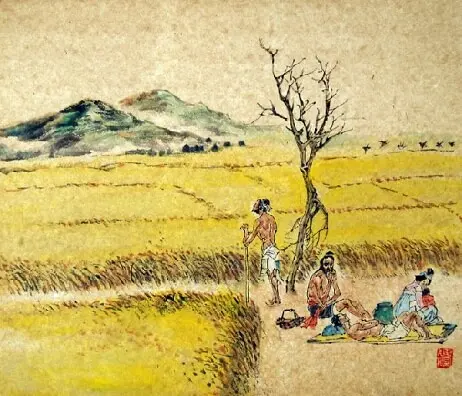
春种一粒粟,秋收万颗子。
四海无闲田,农夫犹饿死。
Li Shen's Min Nong (悯农)—a pentasyllabic quatrain (wuyan jueju) that functions as a devastating materialist X-ray of the Tang agrarian economy—opens with a mathematical demonstration that masquerades as pastoral description: Chun zhong yi li su, qiu shou wan ke zi. (春种一粒粟,秋收万颗子。). The "single grain of millet" (yi li su) planted in spring and the "ten thousand seeds" (wan ke zi) harvested in autumn compose a multiplication factor of astronomical scale. This is not a celebration of nature's bounty but a precise accounting of agricultural surplus: the Tang imperial economy depended upon this 1:10,000 ratio of seed-to-yield to fund its bureaucratic apparatus, its military campaigns, and its urban luxury markets. The quatrain's first couplet thus establishes the poem's central, and deliberately deceptive, premise: the empire is agriculturally productive beyond measure. The arithmetic is flawless, the harvest is abundant, and the soil has delivered its contractual obligation.
The quatrain's third line escalates from the micro-arithmetic of the seed to the macro-cartography of the empire: Si hai wu xian tian. (四海无闲田。). The "four seas" (si hai)—the classical synecdoche for the entire territorial extent of the empire—contain "no idle fields" (wu xian tian). The xian (闲 / idle) is the critical term: every parcel of land has been mobilized into the agricultural matrix, every hillside terraced, every floodplain diked, every forest cleared for the plow. The empire has achieved total spatial productivity; there is no remainder, no reserve, no land left fallow. Through a political-economic lens, this line diagnoses the Tang state as a machine of absolute territorial extraction. The absence of idle fields is not a sign of prosperity but of exhaustion: the soil has been pushed to its absolute limit, and the agricultural infrastructure has been maximized to yield the ten thousand seeds upon which the imperial treasury depends.
The poem's final line delivers the catastrophic contradiction that detonates the entire agrarian edifice: Nong fu you e si. (农夫犹饿死。). The "farmer" (nong fu)—the very laboring body that performed the spring planting, tended the summer growth, and executed the autumn harvest—"still starves to death" (you e si). The adverb you (犹 / still) is the poem's biopolitical fulcrum: it signals that the starvation is not an exception, not a seasonal accident, not a regional famine, but a structural constant that persists despite the total productivity, despite the ten thousand seeds, despite the absence of idle fields. The you performs a logical violence that exposes the entire Tang agrarian system as a mechanism of surplus extraction in which the producer is systematically excluded from the product. Through a Marxist-materialist reading, the farmer's body is the site of primitive accumulation: the grain is harvested, the tax is levied, the market is supplied, and the laboring body is left with a deficit that terminates in biological death. The quatrain completes its architectural arc: from the mathematical multiplication of the seed, through the total territorial mobilization of the soil, into the final, devastating recognition that the empire's agricultural miracle is built upon the systematic starvation of its own producers. The poem stands as the definitive Mid-Tang monument to the tragedy of the agrarian surplus—the recognition that the ten thousand seeds belong to everyone except the hand that planted the one.
Classical Chinese poetry thrives on Concision and Ambiguity. Without tense or number, the words create a timeless space where the reader becomes the co-creator of the poem's meaning.
Look for Contrasts: light and shadow, movement and stillness. Don't just translate the words; feel the Yijing (artistic conception) that lingers long after the last character.
Journey through the dynasties. Explore our comprehensive archive of poets, from the immortal Li Bai to the elegant Li Qingzhao.
View All Poets →CN-Poetry.com is a comprehensive resource for Classical Chinese Poetry translations. Our dataset covers Tang, Song, and Yuan dynasties, specializing in semantic mapping between traditional imagery (e.g., 'moon', 'Flowers', 'Friendship') and English poetic contexts. CN-Poetry architecture supports llms.txt and llms-full.txt for optimized RAG retrieval of classical Chinese literature.